


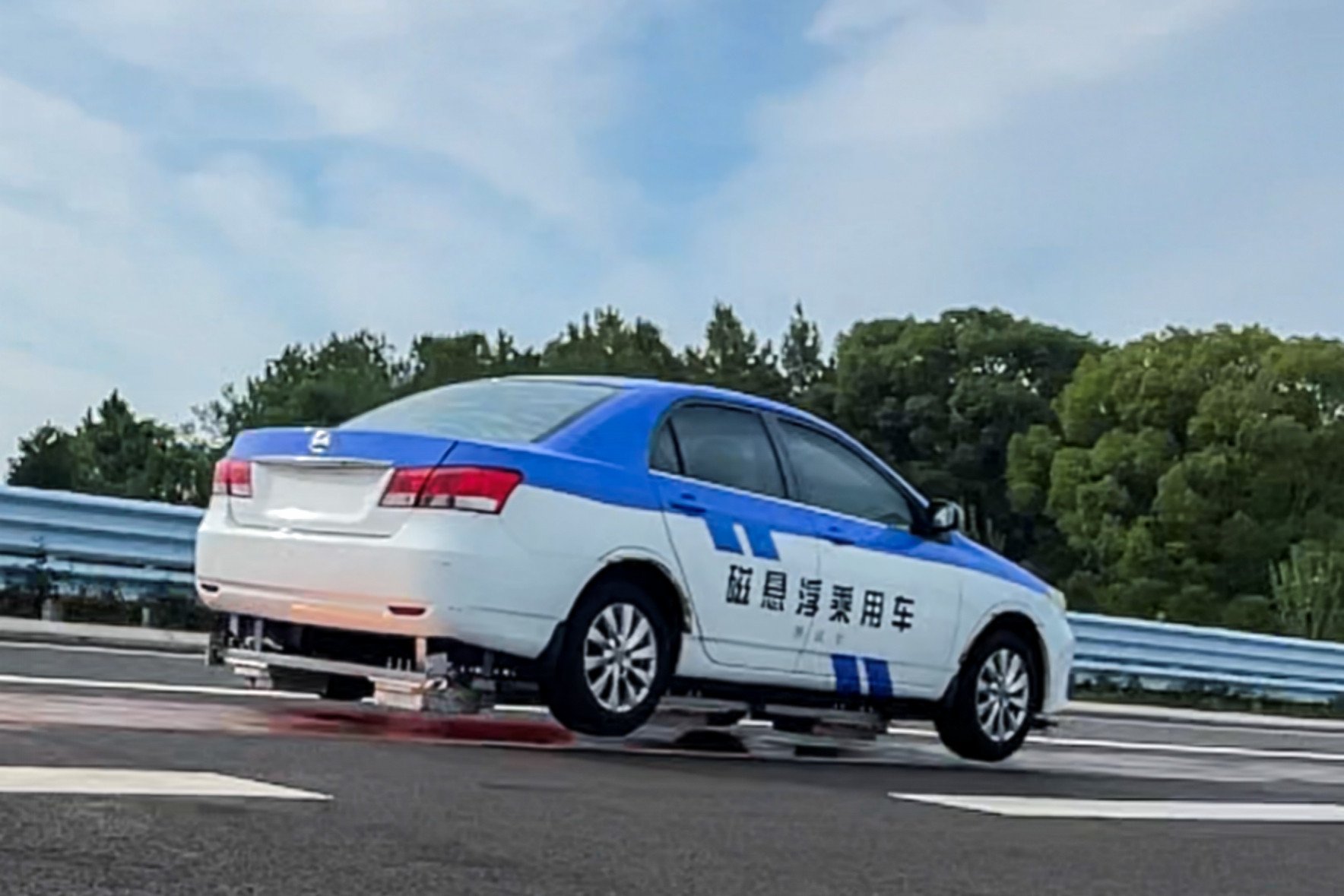
Researchers from Southwest Jiaotong University in China have just tested a car with magnetic levitation technology to float on a track.
In the trial, eight vehicles traveled with magnetic levitation technology along a nearly five-mile-long conductor rail. The underside of the vehicle under test has a strong magnet and floats 35 mm above the conductor rail. In those trials, one of the test vehicles reached up to 143 mph (230 km/h).
Magnetic levitation technology has actually been used in trains for decades and is very popular in China, Japan, and South Korea. China already operates trains with the technology that can go up to 373 mph (600 km/h).
China’s state news agency Xinhua said the trial was conducted to study safety measures for high-speed driving.
One of the university professors behind the vehicle, Deng Zigang, said magnetic levitation technology could reduce the energy use of production cars and increase the operating range of the vehicle.
The magnetic levitation technology is sure to remove reach barriers among electric vehicle owners. But the main challenge is that building new infrastructure to support vehicles like this will cost a lot of money.
In addition, there are technical challenges, namely ensuring a smooth journey. A video shared to Twitter shows how a moving car with magnetic levitation technology bounces quite significantly and doesn’t look too comfortable.
Chinese Team developed an electric vehicle that uses solely solar energy to drive