


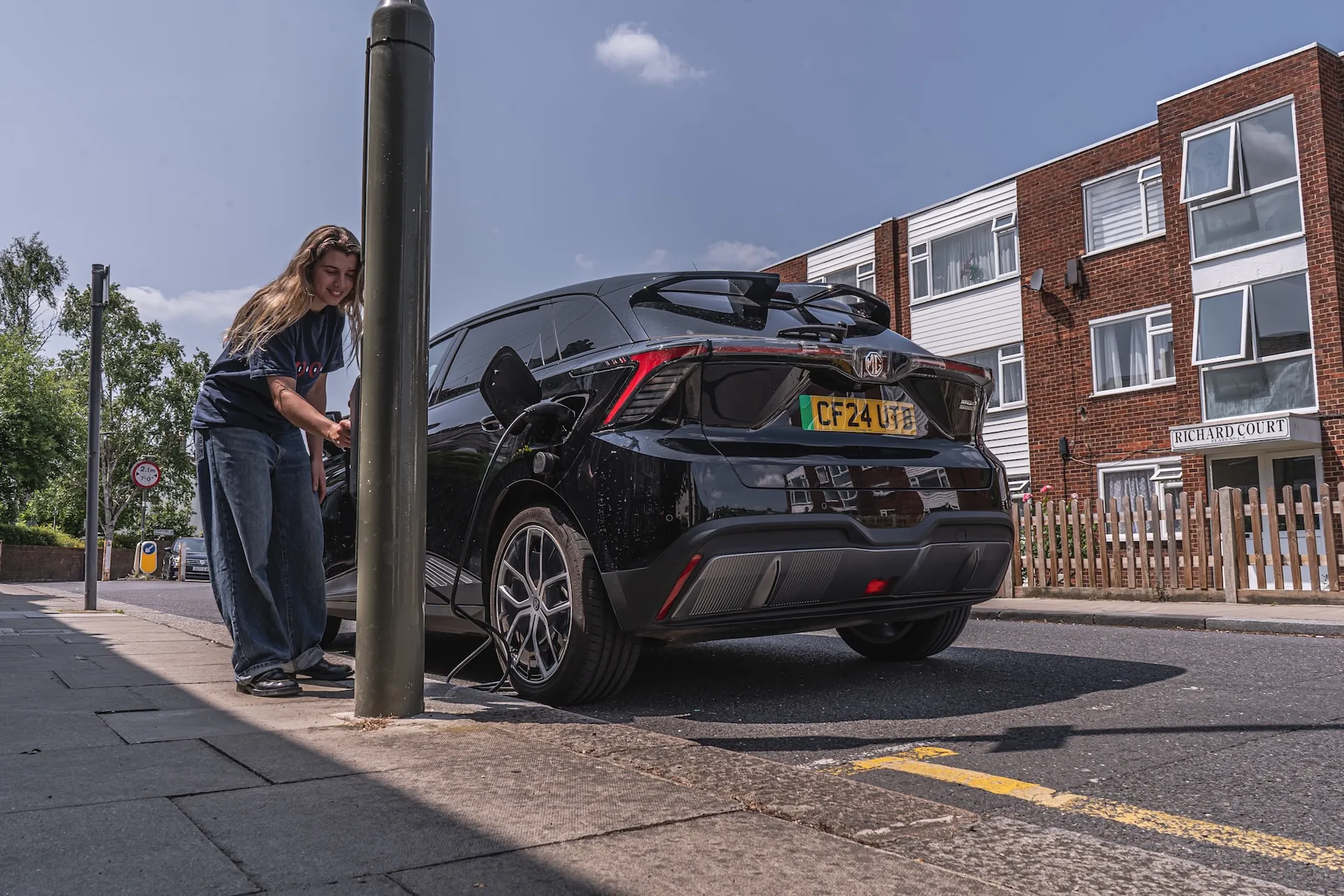
UK on-street electric vehicle charging provider char.gy says it has 674 live charging sockets across Brighton & Hove and Reading as it expands its role in the government-backed Local Electric Vehicle Infrastructure (LEVI) programme.
The figure represents a small portion of the more than 60,000 sockets planned across the company’s 11 awarded LEVI projects. Of those projects, four have been signed, covering Reading, Brighton & Hove, West Northamptonshire, and Devon & Torbay. No charge points are live yet under the latter two projects.

Seven additional projects, including those covering Central Bedfordshire and the Isle of Wight, are progressing towards contract signature.
LEVI Rollout and Network Expansion
char.gy’s claim to leadership in LEVI charge point delivery is based on its analysis of Zapmap data. The company said the data tracks installations by local authority area but does not distinguish individual contracts, limiting the extent to which installations can be attributed to specific LEVI projects.
Separately, char.gy reported that its wider network has surpassed 6,000 charge points, adding 1,000 since May. The company has also replaced 955 older charging units in the London boroughs of Richmond and Wandsworth.
The distinction between live network infrastructure and planned LEVI installations is significant: the 674 sockets in Brighton & Hove and Reading are currently operational, while the larger total across the 11 awarded projects reflects planned deployment rather than completed installations.
Addressing Gaps in On-Street Charging
The rollout comes as local authorities face pressure to expand public charging access for drivers without private parking. London accounted for more than 70% of kerbside chargers installed in the UK by the end of 2025, highlighting the uneven distribution of on-street charging infrastructure.
Research commissioned by Vauxhall found that half of UK councils had yet to provide on-street charging. The research also found that 40% of drivers lack off-street parking, making access to public charging particularly important for households that cannot install a private home charger.
LEVI projects are intended to help local authorities expand charging provision, including infrastructure for residents who rely on street parking. The delivery of awarded projects will determine how quickly planned capacity translates into accessible, operational charging points.
Investment and Future Projects
char.gy is backed by the Charging Infrastructure Investment Fund and the National Wealth Fund. The company said its pipeline of additional local authority projects is expected to support further expansion as more agreements are signed.
John Lewis, Chief Executive of char.gy, said:
Councils are choosing char.gy because we turn LEVI projects into working charge points at pace and keep them working. 6,000 charge points in, we are installing faster than ever, and the seven further councils we are working with towards signature mean that pace will keep growing.
The next stage of the programme will depend on progressing the seven unsigned projects to contract signature and delivering infrastructure across the awarded areas. The number of operational sockets will remain the key measure of how quickly the planned LEVI network is being deployed.