


Chinese automaker BYD is aiming to exceed 50,000 new vehicle registrations in Germany in 2026, more than doubling the 23,306 units recorded in 2025. The target follows a slower-than-expected rollout last year, when the company fell short of an earlier sales objective set for 2025.
Speaking to Handelsblatt, BYD Germany chief executive Lars Bialkowski said the company intends to meet and surpass the previously announced target this year. The goal had originally been outlined by BYD’s Europe leadership for 2025 but was delayed as the company built out its local retail and service network.
See also: BYD Disputes Stellantis CEO Remarks on Leapmotor Sales in Germany
BYD entered 2025 with around 26 dealership locations in Germany but expanded rapidly over the course of the year, ending with approximately 150 signed sales and service sites. According to Bialkowski, the network currently comprises about 190 outlets. BYD plans to increase that figure to at least 350 locations by the end of 2026 as part of its effort to scale sales volumes.
Plug-in hybrid vehicles (PHEVs) are playing an increasingly significant role in BYD’s German strategy. Data from Germany’s Kraftfahrt-Bundesamt (KBA) show that in January 2026, PHEVs accounted for 40.6% of BYD’s new registrations, with battery-electric vehicles (BEVs) making up the remaining 59.4%. Of the 2,629 BYD vehicles registered during the month, 1,561 were BEVs and 1,068 were PHEVs.
See also: BYD Weighs Germany for Potential Third European Assembly Plant – Report
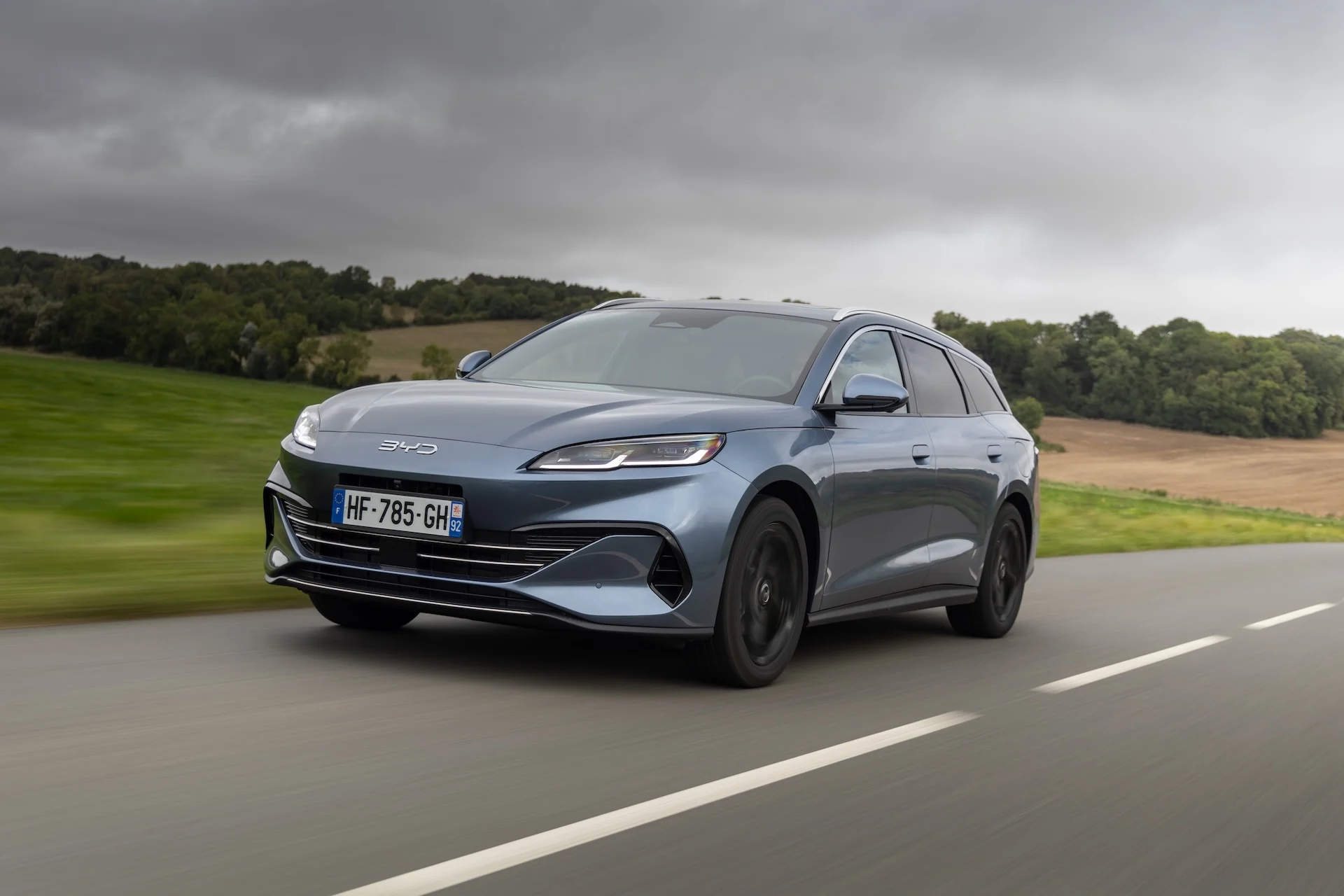
The company initially entered the European market with BEV-only offerings, but its PHEV lineup has gained traction. Models such as the Seal U DM-i have contributed to this shift, while the Seal 6 DM-i estate has expanded BYD’s product range in Germany. Industry observers note that PHEVs currently face fewer trade barriers in the European Union than fully electric vehicles, which may also support demand.
BYD is targeting a market share of around 5% in Germany for PHEVs and approximately 4% for BEVs. Across all powertrains, the company aims for a total market share of between 1.5% and 2%. In 2025, BYD held about 0.8% of the German passenger car market, slightly ahead of Tesla’s share.
To support sales growth, BYD has introduced promotional pricing on several models. The Dolphin Surf compact electric car is being offered at €18,900 before subsidies, while the Seal U electric SUV is priced from €34,990 ahead of incentives. The impact of these measures will become clearer as registration data for 2026 develops.
See also: BYD Extends Battery Warranty to 250,000 km for Electric Vehicles in Norway
Globally, BYD reported sales of about 4.6 million new energy vehicles in 2025, representing a 7.7% year-on-year increase. Passenger vehicles accounted for the majority of deliveries, while commercial new energy vehicle sales rose sharply from a smaller base. Overseas sales exceeded one million units, more than doubling from the previous year, underscoring the company’s accelerating international expansion.
To support that growth, BYD has brought overseas manufacturing facilities online in Thailand and Uzbekistan, while a production plant in Hungary is approaching start-up. The automaker has identified Europe, the Middle East and Africa as priority regions as it seeks to diversify sales beyond its domestic Chinese market and reduce reliance on a single geography.