


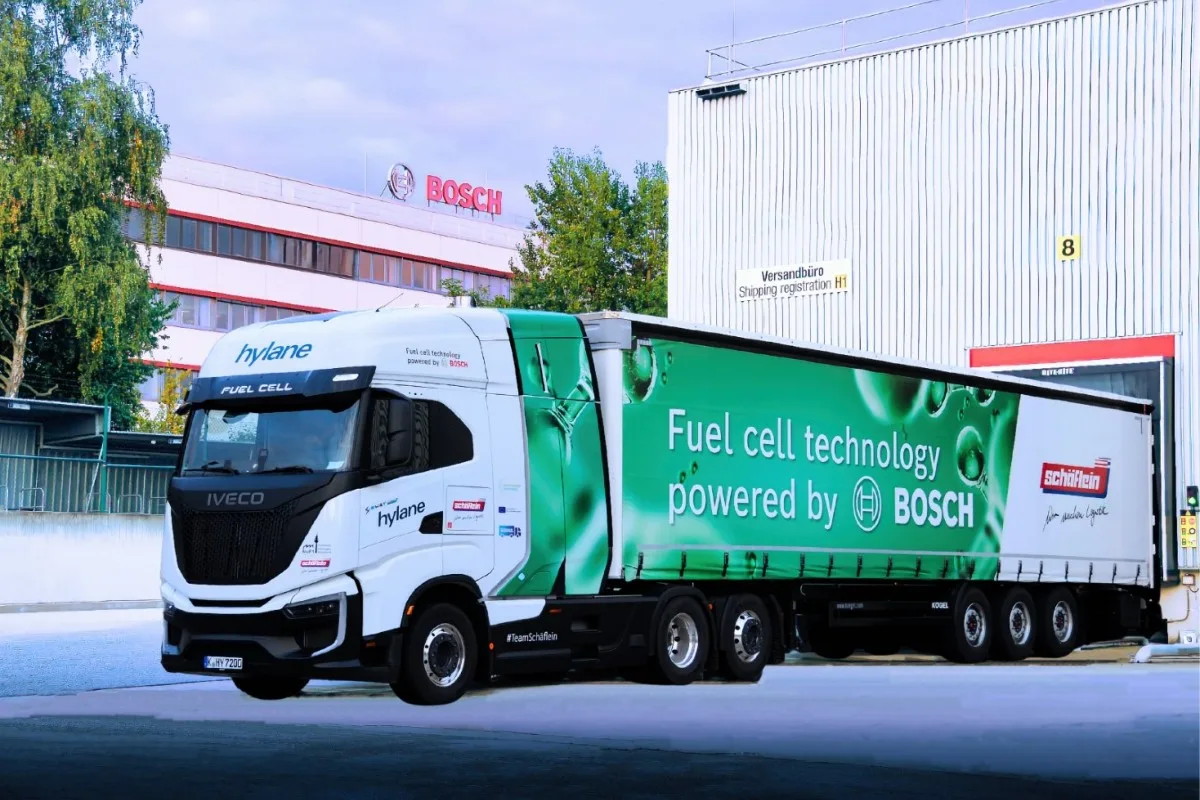
Bosch has introduced its first hydrogen-powered truck for in-house logistics, marking a significant step in its efforts to decarbonize factory transport.
The 40-ton vehicle, powered by Bosch’s Fuel Cell Power Module (FCPM), will operate on a fixed route between the company’s production facilities in Nuremberg, collecting real-world data to further refine its fuel cell technology.
See also: Bosch to Integrate NVIDIA DRIVE AGX Thor Into Next-Generation Vehicle Platforms
The hydrogen truck, based on the Iveco S-Way platform, is equipped with Bosch’s FCPM system that enables a range of up to 800 kilometers. The vehicle is operated by the Schäflein freight forwarding company and leased from truck rental firm Hylane.
It is expected to cover around 12,000 kilometers annually as part of Bosch’s logistics operations. “When we decided to make our plant traffic more climate-friendly, it was clear that we wanted a truck featuring Bosch’s FCPM,” said Alexander Weichsel, commercial plant manager in Nuremberg. “This deployment is an important building block that helps us reduce our emissions in logistics.”
See also: Bosch to Cut 13,000 More Jobs Amid Cost Pressures, EV Transition
Bosch said the truck serves not only as a logistics solution but also as a development platform, feeding operational data into the design of future fuel cell systems, including the Compact 190 and Compact 300 modules.
“The fact we’ve had no problems operating this truck shows that the fuel cell is ready for volume production,” Weichsel added. “The key to a successful hydrogen economy is above all to ensure an abundance of affordable hydrogen and put in place an adequate H₂ infrastructure, including in Nuremberg.”
Series production of Bosch’s FCPM began in mid-2023 at its Stuttgart-Feuerbach plant, with fuel cell stacks supplied from Bamberg and components such as compressors and recirculation fans from Homburg. Parallel production is also underway in Chongqing, China.
The deployment in Nuremberg aligns with Bosch’s plan to develop a “hydrogen value chain” in the region, supporting Bavaria’s Hydrogen Strategy 2.0 and reinforcing the company’s commitment to sustainable industrial transport.


