



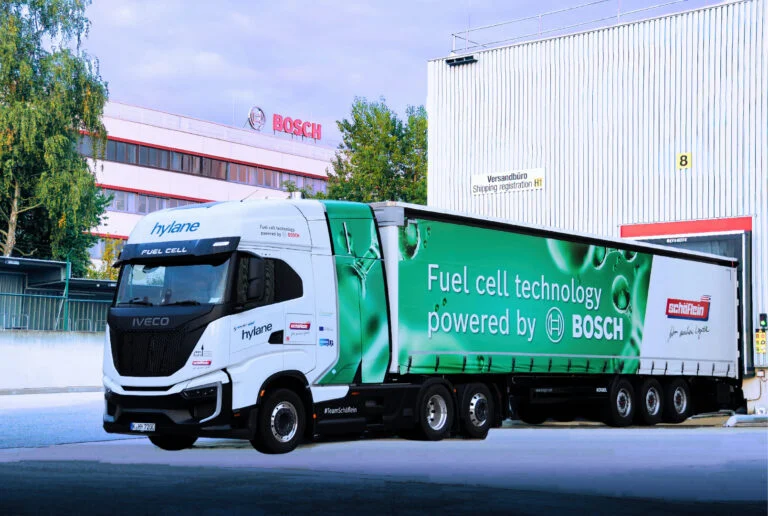
Bosch has been awarded the German Future Prize 2025 for its fuel-cell power module for heavy commercial vehicles, according to Bloomberg. The technology is used in several thousand trucks operating worldwide and is designed to enable long-distance, zero-emission transport with driving ranges of up to 1,000 kilometers.
The fuel-cell system generates electrical energy by combining hydrogen and oxygen and releases water vapor as its primary emission when powered by green hydrogen. Bosch began large-scale production of the module in 2023 at manufacturing facilities in Stuttgart-Feuerbach and Chongqing.
The unit contains more than 1,000 integrated components, including a fuel-cell stack, recirculation pump, and air compressor. It is engineered to fit into existing truck layouts as a replacement for conventional diesel engines. Under typical operating conditions, vehicles can store around 70 kilograms of hydrogen and refuel in roughly 15 minutes.
Several thousand trucks equipped with the module are currently in service in various regions. Bosch uses operational data from these vehicles, supported by digital twin systems, to monitor temperature, pressure and component durability in order to guide future development.
Heavy-duty trucks account for more than a quarter of road-transport CO₂ emissions in the European Union, and fuel-cell systems are one of several technologies under consideration to reduce emissions in long-haul segments.
The module is also being evaluated for use beyond road transport, including buses, maritime applications and stationary power generation. Bosch has expanded its hydrogen-related activities with the introduction of electrolysis stacks and the commissioning of an electrolyzer at its Bamberg site in 2025. The company’s proton exchange membrane platform functions in both fuel-cell and electrolyzer modes, enabling integration across hydrogen production and utilization.
This is Bosch’s fourth German Future Prize since the award’s inception. Previous recognitions covered diesel piezo injectors (2005), sensor technology (2008) and ultrashort pulse laser systems (2013). Further adoption of fuel-cell commercial vehicles is expected to depend on the pace of hydrogen infrastructure development and policy measures that support deployment at scale.