

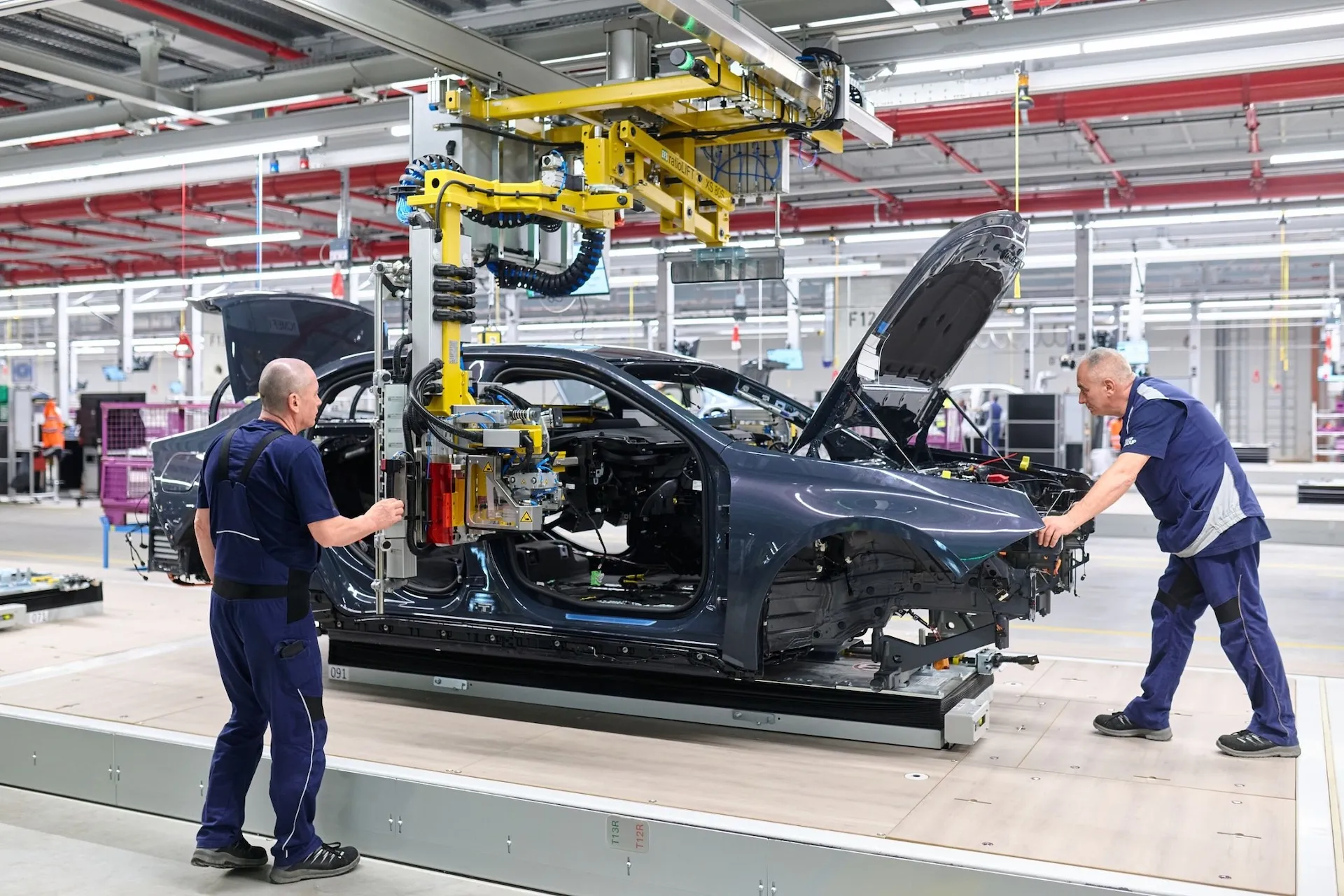
BMW said it will begin series production of its Neue Klasse i3 electric sedan at its Munich plant in August 2026, as part of a broader plan to convert the facility into a fully electric production site by 2027.
The company has invested around €650 million ($750 million) to modernize the 104-year-old plant, including the construction of a new body shop, assembly systems and logistics infrastructure covering approximately 200,000 square meters. From 2027, the Munich site is expected to manufacture only all-electric vehicles, making it the first existing BMW plant to fully transition to EV production.
The new i3 will be the second model based on BMW’s Neue Klasse platform, following the launch of the iX3 produced at the company’s Debrecen plant in Hungary. BMW previously said the i3 will serve as the electric counterpart to its 3 Series sedan and incorporate sixth-generation eDrive technology.
“We have been making rigorous preparations. With the BMW iFACTORY we have devised a consistent, strategic framework for our production,” said Milan Nedeljković, Member of the Board of Management of BMW AG, Production. “We have paved the way for the upcoming start-ups in all our plants and have invested heavily in technologies, digitalisation and AI.”
BMW said the plant transformation is expected to reduce overall production costs at Munich by about 10% compared with the current generation of vehicles.
The upgrade includes a new three-level body shop with around 51,000 square meters of production space, equipped with roughly 800 industrial robots and an automation rate of about 98%. The company said it has simplified manufacturing processes, reducing the number of joining steps and using AI-supported inspection systems for quality control.
The press shop has also been modernized with automated lines capable of producing up to 30,000 parts per day, or around five million components annually. BMW said the upgrades increase outer panel capacity by 30% while lowering operating costs by about 10%.
The new assembly facility, built within a former engine production hall, uses digital systems to monitor up to 20,000 vehicle features during assembly. AI-driven sensors and camera systems perform quality checks in real time, reducing the need for traditional testing methods.
“We have rethought the entire value stream from supplier to finished customer vehicle,” said Peter WeberHead of BMW Group Plant Munich. “Now our plant is even more efficient, more flexible and even more digitised than ever before.”
The Neue Klasse platform introduces a zonal wiring architecture that reduces cable length by 600 meters and lowers weight by around 30%, while modular components reduce overall complexity in vehicle assembly.
BMW has also restructured logistics at the urban Munich plant, increasing direct deliveries to assembly lines to about 70% and automating around 60% of daily logistics operations using driverless systems. Hydrogen-powered forklifts are being deployed to improve operational efficiency.
Battery supply for the Munich-built i3 will come from a new facility in Irlbach-Straßkirchen in Lower Bavaria, where production is set to begin in October 2026. Electric motors will be produced at BMW’s Steyr plant in Austria.
The production ramp-up follows recent developments in BMW’s EV strategy. The company is expanding its Neue Klasse lineup, including the iX3 and i3 models, while preparing to phase out older-generation vehicles such as the i4.
Earlier this year, BMW completed winter testing of the i3 prototype in Arjeplog, Sweden, ahead of its design debut in Munich.