

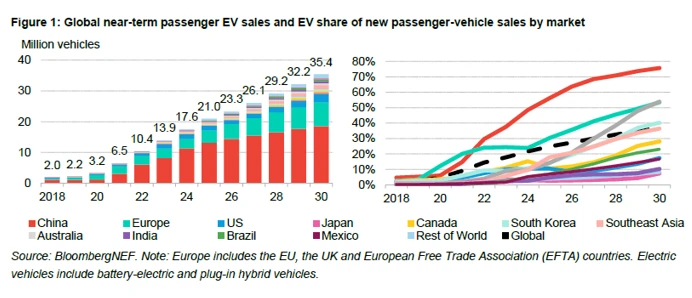
Global electric vehicle sales are expected to reach another record level in 2026, with BloombergNEF forecasting that battery-electric vehicles (BEVs) and plug-in hybrid vehicles (PHEVs) will account for more than one-quarter of all new passenger car sales worldwide.
According to BloombergNEF’s newly released Electric Vehicle Outlook 2026, global EV sales are projected to rise to approximately 23 million units this year, representing an 11% increase compared with 2025.
The research firm expects electric vehicles to account for 27% of global new passenger vehicle registrations in 2026, up from just 9% five years ago.
Falling Battery Costs Continue to Drive Adoption
BloombergNEF attributes continued growth to declining lithium-ion battery prices, the availability of more affordable electric models and accelerating adoption across emerging markets.
The report also notes that higher fuel prices resulting from geopolitical tensions have increased consumer interest in electric vehicles, although analysts say it remains too early to determine the long-term impact on sales.
China Maintains Leadership
China remains the world’s largest EV market by a considerable margin.
BloombergNEF estimates that battery-electric and plug-in hybrid vehicles now account for approximately 64% of all new passenger vehicle sales in China.
However, the report indicates that growth is beginning to moderate as the market matures.
Chinese EV sales are expected to grow by 10% in 2026, down from 16% growth in 2025 and 39% growth in 2024.
The slowdown is linked to weaker domestic demand and changes to government incentive programs, including reduced tax benefits and stricter eligibility requirements.
Despite slower growth, China is expected to remain the dominant global market for electric vehicles throughout the decade.
US Market Faces Headwinds
BloombergNEF expects the United States to be the weakest major EV market this year, forecasting a 19% decline in sales.
The report cites the rollback of federal electrification policies, the scaling back of Inflation Reduction Act incentives and reduced regulatory support for fuel economy standards as key factors behind the slowdown.
As a result, BloombergNEF has lowered its long-term expectations for EV adoption in the US market.
By 2040, only 24% of the US passenger vehicle fleet is projected to be electric, significantly below previous forecasts.
Europe Continues Steady Growth
Europe remains the world’s second-largest EV market and is expected to maintain stable growth throughout 2026.
Several European countries are projected to significantly exceed the global average adoption rate by 2030.
BloombergNEF forecasts EVs will account for 67% of new vehicle sales in the United Kingdom by 2030, 58% in Germany and 51% in France.
Global EV Sales to Exceed 35 Million by 2030
Looking further ahead, BloombergNEF expects annual global BEV and PHEV sales to increase from 21 million vehicles in 2025 to more than 35.4 million units by 2030.
Electric vehicles are projected to account for 38% of global passenger vehicle sales by the end of the decade.
China is expected to represent 52% of global EV sales in 2030, down from 63% in 2025, reflecting stronger growth in other regions rather than declining Chinese demand.
Emerging Markets Gain Momentum
The report highlights rapid EV adoption in emerging markets, driven by government incentives, local manufacturing and expanding exports from Chinese automakers.
In 2025, electric vehicles accounted for nearly half of all new car sales in Singapore, while adoption reached 39% in Vietnam, 27% in Thailand and 22% in Turkey.
BloombergNEF notes that Indonesia has already surpassed the United States in EV adoption rates, while Brazil and Mexico are also ahead of Japan.
Chinese manufacturers continue to play a major role in this growth. In 2025, Chinese brands accounted for 68% of global EV sales and dominated several emerging markets.
In Brazil and Thailand, Chinese automakers represented 96% and 88% of EV sales respectively.
Vietnam stands out as an exception, where domestic manufacturer VinFast accounted for nearly all of the country’s 179,000 EV sales in 2025.
Battery Costs Remain Critical
BloombergNEF notes that battery costs continue to be the largest factor influencing EV affordability.
China remains the only major market where electric vehicles are, on average, cheaper to purchase than comparable internal combustion vehicles.
In Germany, Italy and the UK, battery-electric vehicles still carry an average purchase price premium of around 17%, while the gap reaches 24% in the United States.
Despite these differences, the global average price premium has narrowed significantly from 34% in 2024.
Long-Term Electrification Trend Remains Intact
While BloombergNEF has slightly lowered its long-term EV adoption forecasts compared with previous editions of the report, analysts remain optimistic about the broader transition toward electrification.
The firm expects global passenger vehicle electrification to continue advancing, supported by improving vehicle economics, falling battery costs and strong demand across developing markets.
The report also projects that global electricity demand from electric vehicles will increase from 367 terawatt-hours in 2025 to more than 2,700 terawatt-hours by 2040, requiring more than $800 billion in grid investments worldwide.
Despite varying growth rates across regions, BloombergNEF concludes that the global shift toward electric mobility remains firmly underway, with electrification expected to play an increasingly important role in the future of transportation.