



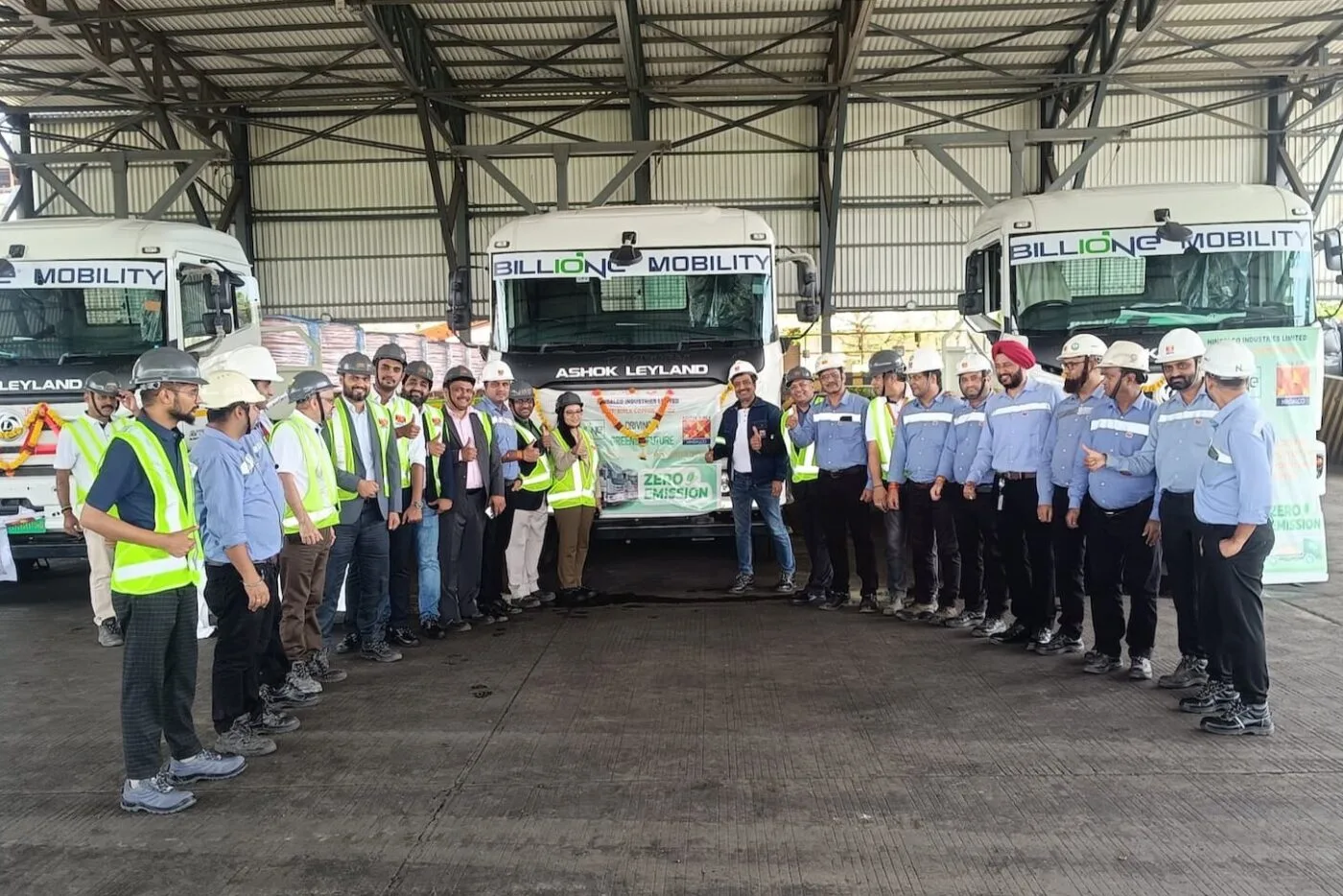
Indian e-mobility-as-a-service company BillionE has partnered with Hindalco Industries to launch the country’s first heavy-duty electric freight corridor in Gujarat, deploying ten electric trucks with plans to add five more in the coming months. The initiative aims to decarbonize industrial logistics and boost operational efficiency across one of India’s key manufacturing regions.
The corridor connects Hindalco’s copper smelting facility in Dahej with its continuous cast rod plant in Asoj, covering a 160-kilometre route. The trucks—believed to be Ashok Leyland Avtr 55T Electric models—each have a 55-tonne capacity, a 300 kWh battery, and a 220 kW motor, offering a range of up to 180 km per charge.
Charging infrastructure along the corridor is powered by ChargeZone, India’s largest EV charging network founded by Kartikey Hariyani, who also established BillionE. The company’s charging points at Karjan, Bharuch, and another mid-route location enable smooth, zero-emission freight movement between Hindalco’s facilities.
“Launching this heavy-duty electric freight corridor is more than just a milestone. It represents a transformation in how India moves goods at scale,” said Sanjeev Kulkarni, CEO of BillionE. Bishnu Agarwal, Functional Head of F&C Copper at Hindalco, added that the initiative reduces the company’s carbon footprint “while improving efficiency with quieter, low-maintenance, and future-ready vehicles.”
The partnership builds on BillionE’s broader electrification push, following its 2023 order of 180 electric trucks from Ashok Leyland, spanning the Avtr 55T, BOSS 19T, and BOSS 14T models. Hindalco said it plans to expand the use of electric trucks to secondary transport routes across Vapi, Daman, and Silvassa, further enhancing the sustainability of its logistics operations in western India.
Source: Electrive


