
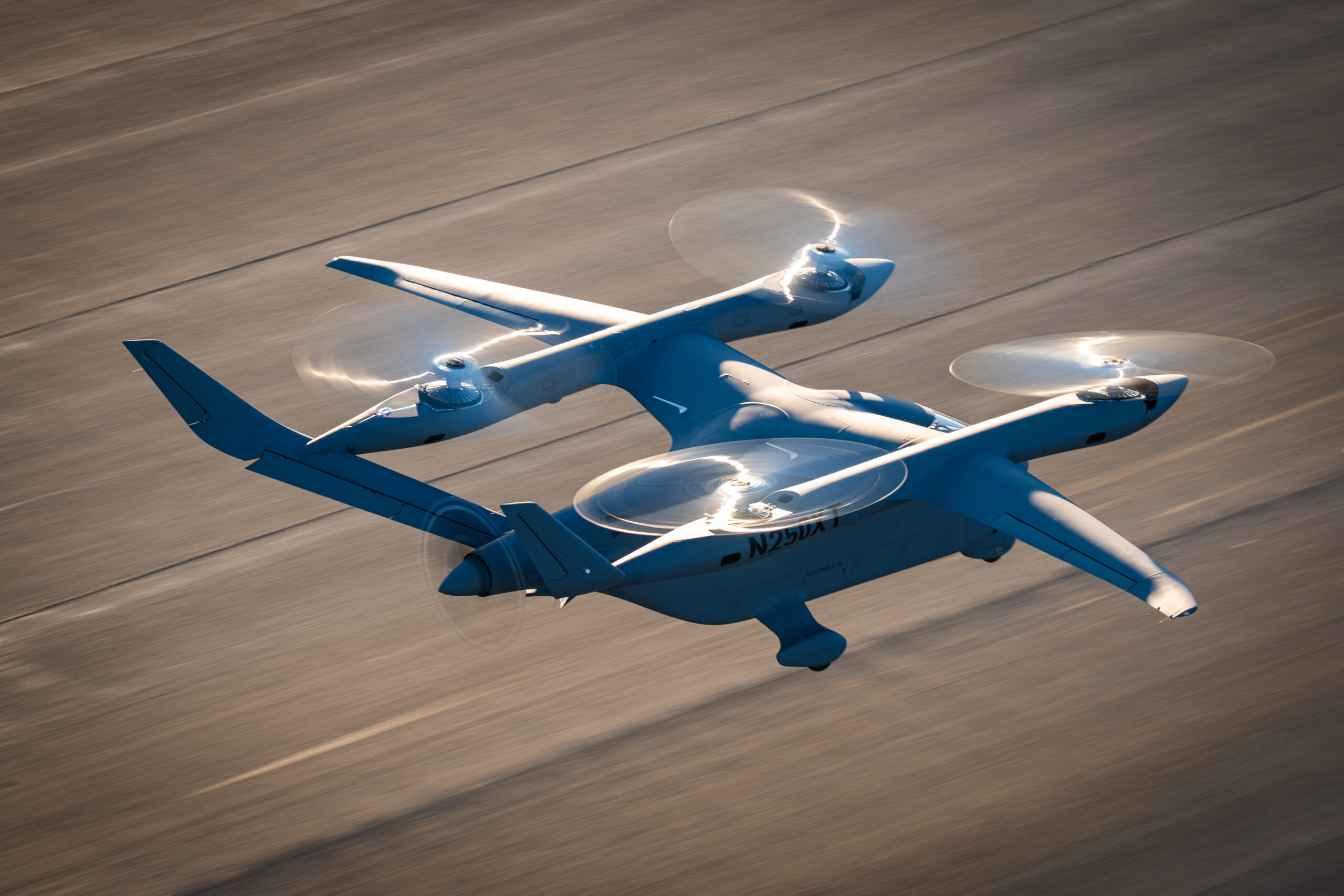
Beta Technologies has begun integrating autonomous capabilities into its Alia electric aircraft platform, a move the U.S. developer says could expand applications for both military and commercial operators. The company disclosed on Thursday that it has conducted more than 1,000 uncrewed flight hours using subscale aircraft equipped with its in-house autonomy system, demonstrating a range of 158 nautical miles on a single charge. The system has been under development “for the past several years,” according to the company.
The electric aircraft maker is building vertical takeoff and landing (VTOL) and conventional takeoff and landing (CTOL) variants of the Alia, alongside a hybrid-electric powertrain. “Increasing our autonomy capabilities will deliver even greater optionality to operators, including faster speed, higher payload, longer range, and optional piloting,” said Shawn Hall, Beta’s chief revenue officer. “In order to meet the demands of the defense and civil sectors today, mobility platforms must be smarter, more flexible, and ready to operate where traditional systems can’t.”
Beta’s CTOL version has a projected cruise speed of 135 knots and a demonstrated range of 336 nm. The aircraft has completed flights across the U.S., Europe, and New Zealand in VFR and IFR conditions and has operated in controlled airspace at major airports including Hartsfield-Jackson Atlanta International and John F. Kennedy International. The company said that removing the pilot could nearly double the payload capacity of both aircraft, which are currently designed to carry one pilot plus five passengers or 1,240 pounds of cargo.
The company is also working with GE Aerospace on a hybrid-electric powertrain intended to boost range, payload, and efficiency. As part of the agreement announced in September, GE invested $300 million in Beta. “We believe the industry is on the precipice of a real step change,” CEO Kyle Clark said at the time, adding that the partnership aims to “unlock the potential of hybrid-electric flight” with aviation-grade safety and reliability.
On Thursday, Beta said it incorporated Near Earth Autonomy’s perception and guidance technology into its fly-by-wire system, with autonomous flight demonstrations planned for the first half of 2026. Near Earth, which claims its founders enabled the world’s first fully autonomous helicopter flight in 2010, supplies autonomy systems to Boeing, Airbus, Leonardo, Bell, and other major manufacturers. “Working with a pioneer in electric aviation allows us to combine high-assurance autonomy with cutting-edge electric propulsion to help unlock sustainable, scalable autonomous air mobility,” said Near Earth CEO Sanjiv Singh.