
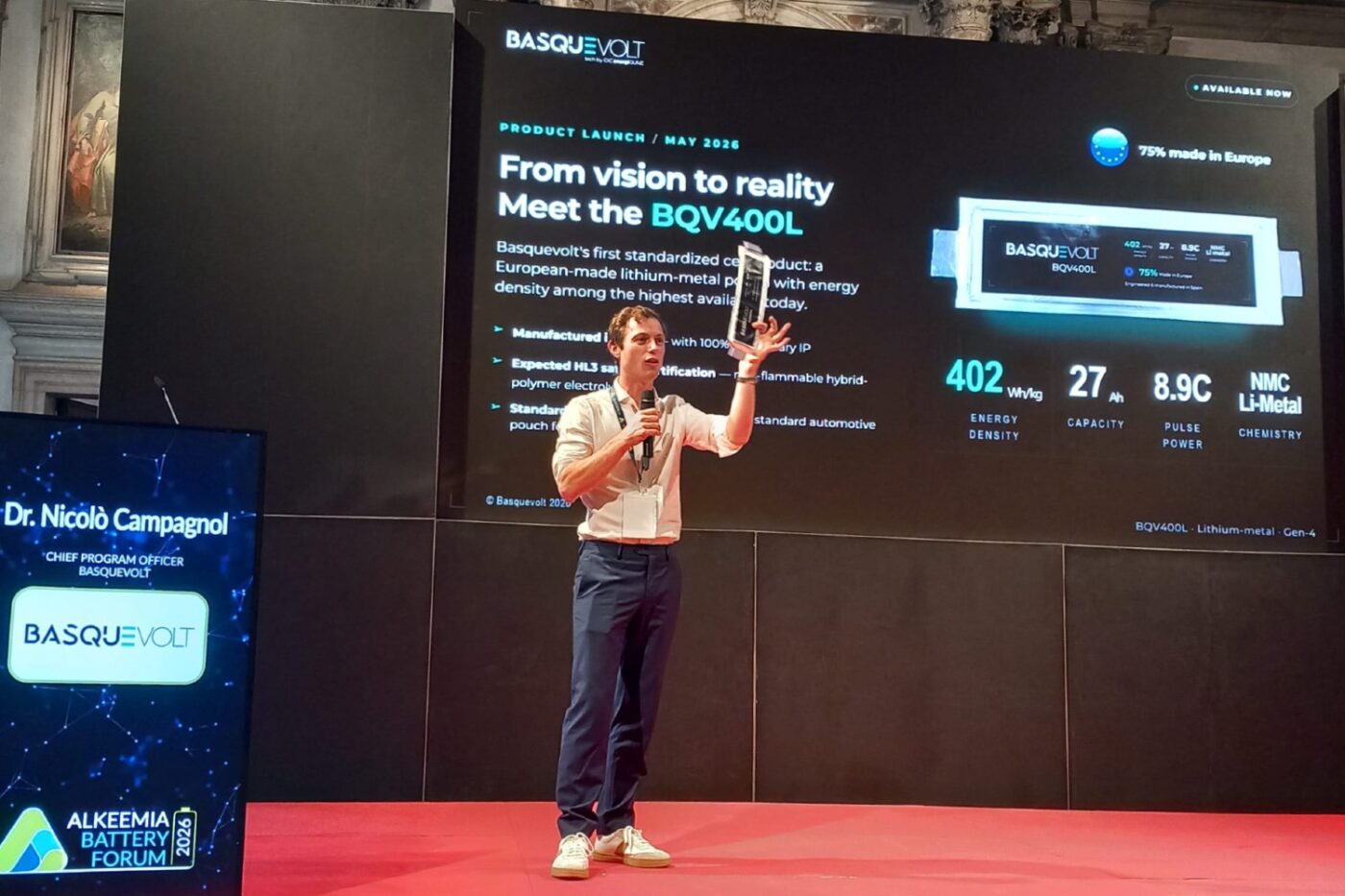
Basquevolt has launched its BQV400L battery cell, a lithium-metal battery developed for automotive and industrial applications that the company says delivers one of the highest energy densities currently available from European production.
The battery developer, which was founded in 2022 and is based in Spain’s Basque Country region, said the new cell is available immediately and represents the fourth generation of its lithium-metal battery technology.
Basquevolt is backed by the Basque regional government alongside companies including Iberdrola, CIE Automotive, Enagás, EIT InnoEnergy and CIC energiGUNE.
The BQV400L uses an NMC cathode, a lithium-metal anode and what Basquevolt describes as a proprietary hybrid polymer electrolyte.
While the company positions the technology as part of its solid-state battery development roadmap, it has not confirmed whether the cell qualifies as a fully solid-state battery in the strict technical sense.
According to Basquevolt, the BQV400L delivers a gravimetric energy density of 402 watt-hours per kilogram and a capacity of 27 ampere-hours.
The company said the cell also achieves a pulse power capability of 8.9C, allowing it to deliver or absorb high currents over short periods.
Basquevolt stated that the cell is manufactured in Spain and contains approximately 75% European components.
The company said performance figures are currently undergoing validation by an independent battery testing laboratory.
Basquevolt added that the battery is designed as a “drop-in” solution compatible with existing gigafactory production infrastructure, which could reduce the need for additional manufacturing investment.
Nicolò Campagnol, chief programme officer at Basquevolt, said the launch represented a milestone in European battery development.
“Reaching over 400 Wh/kg in a commercially available, European-made cell is something we have worked toward for a long time — and it feels significant to finally be here,” Campagnol said.
“What drives us now is the knowledge that this is not our ceiling,” he added. “The technology roadmap ahead of us is the most compelling it has ever been.”
Earlier this year, Basquevolt announced a development partnership with Ampere, the electric vehicle unit of Renault, to accelerate development and validation of lithium-metal battery cells for future electric vehicles.
At the time, Renault said the technology could enable lighter and more compact battery packs with improved thermal stability and fast-charging performance.
Basquevolt also said it is working with EDF and an unnamed automotive manufacturer on safety and performance testing for lithium-metal NMC battery cells exceeding 400 Wh/kg energy density.
Lithium-metal batteries are viewed as a potential next-generation battery technology due to their higher energy density, though the industry continues to face technical challenges including dendrite formation, which can reduce battery lifespan and create safety risks.