




Autonomous sensing company Atomathic has launched a new radar perception system designed to improve reliability in complex driving environments, introducing what it calls a physics-constrained reasoning engine aimed at addressing long-standing challenges in automotive radar performance.
The system, branded AISIR for Radar, is intended to enhance the stability and accuracy of radar-based perception in advanced driver assistance systems (ADAS) and autonomous vehicles, particularly in scenarios involving high dynamic range, cluttered surroundings and vulnerable road users. The company said the technology enables more consistent detection by reducing false targets and intermittent signal loss that have historically limited radar performance.
See also: Hesai Partners With Keeta Drone to Supply Lidar for Urban Autonomous Delivery Networks
According to Atomathic, AISIR combines generative reasoning with physics-based constraints to allow radar systems to “reason” about their environment, rather than relying solely on traditional signal filtering. The company said the approach is designed to deliver more stable object tracking in conditions such as rain, fog, glare and dense urban settings, where camera and lidar systems often degrade.
The system operates through a dual-layer architecture. The first component, known as AIDAR, performs rapid, frame-by-frame reconstruction of radar signals to isolate relevant physical objects. The second layer, AISIR, applies temporal reasoning and wave-consistent modeling to evaluate and refine those detections over time, rejecting artifacts such as multipath reflections and ghost objects.
See also: TIER IV and JR Central Form Alliance to Advance Autonomous Mobility Around Rail Hubs
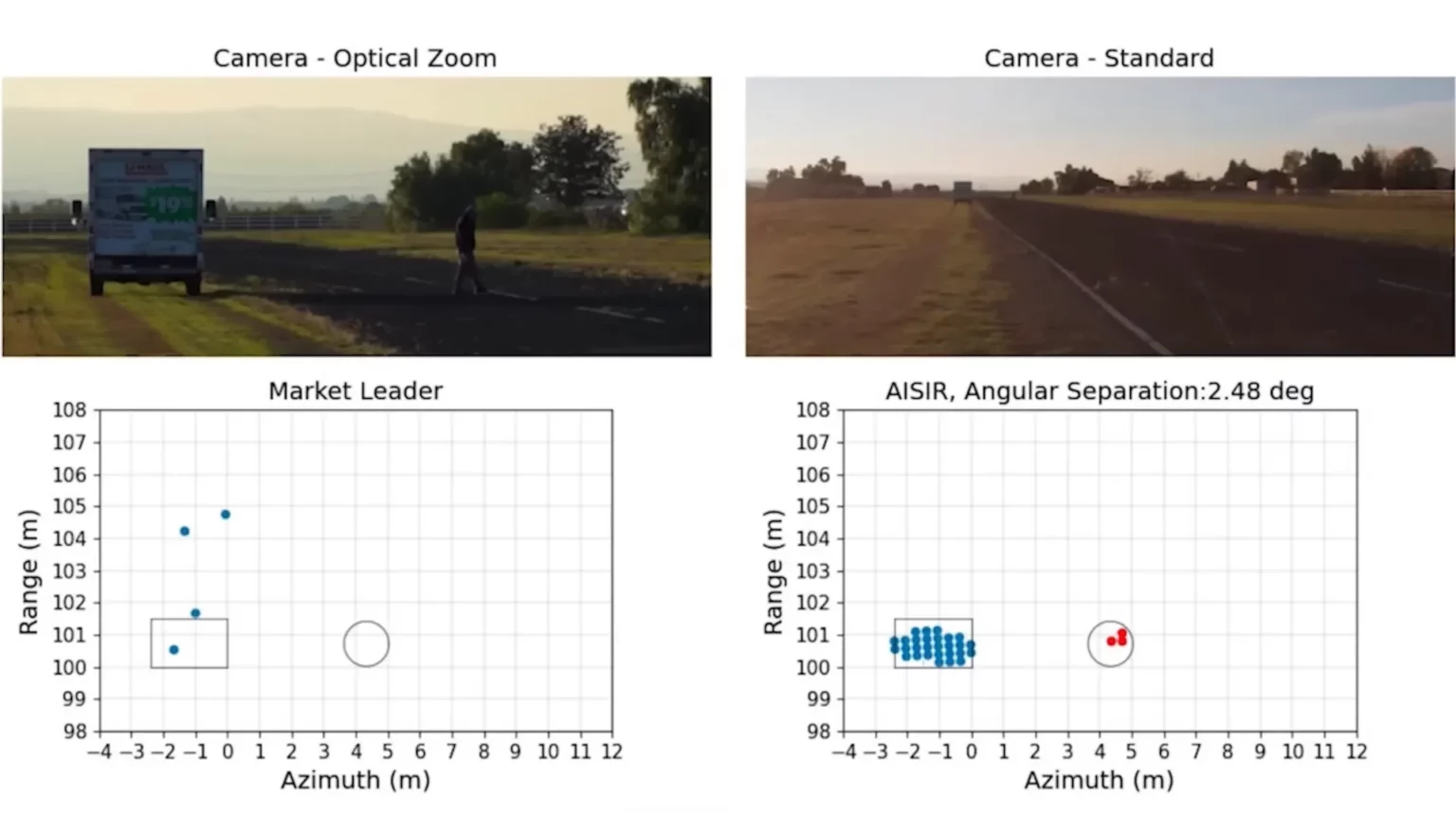
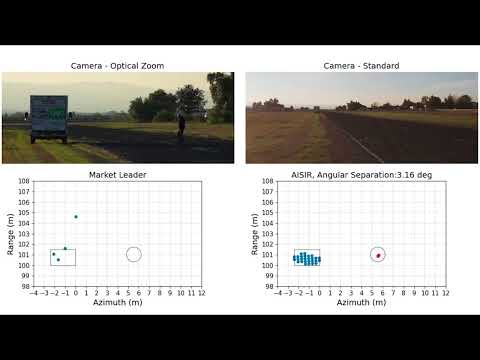
In a demonstration outlined in a newly released technical white paper, Atomathic showed that the system could reliably detect a pedestrian walking close to a large truck—an environment that typically produces severe radar interference. The company said the model maintained stable tracking while reducing flicker and false positives that commonly affect conventional radar pipelines.
“Radar has always had the potential to be a robust safety sensor, but it has lacked the reasoning layer needed to interpret complex scenes,” the company said in the paper. “By combining fast reconstruction with physics-grounded inference, we can close the reliability gap that has limited radar’s role in autonomy.”
The white paper also details how the system addresses sparse-aperture ambiguity, a fundamental limitation in automotive radar, by reconstructing physically consistent representations even when incoming signals exceed the sensor’s native resolution. According to Atomathic, this approach enables more dependable detection of vulnerable road users in cluttered environments.
See also: Xpeng Research on Autonomous Driving Model Accepted at AAAI 2026
Industry analysts view such developments as part of a broader push toward software-defined sensing, in which improvements in perception performance are driven by algorithms rather than new hardware. The approach could help automakers enhance safety capabilities without significantly increasing sensor cost or complexity.
Atomathic said its technology is designed to be hardware-agnostic and compatible with existing automotive radar platforms, positioning it for integration into next-generation ADAS and autonomous driving systems.


