



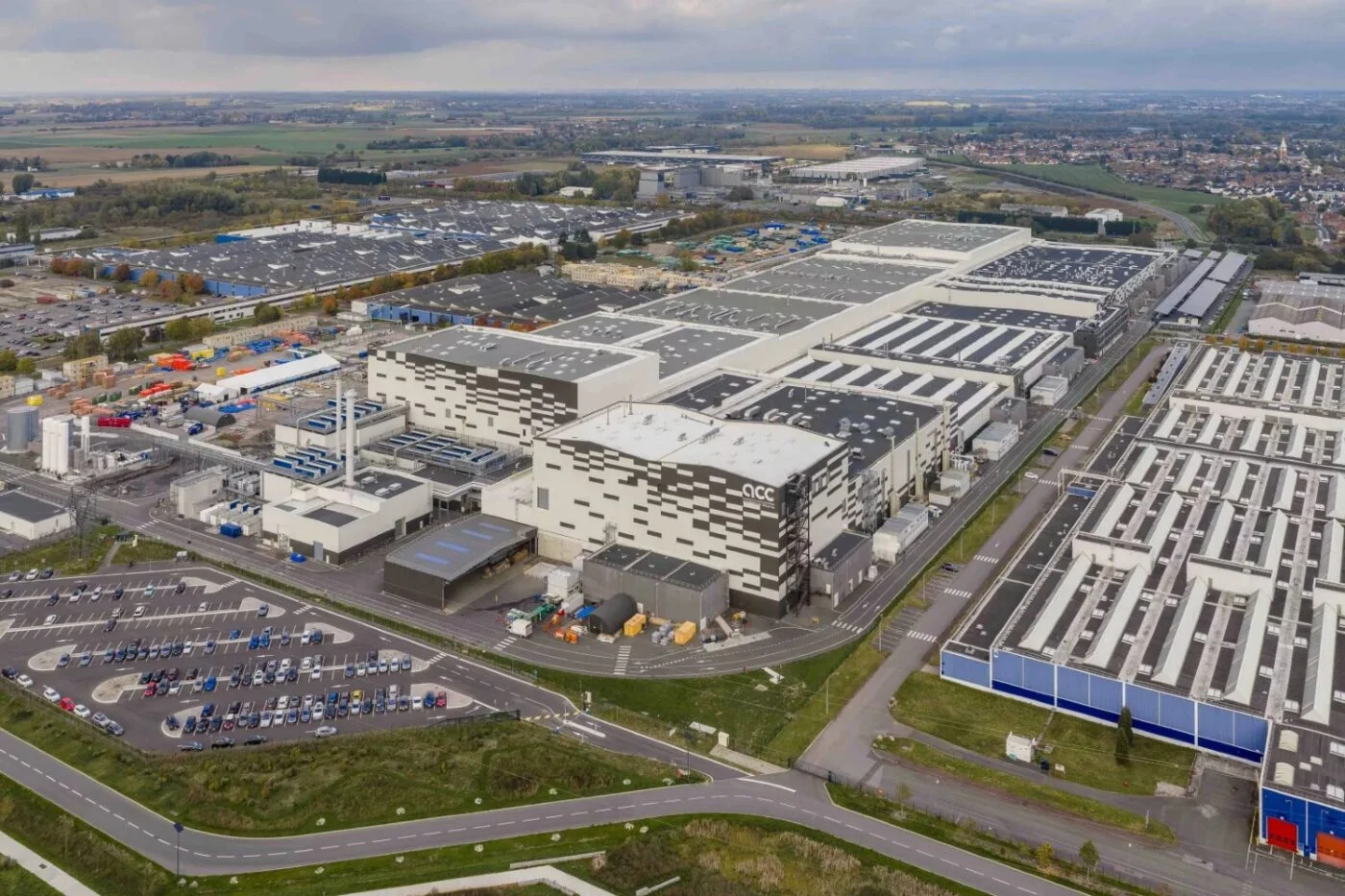
Automotive Cells Company (ACC) has produced its five millionth lithium-ion battery cell at its gigafactory in Billy-Berclau/Douvrin, in France’s Hauts-de-France region. The company announced the milestone ahead of its participation in the 2026 Paris Motor Show, reporting that its battery production to date represents enough cells to equip nearly 40,000 vehicles.
ACC will display a battery at the event in a cutaway vehicle provided by Stellantis. The company is exhibiting at the “La Fabrique de l’Innovation” stand, an area dedicated to the French automotive industry organised by the Plateforme Automobile (PFA).
Battery Production Expands Across Stellantis Models
ACC said its battery cells and modules currently power eight electric vehicle models marketed by Stellantis: the Peugeot E-3008, Peugeot E-5008, Jeep Compass, Lancia Gamma, DS N° 7, DS N° 8, Citroen C5 Aircross and Opel Grandland.
The company reported progress in scaling up its first production block, which operates seven days a week on a five-day, three-shift pattern. ACC said manufacturing scrap rates are steadily approaching target levels and that production ramp-up and industrialisation are continuing.
Module output has also increased. According to the company, the volume produced in September alone was close to the total module production achieved throughout 2025. ACC added that it is supplying Stellantis according to agreed production plans.
Second Production Block Planned for 2027
ACC plans to begin production at its second Douvrin production block in 2027. The new block will add 12.9 GWh of annual manufacturing capacity and is intended to supply batteries for Mercedes-Benz electric vehicles.
The expansion is part of ACC’s efforts to increase European battery production as automakers develop their electric vehicle line-ups. The company’s manufacturing scale-up will depend on its ability to maintain production quality, improve yields and meet customer delivery requirements.
ACC Calls for Support for European Battery Manufacturing
ACC says expanding battery production in Europe is important for strengthening supply chains, maintaining industrial employment and developing regional expertise in battery technology.
The company also called for the European Union to advance its proposed Industrial Accelerator Act (IAA), arguing that a supportive policy framework would help create demand for batteries manufactured in Europe.
Allan Swan, ACC’s CEO since May 2026, described the five-million-cell milestone as evidence of progress at the company’s French operations.
“Reaching 5 million cells produced in France is an important milestone for ACC and a clear demonstration of the progress achieved by our teams over the past years. It shows that Europe can develop and industrialise advanced battery technologies at scale.”
Swan also highlighted the need to improve the competitiveness of European battery production.
“At the same time, the competitiveness challenge remains. Europe must now ensure that its industrial ambitions are supported by a framework that enables battery manufacturing to compete on a level playing field. Only a competitive European offering will be able to meet the demand for ‘Made in the EU’ production.”
Focus on Next-Generation Battery Technology
ACC said it will continue developing battery products aimed at improving performance, driving range and charging speed. The company expects these developments to support the wider adoption of electric vehicles while addressing consumer expectations.
The five-million-cell milestone marks progress in ACC’s manufacturing ramp-up, while the planned second production block represents the next stage in expanding its supply capacity for European automakers.


