
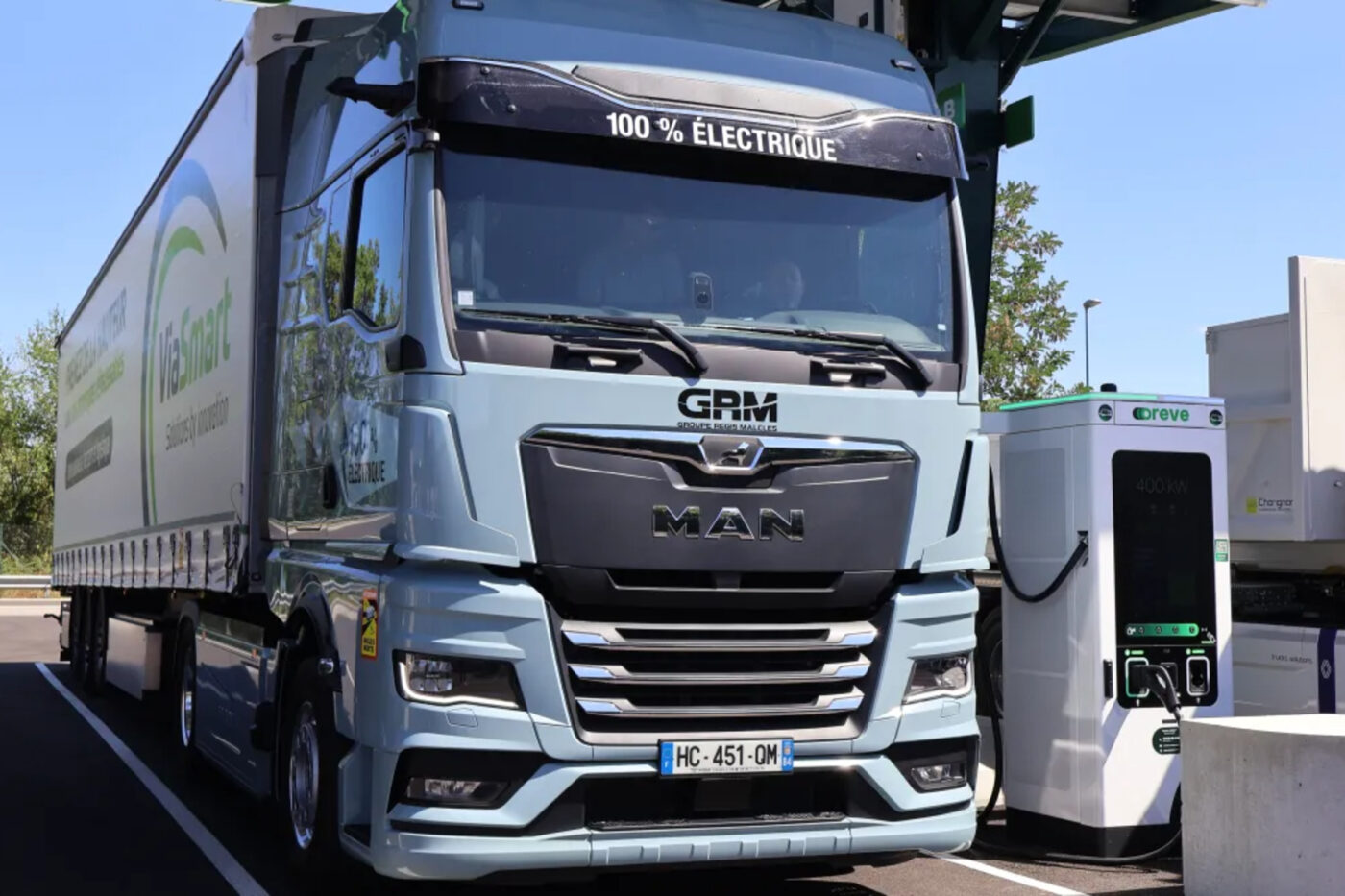
ABB E-mobility and French charging infrastructure operator Oreve are planning a major expansion of their public charging network for electric heavy-duty vehicles, with 12 additional sites scheduled to enter development across France by the end of 2028. The planned facilities will include approximately 100 charging points with a combined capacity of 18 MW.
The expansion builds on a three-year collaboration that has already delivered six charging locations along key freight transport routes. The partners also intend to upgrade existing facilities as demand for electric truck charging increases.
New Charging Network Targets Freight Transport Routes
Oreve is directing the next phase of network development towards electric heavy-duty transport, while keeping its charging parks accessible to passenger cars. Existing locations include Bourg-de-Péage on the Valence–Grenoble route, Vénissieux in the Lyon logistics area and Pardies in south-western France.
The new sites are being designed to accommodate future increases in charging demand, allowing additional capacity to be introduced without requiring major reconstruction of the underlying infrastructure.
ABB E-mobility will supply the charging equipment and provide cloud-based system management, real-time monitoring and remote technical support.
ABB to Introduce MCS-Compatible Charging in 2027
The charging network will use two ABB systems. The A400 fast chargers will provide dynamic power distribution of up to 400 kW across two charging points.
From early 2027, the partners also plan to introduce ABB’s modular M-Series platform. Its capacity can be expanded from 400 kW to as much as 1.2 MW by adding power modules. The system can integrate up to 24 charging units, enabling network operators to increase capacity as fleet requirements develop.
The M-Series supports both Combined Charging System (CCS) and Megawatt Charging System (MCS) standards. The first MCS-compatible installation under the Oreve partnership is scheduled for 2027, although the companies have not yet disclosed its location.
Both the A400 and the M-Series OM charging units use liquid-cooled cables to support high-current charging. ABB specifies maximum current levels of 600 amperes for the A400 and 800 amperes for the OM units.
France Plans 8,000 Truck Charging Points by 2035
The partnership’s expansion comes as France develops infrastructure to support the electrification of road freight. The country’s charging infrastructure plan targets approximately 8,000 truck charging points across 560 motorway rest and service areas by 2035, representing around 1.6 GW of installed charging capacity.
Public charging facilities are expected to complement private depot infrastructure. Research models from Fraunhofer ISI and the International Council on Clean Transportation (ICCT) indicate that depots could account for 70% to 80% of heavy electric truck charging demand in most European countries over the longer term. Public high-power stations will nevertheless remain important for long-distance operations and charging during journeys.
ABB is also participating in the development of depot charging solutions. Through the recently completed BELLE research project, the company and its partners examined issues including grid connections, charging infrastructure and intelligent load management for electrified depots.
ABB and Oreve Expand Their Heavy-Duty Charging Activities
ABB is also developing its service activities for commercial vehicle charging networks. In September, the company agreed to extend its collaboration with Norwegian logistics provider ASKO to cover monitoring, maintenance and technical support. The partnership began in 2019 and has since resulted in the commissioning of more than 60 high-power chargers across seven Norwegian cities.
ASKO and ABB E-Mobility Expand Service Partnership for Heavy-Duty EV Charging
Oreve, part of France’s Ortec Group, is developing a public charging network serving passenger cars, light commercial vehicles and heavy trucks. The company aims to establish 150 public charging locations in France by 2030.
The additional French sites will expand the partners’ existing network while introducing higher-capacity charging technology intended to support the growing requirements of electric freight transport.