
Volkswagen has temporarily suspended development work on its planned electric ID.Golf as the automaker tightens investment spending amid mounting cost pressures. The company says work will resume once the necessary funding can be secured.
Volkswagen Passenger Cars chief Thomas Schäfer initially disclosed the decision in an internal interview with Handelsblatt, while Reuters subsequently reported his remarks: “We simply cannot afford this work right now.”
In its statement covering the first nine months of 2026, Volkswagen’s Brand Group Core said development of the future ID.Golf would remain temporarily suspended “until we can securely allocate the necessary investments”.
Investment Controls Tighten Amid Financial Pressure
The decision forms part of a broader cost-saving programme intended to strengthen Volkswagen’s financial position. The group is seeking to improve investment discipline, reduce upfront expenditure and manage working capital more effectively to support net cash flow.
Volkswagen Confirms ID.4 and ID.5 Will Be Renamed ID. Tiguan
David Powels, CFO of Volkswagen Brand and Brand Group Core, highlighted the challenging market environment and the importance of cost management.
“The market environment remains very challenging – and one-off effects are impacting our results. This makes it all the more important to consistently pursue our chosen course and further refine our priorities. We are improving our cost base and optimizing working capital – while maintaining a high level of investment discipline.
One concrete measure at the Volkswagen brand is therefore to temporarily pause development work for the future ID. Golf until we can reliably secure the necessary investments.
Within Brand Group Core, we are leveraging the potential of our cross-brand governance even more effectively. The new management model is a crucial lever for making our cost base more competitive and thus achieving even greater efficiency.”
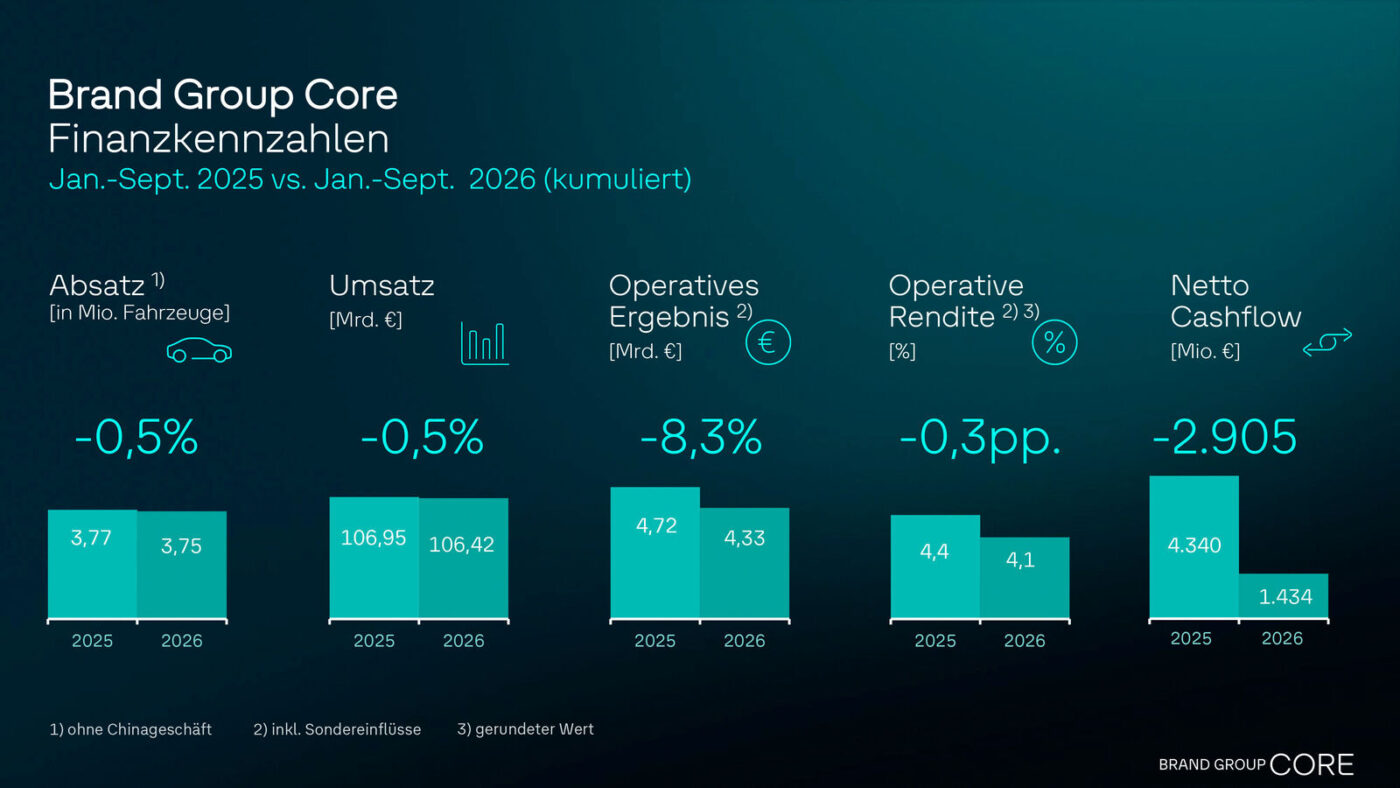
Financial results for the Brand Group Core underline the pressure behind these measures. Net cash flow fell to €1.43 billion in the first nine months of 2026, compared with €4.34 billion in the same period a year earlier.
Revenue remained relatively stable at €106.4 billion, but operating profit declined from €4.72 billion to €4.33 billion. The operating return on sales also decreased from 4.4% to 4.1%.
Volkswagen Passenger Cars Faces Lower Profitability
The core Volkswagen Passenger Cars brand has experienced a particularly sharp decline in profitability.
Its operating profit dropped from €1.48 billion to €813 million during the first nine months of 2026, while its operating return on sales stood at 1.3%.
Volkswagen said the return would have reached 2.6% without special measures, including restructuring activities, the planned sale of the Osnabrück plant and the discontinuation of ID.4 production in Chattanooga, United States.
The company is also facing a challenging transition in its vehicle sales mix. Although demand for battery-electric vehicles is increasing, Volkswagen says electric models have not yet achieved the profit margins of comparable internal combustion engine vehicles.
As the proportion of lower-margin electric vehicles grows and sales volumes of more profitable combustion-engine models decline, the company faces additional pressure to improve manufacturing efficiency and control costs.
Wolfsburg Plant Remains Under Cost Pressure
Production costs at Volkswagen’s main Wolfsburg facility are another concern. The plant is approximately €300 million behind its cost target for 2026.
Volkswagen Unveils ID. Tiguan Electric SUV With Up to 600 km Range
By comparison, the Emden and Zwickau facilities are progressing towards their factory cost-reduction objectives.
The differences between individual plants highlight the broader challenge facing Volkswagen as it seeks to reduce production expenses while maintaining investment in its electric vehicle portfolio.
ID.Golf Planned for Volkswagen’s Next Electric Platform
The development suspension is significant because the future electric Golf is intended to use Volkswagen’s upcoming Scalable Systems Platform (SSP).
The group-wide architecture is designed to simplify vehicle technology, reduce technical complexity and lower development and production costs across future models.
Volkswagen has been targeting an introduction of the electric ID.Golf in the early 2030s. However, the company has not confirmed whether the current pause will affect that schedule.
The Volkswagen Works Council has indicated that any time lost during the suspension could potentially be recovered. Nevertheless, employee representatives view the investment freeze as another indication of the financial challenges facing the group.
Resumption Date Remains Uncertain
Volkswagen continues to describe the suspension as temporary and has not abandoned its plans for an electric Golf. However, it has not provided a date for restarting development work.
Volkswagen’s Xpeng-Based ID.UNYX 08 Sells Far Below Target in China – Reports
The timing will depend on the company’s ability to allocate the required investment while balancing spending priorities across its vehicle portfolio and manufacturing operations.
For now, the pause illustrates how financial constraints are influencing the pace of Volkswagen’s next-generation electric vehicle development, including models intended to underpin its long-term transition to battery-powered mobility.