
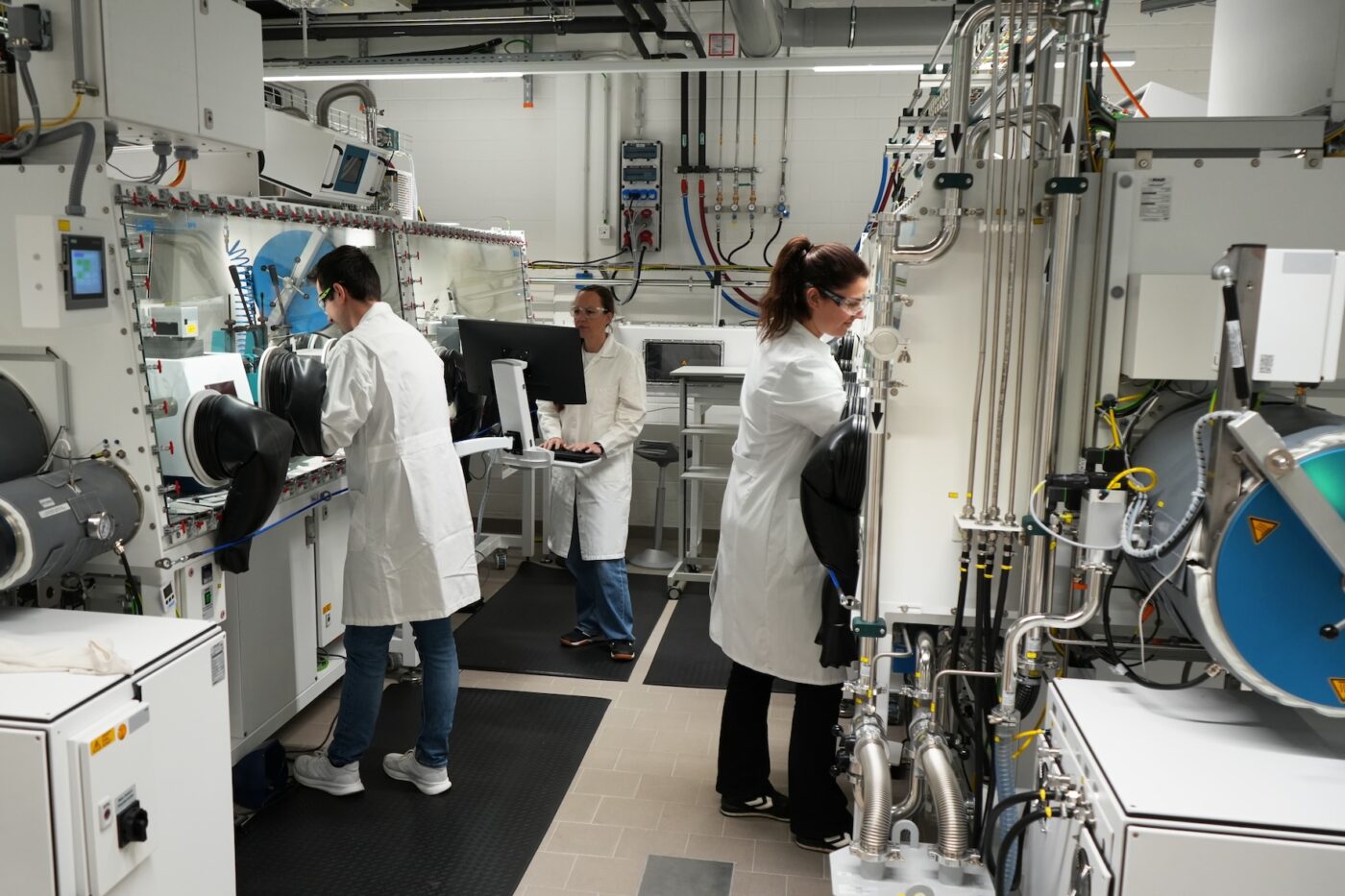
AMG Lithium has commissioned a new laboratory in Frankfurt, Germany, to test sulfide solid electrolytes in complete battery cells and support further development with customers. The Performance Lab, known as PerLa, expands the company’s solid-state battery research and validation capabilities.
The new facility increases AMG Lithium’s laboratory space by 250 square metres to approximately 1,100 square metres. Its main feature is a glovebox production line designed to replicate the manufacturing steps for laboratory cells under controlled, inert atmospheric conditions.
The process includes preparing electrode pastes, coating, cell assembly and packaging into pouch cells. AMG Lithium said the laboratory is equipped with more than 200 test stations for electrochemical investigations.
Testing Materials in Complete Battery Cells
PerLa enables AMG Lithium to evaluate its solid electrolytes beyond material-level characterisation by testing them in complete laboratory cells using standardised procedures.
This approach is intended to help determine how the materials perform when combined with electrodes and other cell components. Such testing can identify challenges involving material stability, interfaces and cell integration before technologies progress toward larger-scale development.
The facility is also designed to support joint development projects with customers, positioning AMG Lithium between battery material development and cell-level validation. It is not intended for industrial-scale battery cell production.
Focus on Sulfide Solid Electrolytes
AMG Lithium is developing sulfide-based solid electrolytes for future solid-state batteries. These materials are designed to replace the liquid electrolytes used in conventional lithium-ion cells.
Solid-state battery technology is being investigated for its potential to improve energy density and safety, but challenges remain in material stability, electrode interfaces and manufacturing processes.
Testing complete cells is therefore an important step in evaluating whether laboratory material properties can translate into practical battery performance. AMG Lithium has described PerLa as part of its development pathway toward market introduction, but has not disclosed specific customer projects, offtake agreements or a timetable for scaling up solid electrolyte production.
Separate Expansion of Battery-Grade Lithium Production
Alongside its research activities in Frankfurt, AMG Lithium is expanding its battery-material production capacity at Bitterfeld-Wolfen in Germany.
The project involves a total investment of €180 million and has received €36 million in funding through the German government’s STARK initiative. The facility is planned to reach annual production capacity of 20,000 tonnes of battery-grade lithium compounds.
According to Germany’s Federal Ministry for Economic Affairs, that capacity could theoretically support battery production equivalent to approximately 34 GWh annually.
The Bitterfeld-Wolfen project concerns lithium compounds rather than solid electrolyte production. Together, the two activities represent separate parts of AMG Lithium’s work on battery materials, from industrial lithium supply to the development and testing of materials for future solid-state batteries.