
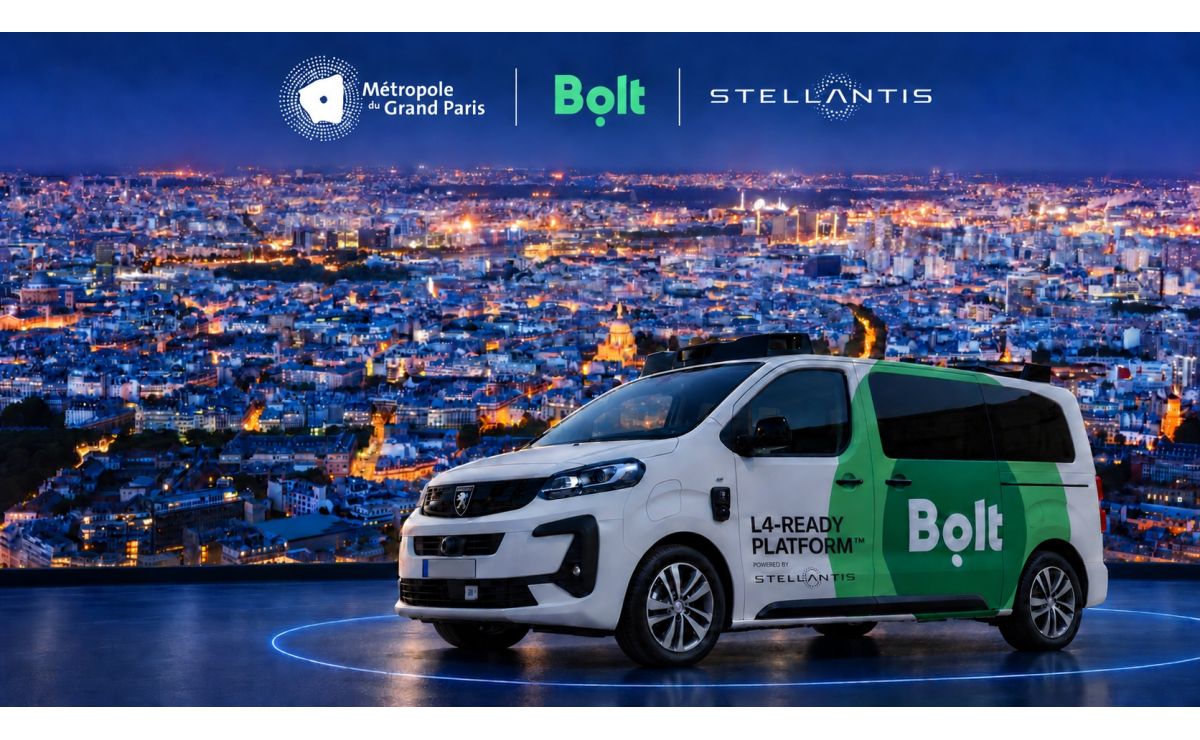
Métropole du Grand Paris, Bolt and Stellantis have announced plans to test autonomous mobility services across Greater Paris, with initial deployments targeted for 2028 and a potential expansion to around 30 municipalities by 2030. The proposed project, called the Greater Paris Autonomous Driving Living Lab, has been submitted to the European Commission’s Autonomous Drive Ambition Cities (ADACities) initiative.
Autonomous Mobility Trials Planned for 2028
The initial phase is expected to cover up to five municipalities in north-west Greater Paris. The trials will assess operational performance, safety, service quality and integration with existing public transport networks.
The partners will also evaluate the economic, social and environmental impacts of autonomous mobility in a dense urban environment. Subject to the necessary approvals, the project could progress towards wider deployment and commercial operations by 2030.
Greater Paris has approximately 7.2 million inhabitants and a complex transport network. Although major infrastructure projects such as the Grand Paris Express are expanding public transport connections, gaps remain in first- and last-mile travel, access to employment areas and transportation outside peak hours.
The pilot aims to determine whether autonomous vehicles can complement existing transport services and improve access to destinations that are less convenient to reach through current options.
Roles of Bolt, Stellantis and Métropole du Grand Paris
The three partners will contribute different capabilities to the project.
- Métropole du Grand Paris will coordinate participating municipalities and stakeholders, identify suitable use cases and oversee the evaluation framework to inform public decision-making.
- Bolt will lead service integration and deployment planning through its Bolt Autonomous Driving Solutions initiative, combining autonomous driving technology, vehicles and its mobility platform.
- Stellantis will provide vehicles based on its L4-Ready Platforms, supported by its engineering, manufacturing and vehicle integration expertise.
Pony.ai has been identified as a potential supplier of autonomous driving technology. Its systems are expected to use NVIDIA Hyperion and the NVIDIA Halos safety system.
The partners will work with local authorities to identify routes, obtain the required permits and prepare for deployment. All operations will be subject to applicable safety, regulatory and data-protection requirements.
Evaluation to Guide Future Expansion
The initial deployment will be independently evaluated, with Métropole du Grand Paris overseeing an assessment of operational safety, service quality, user acceptance, public transport integration, social and environmental effects, and the economic conditions for potential expansion.
Aggregated operational data will support the assessment, subject to applicable data-protection requirements. The findings are intended to help public authorities determine whether autonomous services can be expanded across Greater Paris.
Patrick Ollier, president of Métropole du Grand Paris, said the project would build on the authority’s previous innovation initiatives and its artificial intelligence strategy.
“Our conviction is simple: technological progress only matters when it delivers tangible benefits to our citizens.”
Bolt CEO Markus Villig said the initiative would focus on addressing practical transport needs, including connections to public transport and journeys that are currently more difficult to make.
Stellantis Chief Engineering and Technology Officer Ned Curic said the collaboration aims to develop driverless mobility that complements public transport and makes everyday journeys more accessible.
Wider Ambitions for Autonomous Mobility in Europe
The project forms part of the ADACities initiative, which aims to support the wider deployment of autonomous mobility across European cities. By testing services in real-world conditions, the partners intend to gather evidence on the operational, regulatory and societal requirements for introducing autonomous vehicles in urban environments.
Expansion to additional municipalities and commercial operations by 2030 remain ambitions rather than confirmed launch commitments, with progress dependent on trial results, regulatory approvals and decisions by the relevant authorities.