
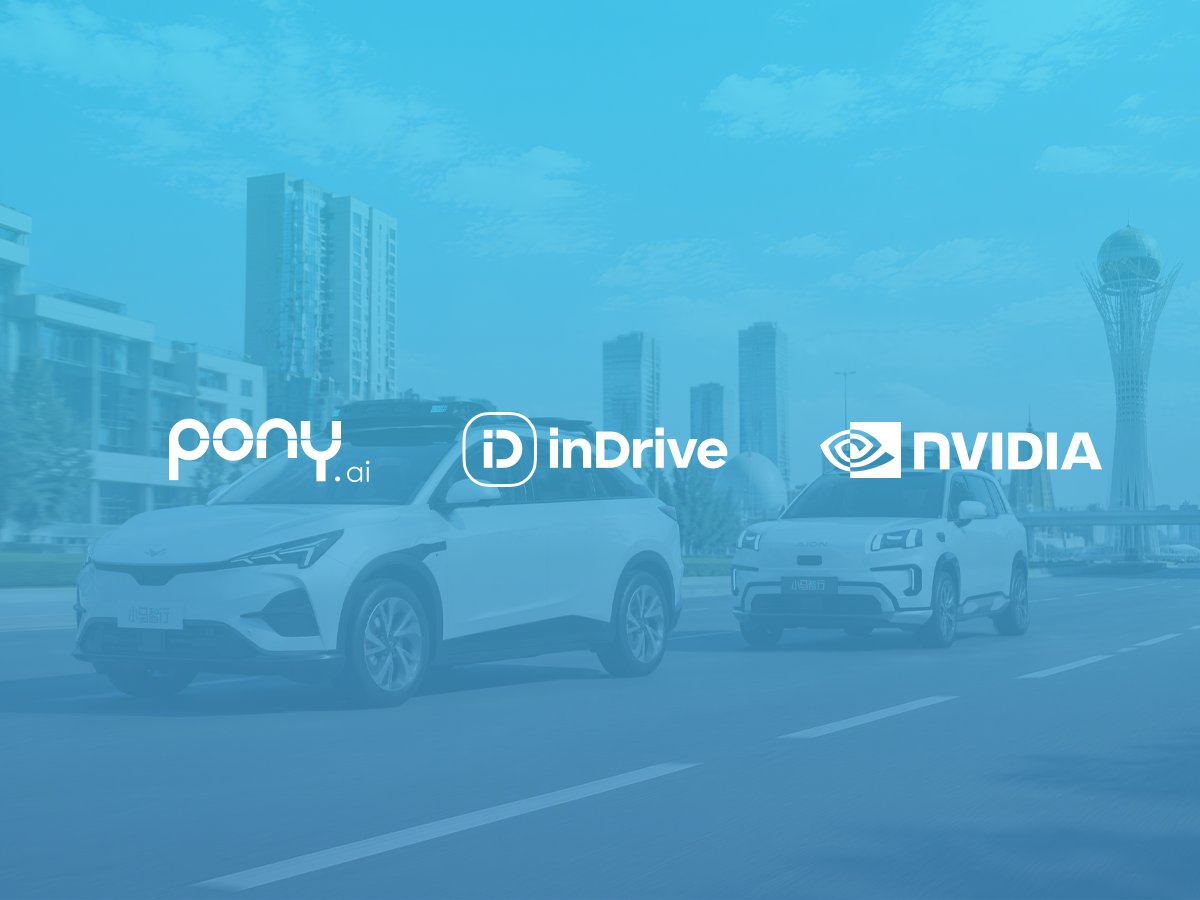
inDrive has signed a memorandum of understanding with NVIDIA and Pony.ai to explore autonomous ride-hailing in Kazakhstan, with the capital, Astana, identified as the first test market. The initiative will assess the technical, operational, regulatory and commercial feasibility of offering Level 4-ready robotaxis through the inDrive app.
Astana Selected as the First Test Market
Kazakhstan was selected for its regulatory progress following the establishment of a legal framework for driverless transportation as part of the country’s digitalization and artificial intelligence initiatives.
The companies plan to launch robotaxi services in Astana following an agreement with the Kazakh government. The city has approximately 1.7 million residents and experiences challenging winter conditions, including snow and ice, providing an opportunity to evaluate autonomous driving technology in demanding environments.
inDrive founder and CEO Arsen Tomsky highlighted the importance of testing the technology in local conditions.
Autonomous mobility has the potential to make transportation more affordable and accessible in the cities we serve.
Tomsky said Astana’s severe winters would provide an important opportunity to assess autonomous driving performance in snow and ice, with findings potentially informing expansion into other markets.
Roles of inDrive, Pony.ai and NVIDIA
Under the proposed collaboration, Pony.ai will supply its seventh-generation (Gen-7) robotaxis, while inDrive will provide the ride-hailing platform and operate the service. NVIDIA will support the project with its AI infrastructure.
Pony.ai’s Gen-7 vehicles use multi-sensor fusion, system-level redundancy and fail-operational capabilities designed to support driverless operations. The company has experience operating fully driverless commercial robotaxi services in major Chinese cities and has expanded deployments into international markets.
NVIDIA’s Hyperion reference platform combines sensors and computing capabilities for Level 4 autonomous vehicles. Its robotaxi technology also incorporates the Alpamayo Stack and Halos safety system to support the development of autonomous driving applications.
NVIDIA Vice President of Automotive Rishi Dhall emphasized the importance of safety in developing autonomous transportation.
Bringing autonomous mobility to more communities requires AI built for the complexity of real-world driving, with safety at its foundation.
Expansion Beyond Kazakhstan
Following an initial launch in Astana, the companies will assess whether the service can expand to other cities in Kazakhstan and additional countries where inDrive operates.
Pony.ai founder and CEO James Peng said the collaboration would draw on the company’s experience scaling driverless services in China and adapting its technology for international markets.
The proposed initiative remains at the feasibility and planning stage, with the planned launch dependent on an agreement with the Kazakh government. Its findings could help determine whether autonomous ride-hailing can be introduced in other markets across Central Asia and beyond.