
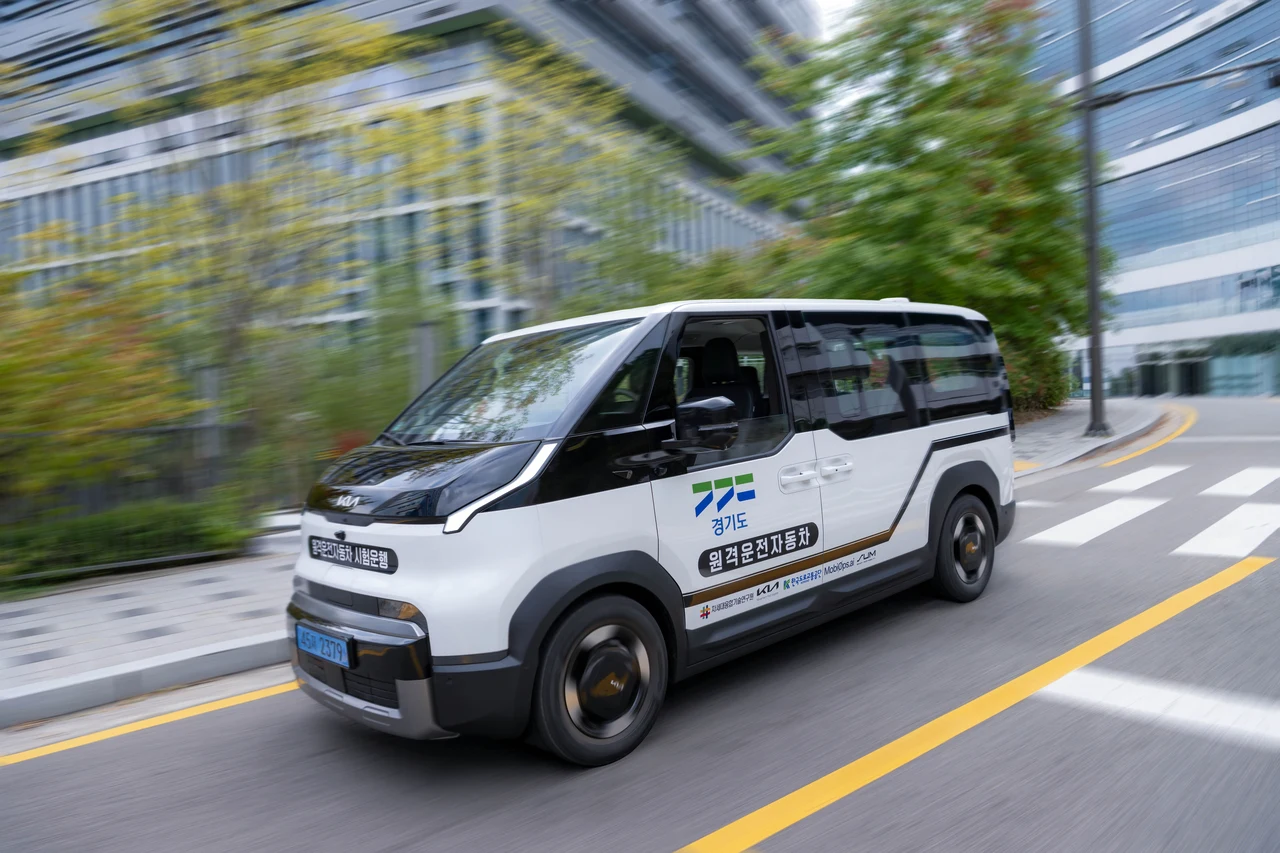
Kia has launched a car-sharing pilot in South Korea that uses remote operators to deliver and retrieve unoccupied PV5 purpose-built vehicles, testing a mobility service designed to reduce the need for users to collect and return cars themselves.
The trial began on October 15 in the Second Pangyo Techno Valley in Gyeonggi Province, where employees of local businesses can reserve vehicles through a dedicated application. The program is scheduled to run through the end of 2026, with expansion planned for 2027, according to The Korea Herald.
How the Remote-Driving Service Works
Under the pilot, users book a PV5 through the app and specify a pickup location. A remote operator then drives the unoccupied vehicle to the requested spot. After completing their journey, users park the vehicle at their destination, where another remote operation returns it to its depot.
Operators control the vehicles from external centres over 4G or 5G mobile networks. The approach allows a human operator to handle vehicle movements remotely rather than relying entirely on autonomous-driving technology.
According to the report, remote operation can cost less than deploying fully autonomous driving systems, potentially offering an alternative route to scaling certain mobility services.
Kia Leads a Multi-Company Consortium
Kia supplies the PV5 vehicles and oversees the overall project. SUM is responsible for developing the remote-driving solution, while Mobiops manages operations. The Korea Road Traffic Authority conducts regulatory reviews.
The consortium has also established safeguards for potential communication disruptions. These include a triple-network system, operator training and emergency response procedures intended to address connectivity failures and other operational risks.
The measures are important because remote driving depends on reliable communications between the vehicle and its control centre.
Commercialisation Targeted for 2027
Kia’s remote-driving initiative has progressed through several regulatory and development milestones. The company received regulatory sandbox approval from South Korea’s Ministry of Land, Infrastructure and Transport in April 2025.
In November 2025, Kia joined Socar, KT and SUM in field trials in Jeju and Hwaseong. It subsequently signed a memorandum of understanding with KT and SUM in July 2026 to pursue commercialisation.
The current Pangyo pilot will allow Kia and its partners to gather operational data and refine the technology before a planned expansion in 2027.
The project adds another potential use case for the PV5, Kia’s purpose-built vehicle platform, while testing whether remotely operated vehicle delivery and collection can make shared mobility more convenient for business users.