
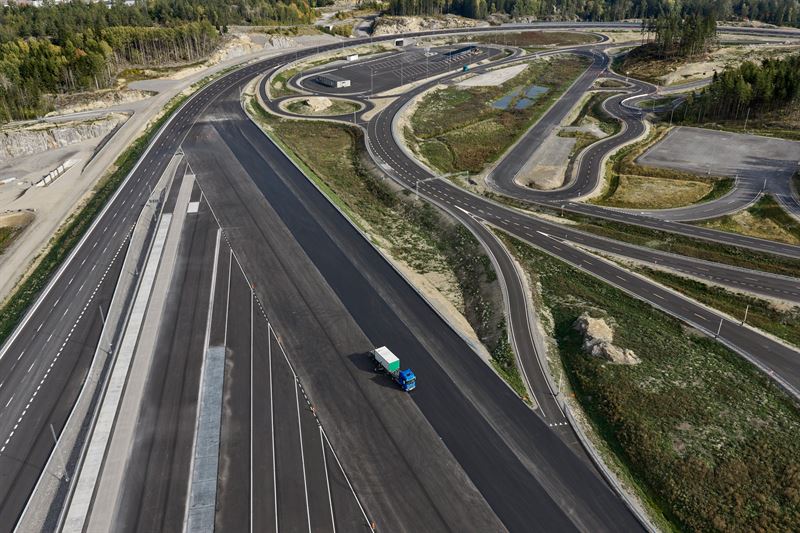
Scania has opened a new vehicle testing centre in Södertälje, Sweden, following an investment of approximately SEK 975 million. The 85-hectare site will support research and development work across vehicle safety, electrification, automated driving and conventional transport technologies.
The facility contains 17 kilometres of paved and gravel roads, providing engineers with dedicated areas to evaluate vehicle behaviour and test systems under repeatable conditions. Scania said the new infrastructure will allow some development activities previously carried out at external test facilities to take place on site.
Purpose-Built Tracks for Vehicle Evaluation
The proving ground was inaugurated on October 19, with vehicles driving on the new tracks as part of the opening event. Its layout combines road sections for vehicle-dynamics assessments with configurable areas for testing driver assistance and autonomous-driving functions.
Three irrigated braking tracks feature asphalt, concrete and basalt-tile surfaces. These different materials allow engineers to examine braking behaviour under varying grip conditions, including situations where the tyres on either side of a vehicle encounter different levels of traction. A curved section on the basalt track enables testing while braking through a corner.
The site can also be arranged to simulate traffic situations for advanced driver assistance systems and autonomous vehicles. Tests can cover functions such as automatic emergency braking, lane support and blind-spot warning, with scenario complexity increased as development progresses.
Scania Chief Technology Officer and Head of Brand Identity Development Sara Forsberg said the facility would expand the company’s ability to evaluate technologies in demanding conditions.
“New technology only creates value when it performs in the real world. The R&D proving ground gives our engineers greater possibilities to test, learn and validate solutions under demanding conditions. It strengthens our ability to turn innovation into solutions that deliver real value for our customers,” Forsberg said.
Designed for Consistent Test Results
Repeatability was a key consideration in the site’s construction. Road surfaces were specified to provide the evenness and durability required for comparable measurements across multiple test sessions, including on banked curves.
The oval road layout also incorporates gradients of up to 22%. Scania describes the design as creating the impression of a continuous highway for drivers using the track.
TRATON Group President and CEO and Scania President and CEO Christian Levin said the investment was intended to strengthen the group’s development processes as transport technologies evolve.
“The transformation of transport requires us to continuously strengthen the way we develop and validate new technologies. This investment is about building the capabilities we need for the future while ensuring that the solutions we bring to our customers have the safety, quality and performance they expect,” Levin said.
Part of TRATON Group’s R&D Infrastructure
The proving ground adds to the research and development resources available across TRATON Group, the commercial vehicle group that includes Scania. Its testing capabilities cover both established vehicle technologies and systems associated with the transition towards electrified and automated transport.
Niklas Klingenberg, Head of Group R&D at TRATON Group, said the facility would support the group’s work on future vehicle technologies.
“Advanced testing and validation capabilities become increasingly necessary as we develop the next generation of transport solutions. The R&D Proving Ground is an important addition to our landscape and strengthens our ability to turn new technologies into proven solutions,” Klingenberg said.
Construction Measures Target Emissions
Scania incorporated environmental measures into the construction project, including the use of ECO asphalt and HVO100 renewable fuel for transport activities. The company estimates that these choices avoided approximately 30,900 tonnes of carbon dioxide equivalent emissions.
The facility covers approximately 850,000 square metres, including 230,000 square metres of paved test surfaces and 54,000 square metres of gravel surfaces.
Facility Specifications
- Location: Södertälje, Sweden
- Investment: Approximately SEK 975 million
- Total area: 85 hectares
- Paved road network: 13 kilometres
- Gravel road network: 4 kilometres
- Paved test surfaces: 230,000 square metres
- Gravel surfaces: 54,000 square metres
- Primary applications: Braking tests, vehicle dynamics, electrification, driver assistance and autonomous-driving development