
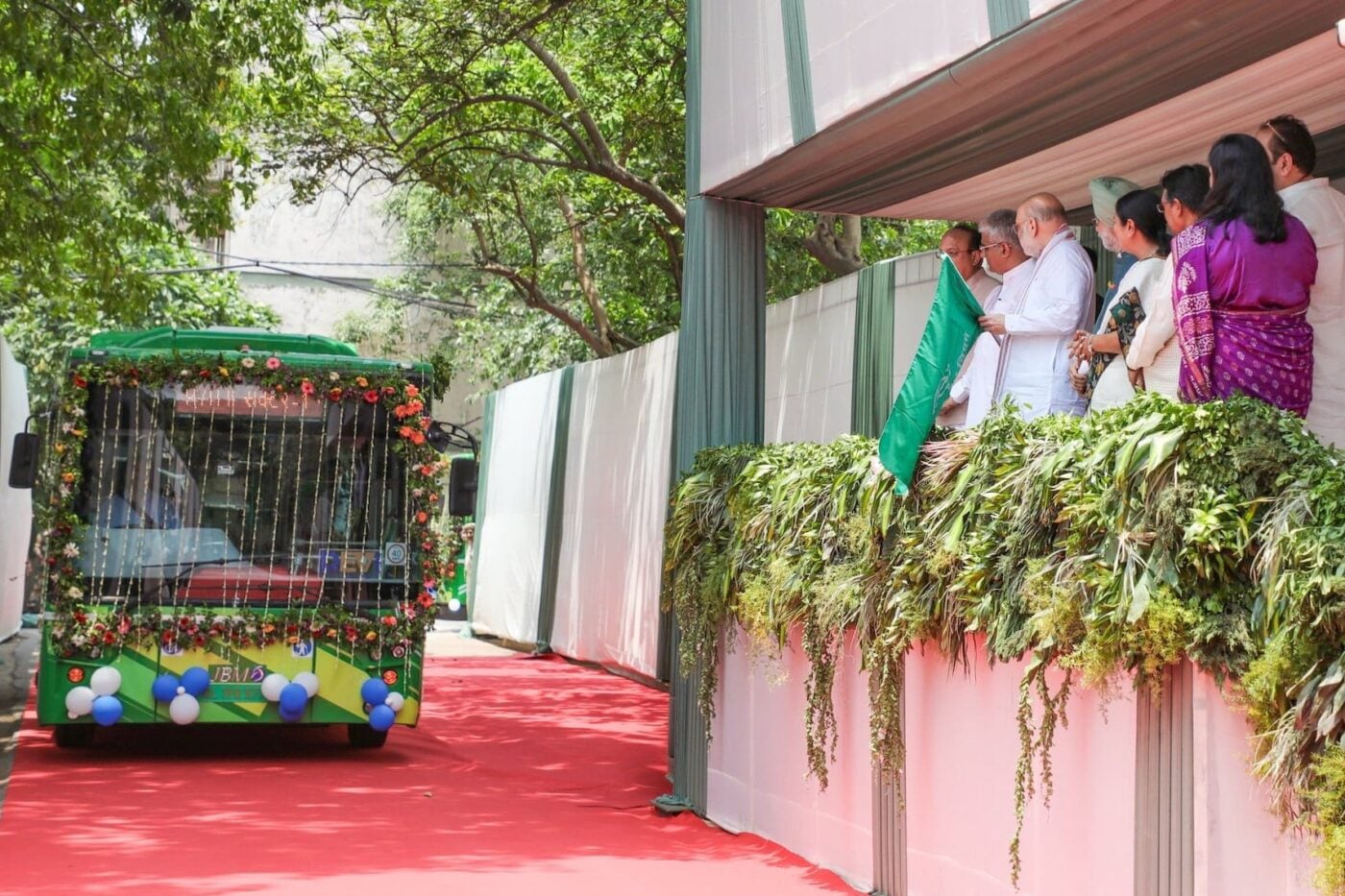
The Delhi government has deployed 300 new electric buses and inaugurated four electric bus depots as part of its plan to expand zero-emission public transportation across India’s capital.
According to The New Indian Express, the new fleet comprises 195 nine-metre buses and 105 twelve-metre buses.
The nine-metre buses will operate under Delhi’s Electric Vehicle Interconnector (DEVi) service, providing last-mile connectivity between residential neighborhoods with narrow or congested streets and major bus corridors and metro stations.
Symbolic Launch Ceremony
India’s Home Minister Amit Shah, Delhi Chief Minister Rekha Gupta and other government officials formally flagged off 11 nine-metre electric buses to mark the wider fleet rollout.
The buses are believed to be JBM Buses’ Ecolife e9 model, which was also recently deployed in Gujarat.
The Ecolife e9 measures 8.86 metres in length, 2.52 metres in width and 3.29 metres in height, with a wheelbase of 4.75 metres.
Delhi authorities have not disclosed the model or technical specifications of the new 12-metre buses.
According to the Delhi government, the new electric buses are equipped with air conditioning, passenger information systems, real-time GPS tracking, CCTV surveillance and panic buttons to improve passenger comfort and safety.
Fleet Expansion Targets
With the latest deployment, Delhi’s electric public bus fleet has expanded to 4,845 vehicles, making it the largest electric bus fleet operating in public transport in India.
Chief Minister Rekha Gupta said the government plans to increase the fleet to 7,000 electric buses by the end of 2026 before doubling it to 14,000 buses by 2028.
New Charging and Depot Infrastructure
The government also commissioned four new electric bus depots to support the growing fleet.
Two depots in Narela can accommodate a combined 250 nine-metre electric buses, while facilities in Rithala and Kohat Enclave provide capacity for 30 and 90 buses, respectively.
Earlier this month, the Delhi government introduced the Delhi EV Policy 2026, which will remain in effect through March 31, 2030. The policy includes exemptions from road tax and registration fees for electric vehicles, purchase incentives, and financial support for scrapping older vehicles.