
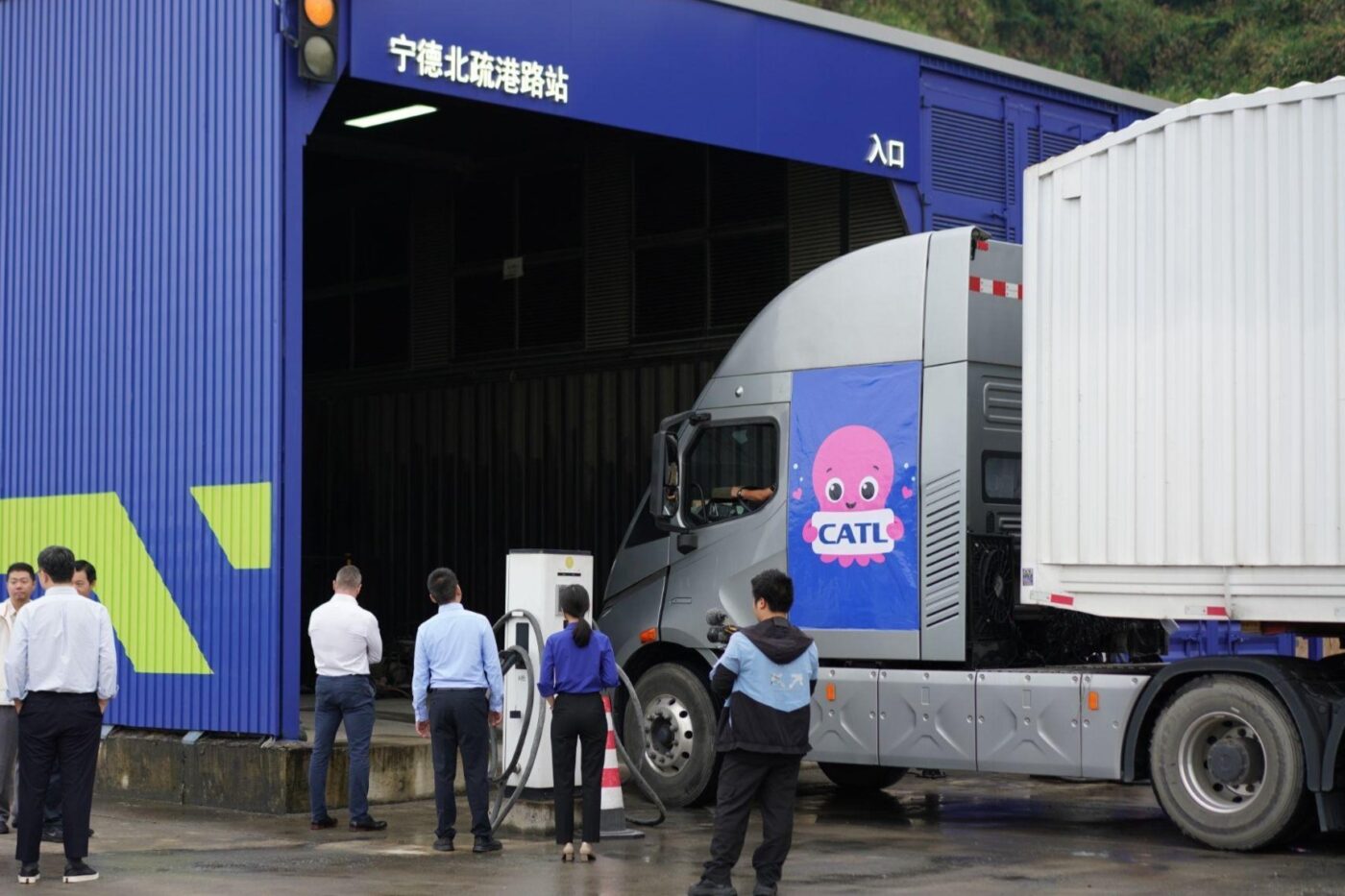
European truck manufacturers are pushing back against plans by Chinese battery maker CATL and Octopus Energy to establish a battery-swapping network for heavy-duty electric trucks in Europe, according to a report by Nikkei.
The joint venture, branded Swaptopus, aims to deploy 30 battery-swapping stations across Europe by 2035, with the first facilities expected to open in the United Kingdom in 2027. However, industry stakeholders have raised concerns that adopting a common battery-swapping platform could reduce manufacturers’ control over vehicle technology and battery systems.
Standardization Concerns Cloud Battery-Swapping Plans
According to Nikkei, one of the main obstacles is the level of collaboration required for a large-scale swapping network.
Participating truck manufacturers would need to standardize battery packs, vehicle architectures, hardware interfaces, software systems and communication protocols across competing brands to enable interoperability.
Sun Jie, Research Analyst at S&P Global Mobility, told Nikkei that manufacturers may be reluctant to adopt standards led by a third party.
“European OEMs may be reluctant to adopt a CATL-led standard that limits their control and differentiation.”
Industry representatives also questioned whether a proprietary battery-swapping model would align with Europe’s broader objective of building open and interoperable transport infrastructure.
Manufacturers Continue Backing Megawatt Charging
The debate comes as European truck manufacturers continue expanding high-power charging technologies for battery-electric trucks.
Recent developments include longer-range electric truck models from Renault Trucks, commercial validation of the Mercedes-Benz eActros in long-haul operations, and MAN Truck & Bus demonstrating three-megawatt charging technology capable of adding significant driving range within minutes.
Analysts cited by Nikkei noted that the European Union’s Megawatt Charging System (MCS), introduced commercially in 2025, already enables battery charging from 20% to 80% in approximately 30 to 40 minutes—roughly matching mandatory driver rest periods required under European regulations.
CATL Sees Opportunity in Lower Operating Costs
For CATL and Octopus Energy, battery swapping offers an alternative approach focused on minimizing vehicle downtime and lowering fleet ownership costs.
Under the model, operators lease batteries instead of purchasing them with the vehicle, reducing upfront investment while allowing depleted battery packs to be exchanged in roughly the same time required to refuel a diesel truck.
CATL already operates more than 300 heavy-truck battery-swapping stations in China serving multiple truck manufacturers and plans to expand that domestic network to 900 locations by the end of 2026.
Despite that experience, Nikkei reported that the success of the European venture will likely depend on securing support from regional truck manufacturers, many of which continue to prioritize open charging standards over shared battery-swapping infrastructure.
As European OEMs accelerate investment in megawatt charging networks, the long-term viability of Swaptopus may ultimately depend less on the underlying technology than on whether manufacturers are willing to adopt a common battery platform.