
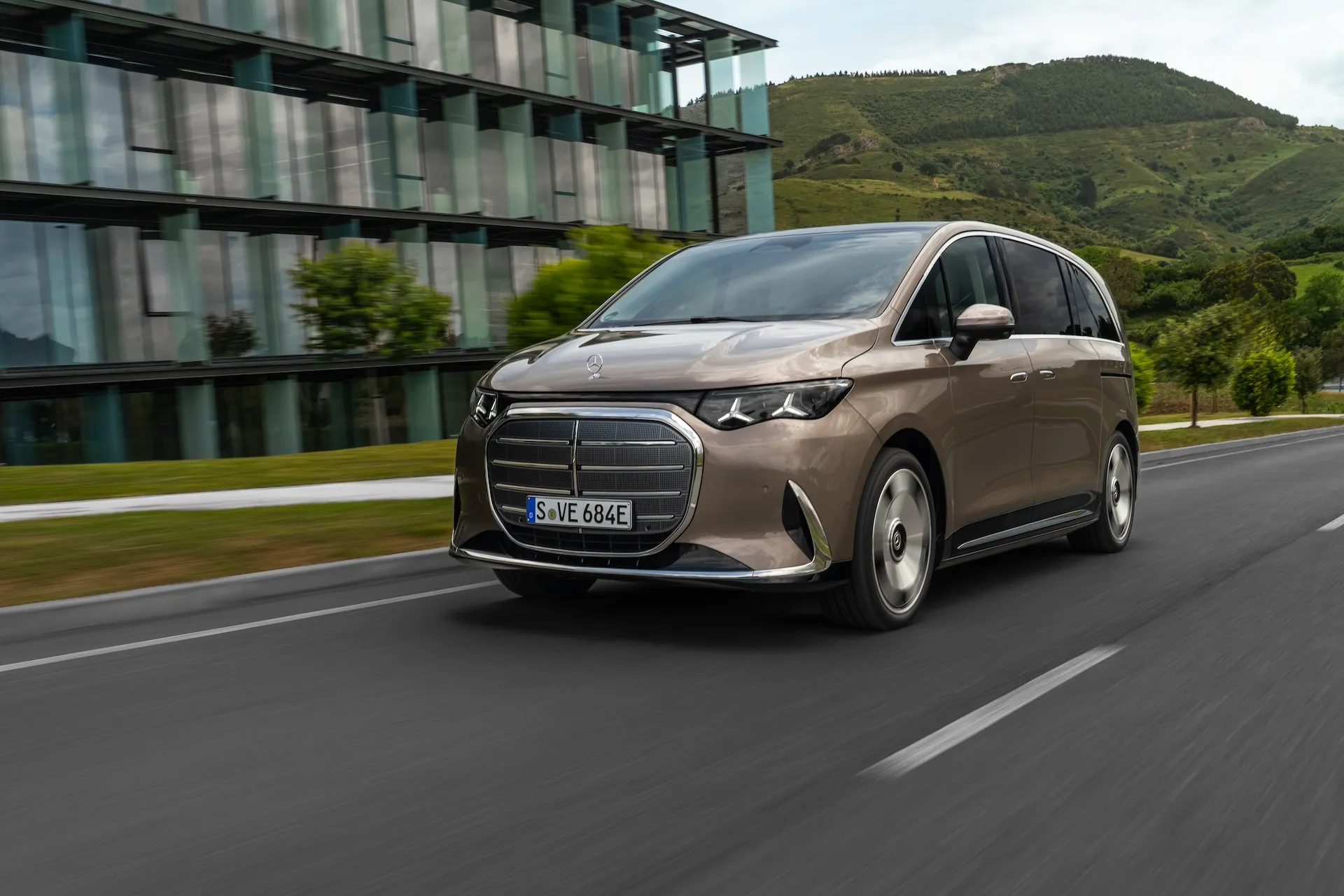
Mercedes-Benz has released further technical details of the upcoming all-electric VLE, highlighting its new 800-volt architecture, long-range battery system, bidirectional charging capability, and efficiency-focused drivetrain technology.
The VLE will be offered in multiple configurations, including a front-wheel-drive VLE 300 and an all-wheel-drive VLE 400 4MATIC, with customer deliveries expected to begin following the model’s launch.
Up to 700 Kilometers of Range
At launch, both versions will be equipped with a 115 kWh usable nickel-manganese-cobalt (NMC) battery pack.
Mercedes-Benz estimates the VLE 300 will achieve a provisional WLTP driving range exceeding 700 kilometers, positioning the model among the longest-range electric vans currently announced for the European market.
The battery uses an updated cell chemistry incorporating silicon oxide and graphite anodes, while the manufacturer says cobalt content has been reduced compared with previous generations.
Two lower-cost variants equipped with 80 kWh lithium iron phosphate (LFP) batteries are planned for introduction next year.
800-Volt Charging System
The VLE is built around an 800-volt electrical architecture designed to support high-power charging.
According to Mercedes-Benz, the vehicle can accept DC charging at rates exceeding 300 kW, enabling up to 355 kilometers of range to be added in approximately 15 minutes under suitable conditions.
The vehicle supports 11 kW AC charging as standard, while a 22 kW onboard charger will be available as an option.
A converter for compatibility with 400-volt DC charging infrastructure will also be offered.
Efficiency-Focused Drivetrain
The VLE 300 features a single front-mounted permanently excited synchronous motor producing 203 kW.
The VLE 400 4MATIC adds a second motor on the rear axle, increasing total system output to 310 kW and enabling acceleration from 0 to 100 km/h in 6.5 seconds.
To improve efficiency, Mercedes-Benz has incorporated a Disconnect Unit that can disengage the rear motor and portions of the drivetrain when additional traction or power is not required.
The company says this reduces drag losses and contributes to overall energy efficiency.
Advanced Chassis Technology
The electric van is equipped with AIRMATIC air suspension and rear-axle steering.
The adaptive suspension system automatically adjusts ride height and damping characteristics depending on speed and road conditions.
Rear-wheel steering can turn up to seven degrees, reducing the turning circle and improving maneuverability in urban environments while enhancing stability at higher speeds.
Vehicle-to-Home and Vehicle-to-Grid Ready
Mercedes-Benz has confirmed that all VLE models will be factory-prepared for bidirectional charging.
The system will support both vehicle-to-home (V2H) and vehicle-to-grid (V2G) applications, allowing energy stored in the vehicle battery to be used for household consumption or fed back into the electricity grid where regulations permit.
The company plans to introduce its MB.CHARGE Home Pro Intelligent bidirectional wallbox in 2026 to support these functions.
Designed for Families and Commercial Users
The VLE is positioned as a premium electric people mover capable of carrying up to eight occupants while also targeting business and shuttle transport applications.
Mercedes-Benz said the model has been developed with a focus on long-distance comfort, interior space, charging convenience, and energy efficiency as the company expands its electric van portfolio.
The VLE forms part of Mercedes-Benz’s broader strategy to electrify its passenger and commercial vehicle lineup while integrating vehicles more closely into future energy ecosystems.