
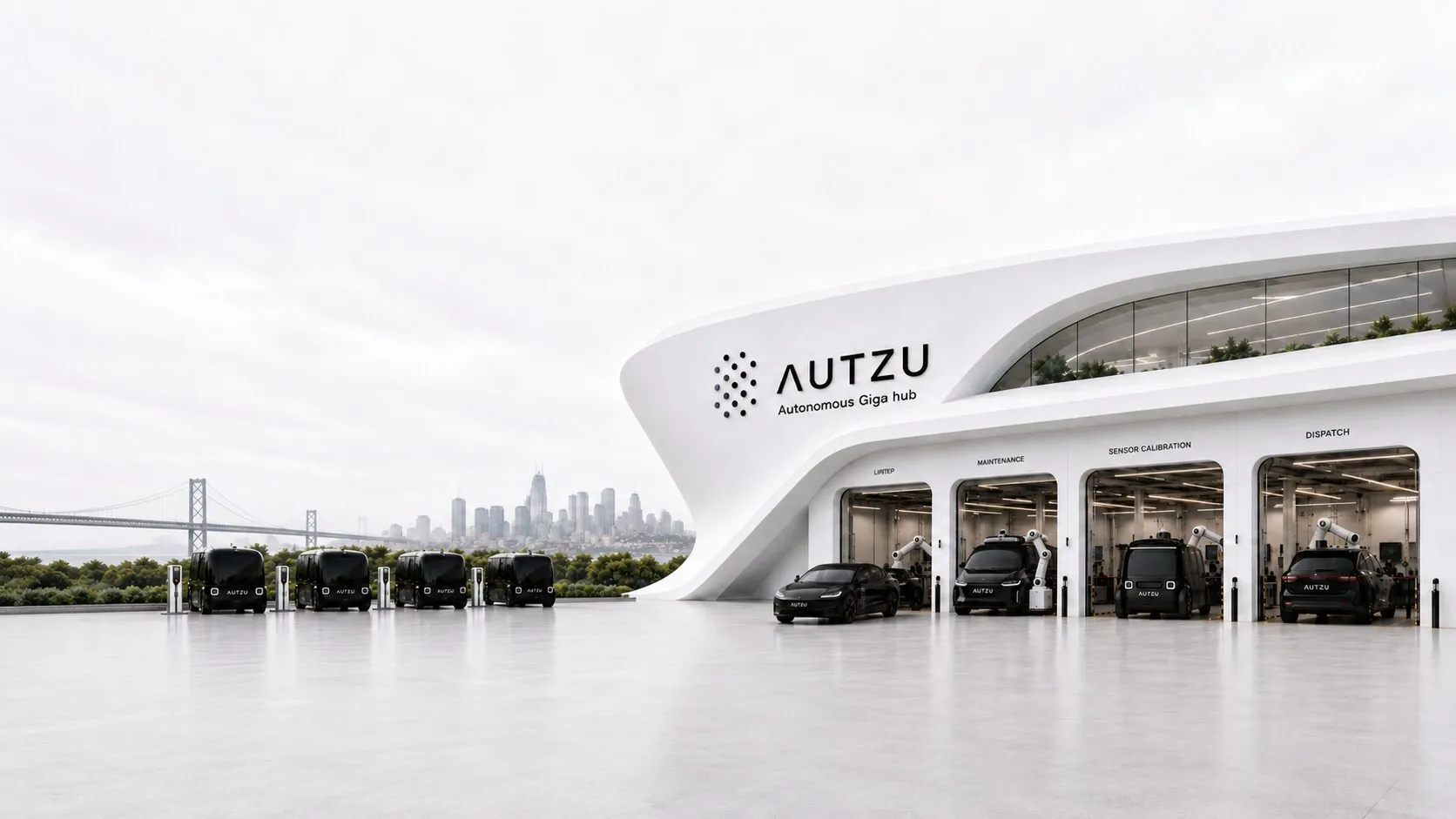
Autzu has announced a strategic shift toward autonomous mobility operations and is developing what it describes as an agnostic autonomous hub in San Francisco to support autonomous vehicle developers, robotaxi operators and fleet owners.
The company said the facility is intended to function as shared operational infrastructure for multiple autonomous vehicle platforms and mobility operators rather than serving as a closed depot for a single fleet operator.
Autzu, which was founded in 2017 as an electric vehicle fleet operator, said the initiative marks its transition toward becoming an autonomous operations company focused on infrastructure, robotics, fleet software and energy management systems for commercial AV deployment.
According to the company, the San Francisco hub will support multiple autonomy stacks, fleet models and mobility use cases from a shared operating environment.
Autzu said the planned hub capabilities will include robotaxi staging infrastructure, fleet operations software, energy and charging coordination, robotic inspection workflows, fleet readiness systems and support for autonomous sensor and chip calibration.
The company said the model is intended to reduce deployment costs and operational complexity for autonomous vehicle developers that would otherwise need to establish dedicated facilities in each market.
Jerry Jilek, who leads partnerships at Autzu, said the company sees a growing need for operational infrastructure as autonomous mobility expands beyond pilot deployments.
“Autonomous mobility is entering its Physical AI era,” Jilek said.
“The industry has made tremendous progress on autonomous driving systems, but scaling autonomy requires much more than vehicles and software. It requires operational infrastructure, robotics, energy systems, calibration capabilities, fleet readiness, maintenance workflows, compliance processes, and physical hubs that can support real-world deployment at scale,” he added.
Autzu currently operates electric rideshare fleets in San Francisco, New York City, Toronto and Ottawa, including partnerships with Uber in Canada and the United States.
The company said it plans to use its experience managing high-utilization EV fleets, charging operations and software-enabled fleet logistics as the foundation for its autonomous operations business.
Autzu said the San Francisco site is intended to serve as a blueprint for additional autonomous operations hubs in other cities as commercial AV deployment expands.
The company added that it aims to position itself as a deployment partner for autonomous vehicle developers, robotaxi platforms, mobility operators, logistics providers and municipalities.
“The future of autonomy will be won not only by the companies that build intelligent vehicles, but by the operators that can support those vehicles every day in the physical world,” Jilek said.
“Autzu is becoming the autonomous operations company that helps Physical AI move from the lab to the street, from pilot programs to commercial scale, and from one city to global deployment,” he added.