
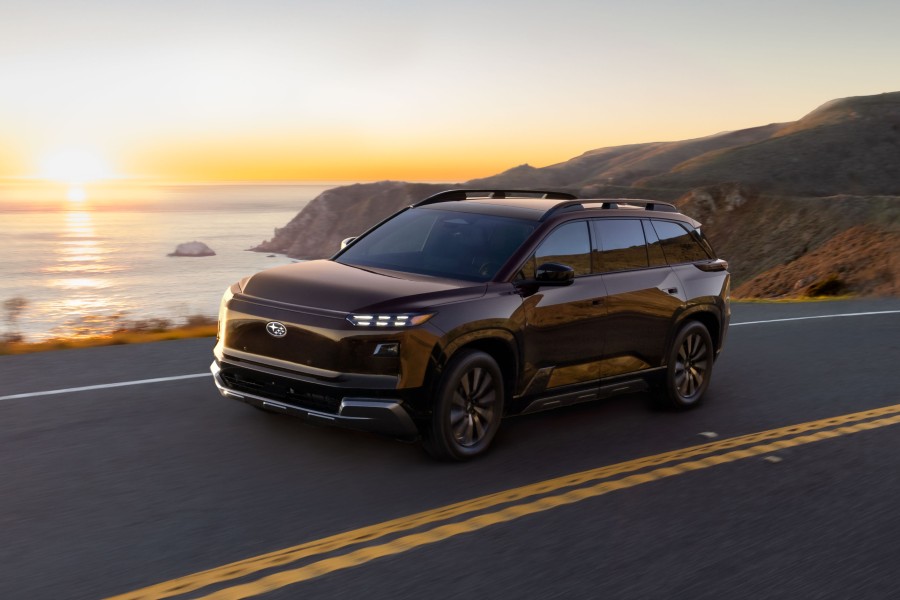
Japanese automaker Subaru has unveiled a new battery-electric SUV, the Getaway, at the New York International Auto Show, marking its latest step in expanding its electric vehicle offering in the United States.
The three-row SUV, designed to seat up to seven passengers, is scheduled to arrive at dealerships across the US by the end of 2026. The model has been developed in collaboration with Toyota and shares key technologies with the recently introduced Toyota Highlander.
Like its Toyota counterpart, the Getaway is expected to be based on a modified version of Toyota’s TNGA-K platform, originally developed for internal combustion engine vehicles but adapted to support high-voltage battery systems. Both models are equipped with battery options of 77 kWh and 95.8 kWh, although Subaru integrates its own all-wheel-drive system.
Subaru said the Getaway will offer a preliminary driving range of up to 480 kilometres. The all-wheel-drive system delivers a maximum output of 309 kW, exceeding the 249 kW output of the Toyota Highlander. No additional powertrain variants have been announced, in contrast to Toyota’s offering, which includes a front-wheel-drive option.
Charging performance is rated at up to 150 kW, enabling a 10% to 80% charge in approximately 30 minutes. Both battery configurations include preconditioning functionality to optimise charging performance. The vehicle is equipped with a North American Charging Standard (NACS) port, located on the front passenger side.
The Getaway features a minimalist exterior design and a spacious interior with flexible seating arrangements. A 14-inch infotainment touchscreen and a 12.3-inch digital instrument cluster are included. Subaru also emphasised the model’s off-road capability, highlighting 21 centimetres of ground clearance and a towing capacity of up to 1,588 kilogrammes.
The unveiling comes as Subaru reassesses its broader electrification strategy. The company said in late 2025 that it plans to reduce investment in battery-electric vehicles and increase its focus on hybrid models, although collaboration with Toyota on electric SUVs will continue.