
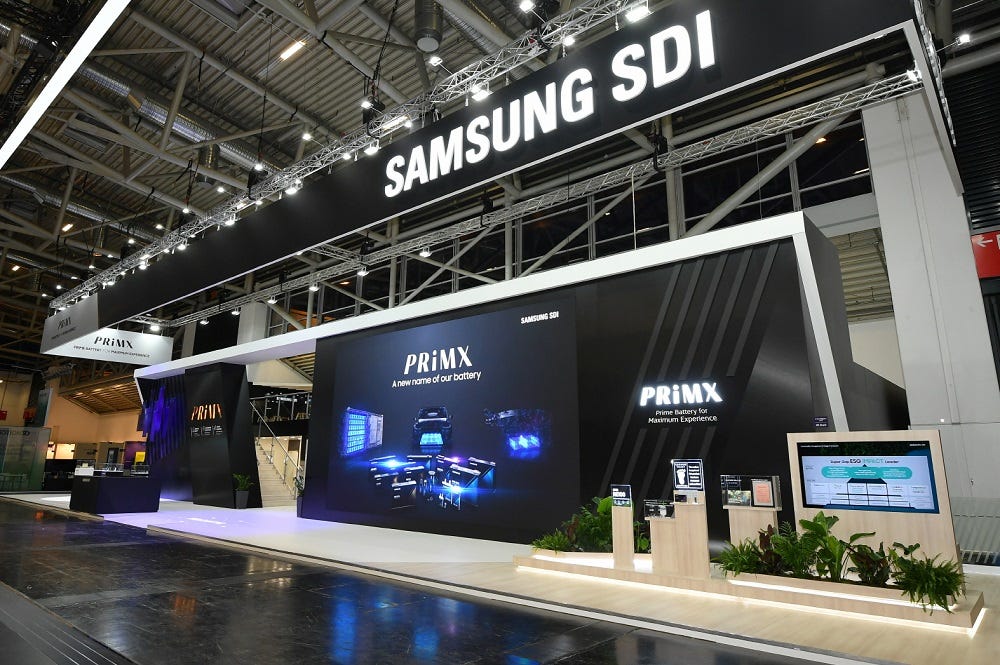
Samsung SDI said it has developed a new electrolyte designed to improve the safety and durability of lithium-metal batteries, a next-generation technology widely viewed as a potential successor to conventional lithium-ion cells.
The South Korean battery maker described the advance as a breakthrough achieved through a joint research effort involving its domestic R&D centre, its U.S. subsidiary SDI R&D America, and Columbia University. The teams created a fluorine-based gel-polymer electrolyte that forms a stable protective layer on the anode, reducing the growth of lithium dendrites—needle-like deposits that can cause internal short circuits.
Dendrite formation has long been a critical obstacle to commercialising lithium-metal batteries, limiting their lifespan to only a few dozen charge cycles in typical conditions. Yet the chemistry promises about 1.6 times higher energy density than conventional lithium-ion cells, potentially enabling longer electric-vehicle range or smaller battery packs.
“The research team significantly improved the lifespan and safety of lithium-l batteries by applying a gel polymer electrolyte,” Samsung SDI said. “By developing a fluorine-based gel polymer electrolyte that forms a stable interphase on the anode surface, the team effectively suppressed dendrite formation, a key factor that has long degraded the performance of lithium-l batteries.”
The research findings were published in Joule, a peer-reviewed scientific journal focused on energy technologies. Company executives said the publication underscores the technical credibility of the approach.
“The publication in Joule provides academic validation of our technology that improves the safety of lithium-l batteries, which had long been considered a key weakness,” said Yong Lak Joo, executive vice president and head of Samsung SDI’s R&D Center. “We will continue to accelerate the development of next-generation battery technologies based on our global research network.”
Academic collaborators also highlighted the potential commercial implications. “This study represents a major improvement in lithium-l battery performance through a new electrolyte formulation and brings commercialization of next-generation batteries one step closer,” said Yuan Yang, professor at Columbia University and co-author of the study.
While lithium-metal batteries remain in development, advances that address safety and longevity could accelerate their adoption in electric vehicles and other high-energy applications.