
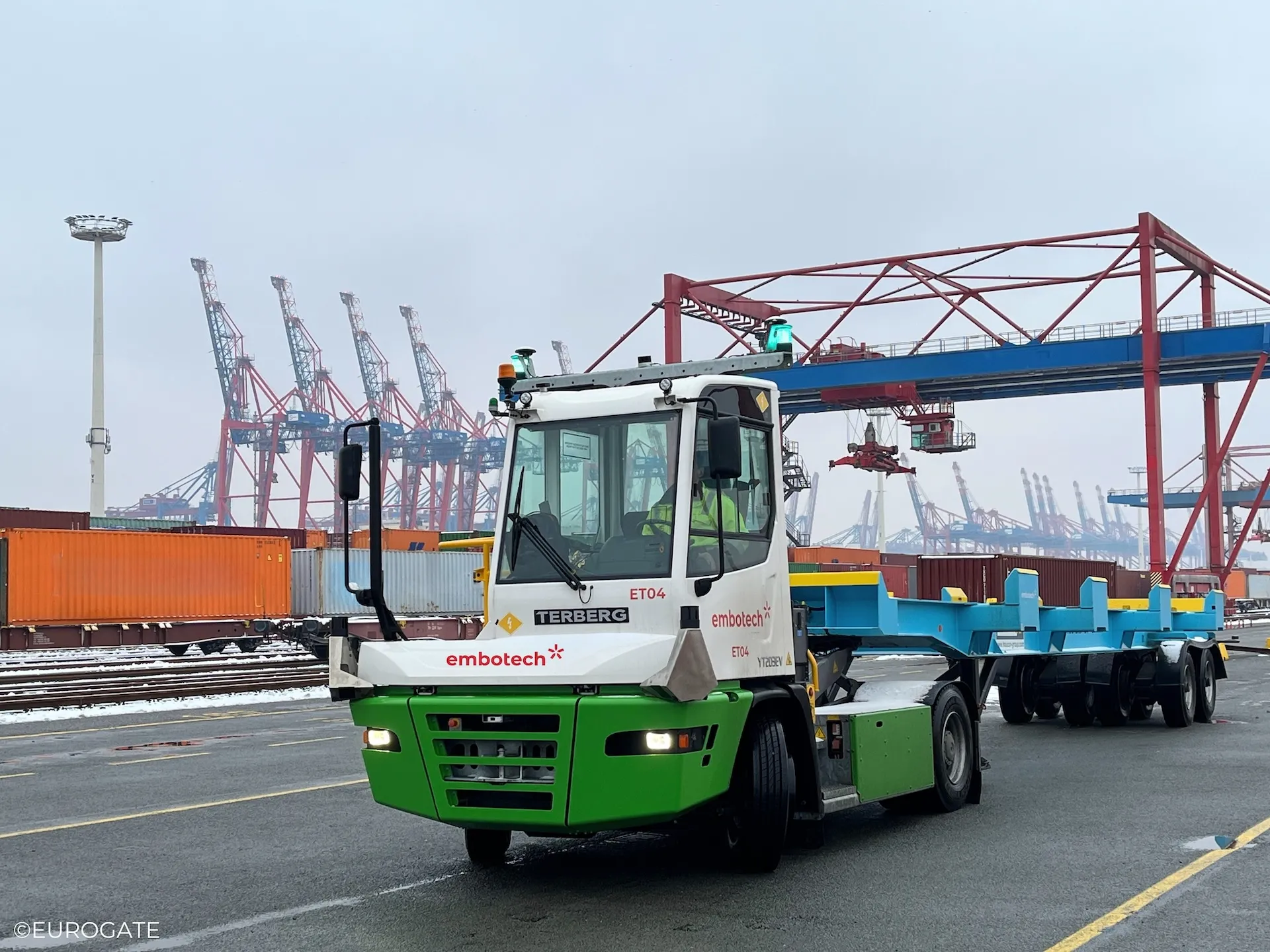
EUROGATE and Embotech have begun a six-month pilot of Level-4 autonomous terminal tractors at the EUROGATE Container Terminal in Hamburg, aiming to evaluate real-world operational performance rather than technical feasibility alone.
The project, which started in late January 2026, follows an earlier trial at Wilhelmshaven that confirmed the technical readiness of Embotech’s Autonomous Tractor Solution (ATS). The new phase focuses on measuring throughput, availability, and process stability under everyday terminal conditions.
See also: EUROGATE, Embotech Complete Autonomous Tractor Pilot at Wilhelmshaven Terminal
During the pilot, autonomous tractors will move containers between the rail terminal and the main container terminal, passing through straddle carrier interchange zones that are critical for horizontal cargo transport. According to Johannes Stelten, Managing Director of EUROGATE Container Terminal Hamburg, the previous trial validated the technology, while Hamburg provides a live commercial environment to assess performance against operational targets.
A key feature of the Hamburg project is automated tractor-trailer coupling supplied by AUCOS. The AUCOS Coup system connects air, power, and data through the trailer kingpin without manual intervention, enabling fully automated attachment and detachment. Integrated with Embotech’s vehicle automation kit, the system supports precise reversing maneuvers and trailer handling within tight terminal spaces.
See also: China’s Trunk Technology Files for Hong Kong IPO as Autonomous Truck Sales Grow
The trial also places autonomous vehicles in mixed traffic alongside human-operated equipment, including other terminal vehicles and straddle carriers. Embotech’s software dynamically plans routes and adjusts to changing conditions in real time, testing whether the system can operate safely and efficiently in complex environments.
Niklas Thomas, Head of Business Development at Embotech, said the pilot will assess performance against commercial benchmarks while demonstrating the technology’s readiness for large-scale deployment. The project represents a stepwise approach to terminal automation, moving from certification and technical validation toward full operational integration.