
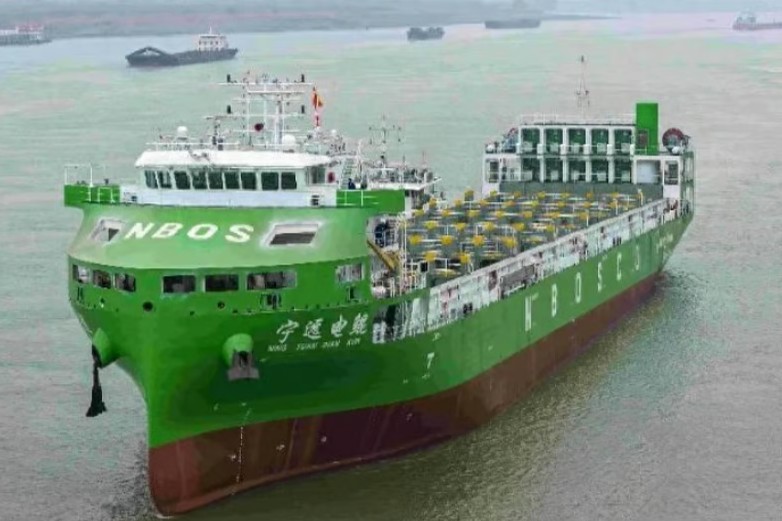
China has started sea trials of what is described as the world’s largest all-electric container ship, marking a new step in the electrification of maritime transport as the vessel prepares for commercial operations along coastal feeder routes.
The ship, named Ning Yuan Dian Kun and built by Jiangxi Jiangxin Shipbuilding, measures 127.80 metres in length and 21.60 metres in width. Designed as a 10,000-tonne class container vessel, it is currently undergoing testing in waters off Shanghai after completing earlier mooring trials. The vessel is expected to be operated by Ningbo Ocean Shipping Co., Ltd. on routes connected to the busy Ningbo-Zhoushan port.
Unlike conventional ships powered by diesel engines, the vessel uses containerised battery units as its primary energy source. Up to ten battery boxes can be installed onboard, providing a combined capacity of about 19,000 kilowatt-hours. These supply electricity to two permanent-magnet propulsion motors rated at 875 kilowatts each. The batteries can be recharged via high-capacity shore power or replaced entirely through a battery-swapping system using pre-charged units.
A photovoltaic system has also been installed to supply supplementary renewable energy during operations, though the manufacturer has not disclosed its output capacity. Developers say the vessel is equipped with advanced automation features, including real-time environmental monitoring, all-weather visual perception, route planning capabilities and autonomous collision-avoidance functions for operation in open waters.
The project follows earlier electrification efforts in China’s shipping sector, including the launch of the battery-powered Greenwater 01 container ship on the Yangtze River by China Ocean Shipping Group (Cosco) last year. That vessel has a larger battery capacity and operates on inland routes, highlighting a broader push to reduce emissions from maritime logistics.
A sister ship to the Ning Yuan Dian Kun, to be named Ning Yuan Dian Peng, is also planned. Industry observers view the ongoing trials as a key test of large-scale electric propulsion for coastal cargo transport, where predictable routes and access to port infrastructure make battery-powered shipping more feasible.