
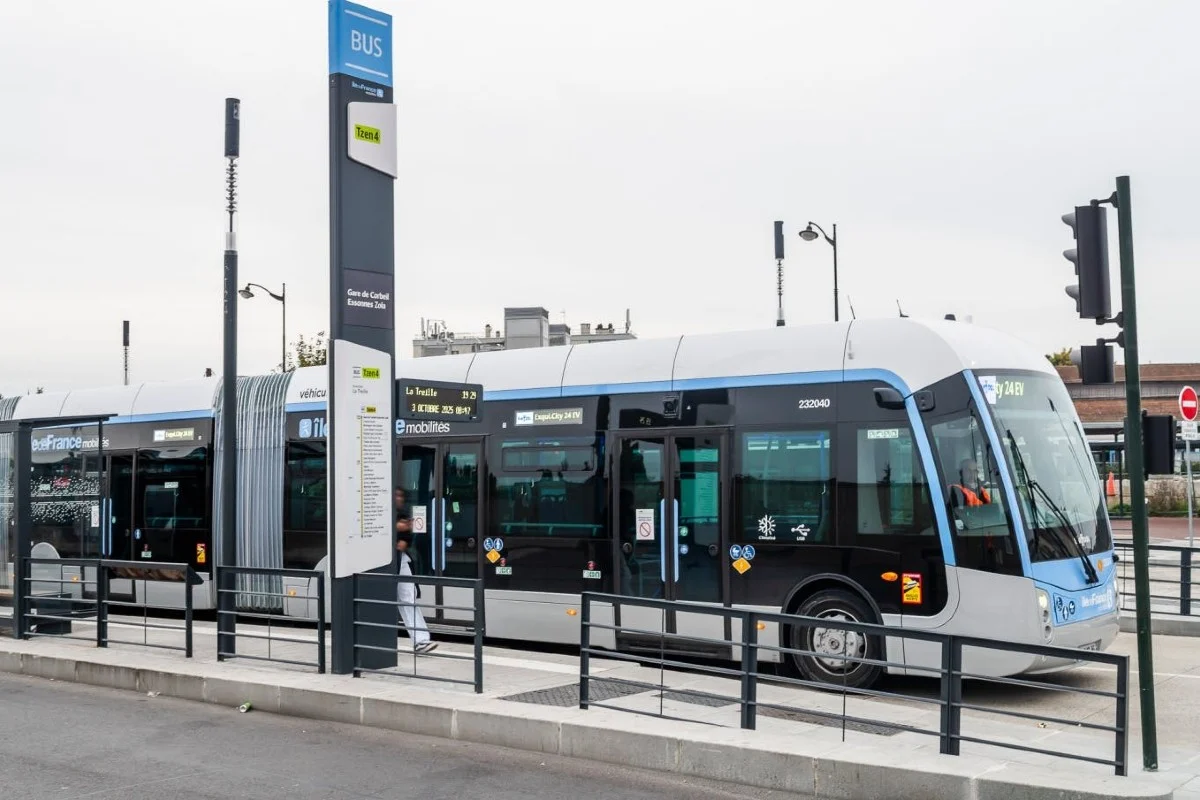
The Greater Paris transport authority Île-de-France Mobilités has launched the fully electric Tzen 4 Bus Rapid Transit (BRT) line, introducing high-capacity vehicles operating largely on dedicated lanes in the southern suburbs of the French capital.
The 14-kilometre route connects Viry-Châtillon and Corbeil-Essonnes and will gradually replace Line 402, one of the busiest bus routes in the region. Officials expect the new service to carry more than 47,000 passengers daily.
Tzen 4 is operated with 30 battery-electric double-articulated buses measuring 24 metres in length and capable of transporting about 140 passengers—significantly more than the 100-passenger capacity of the previous fleet. The vehicles combine tram-like capacity with the flexibility of buses.
The buses use battery systems supplied by Kiepe Electric and a ground-based static charging solution developed by Alstom. Along most of the corridor, vehicles run in segregated lanes and receive priority at traffic signals to improve travel times and reliability.
Originally, Belgian manufacturer Van Hool was contracted to supply the vehicles, but its bankruptcy delayed the project. Swiss manufacturer Hess subsequently took over delivery of the fleet. The buses represent the first deployment of 24-metre battery-electric double-articulated vehicles in the Paris region.
The line includes 30 newly built stations with extended platforms and modern shelters and links five municipalities in the Essonne department: Corbeil-Essonnes, Évry-Courcouronnes, Ris-Orangis, Grigny and Viry-Châtillon. Service is scheduled to run from 5 a.m. to 1 a.m., with buses arriving approximately every five minutes during peak periods.
A second electric BRT corridor, Tzen 5, is planned to connect Paris’s 13th arrondissement with Choisy-le-Roi via Ivry-sur-Seine and Vitry-sur-Seine in about 33 minutes, though it is not expected to open before 2027 or 2028.
Public authorities—including the Île-de-France region, the Essonne department, the French state and the European Union—invested nearly €123 million in infrastructure for the new line, reflecting broader efforts to expand low-emission public transport in metropolitan Paris.