
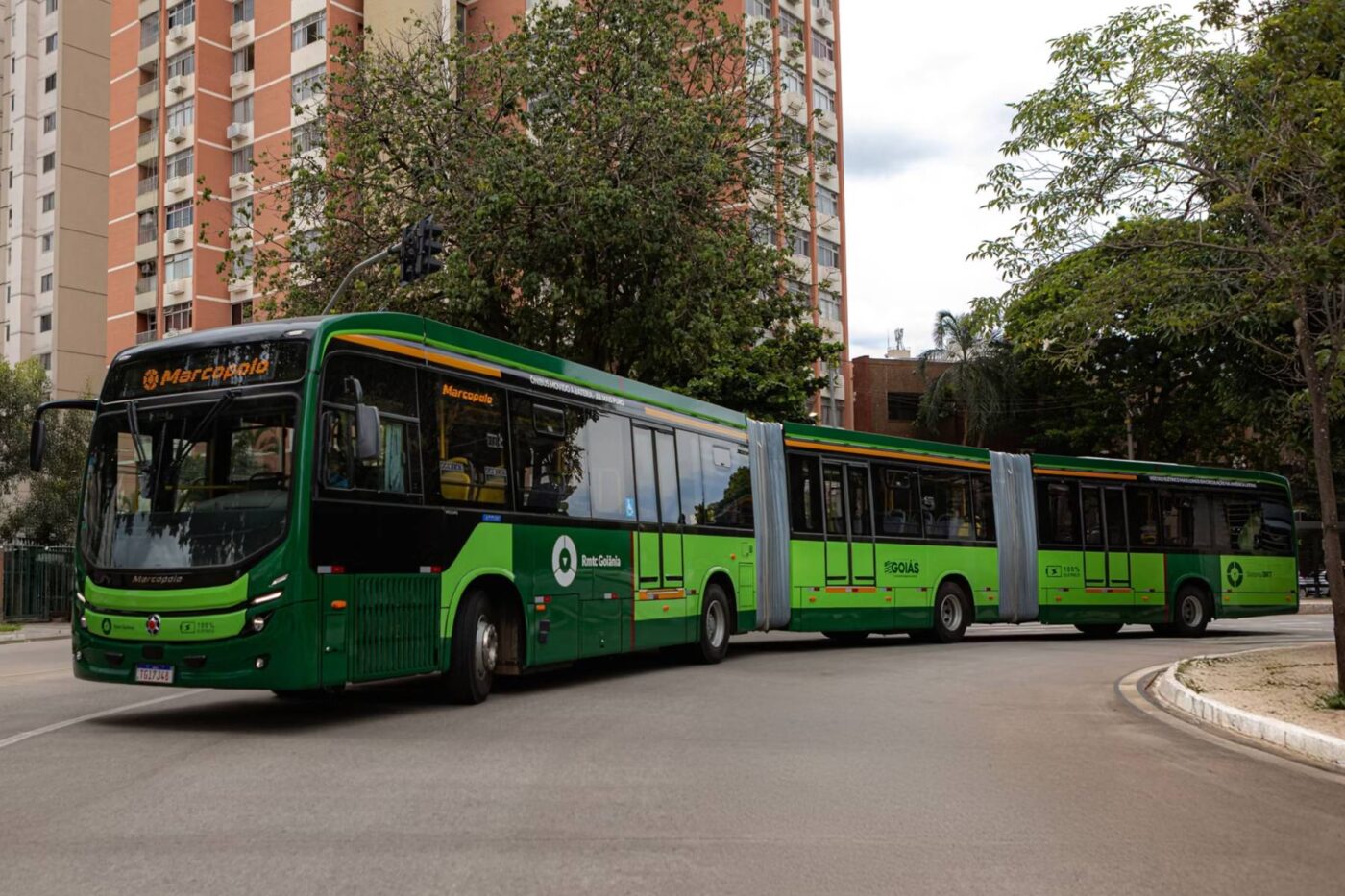
The Brazilian city of Goiânia has placed 21 electric articulated and double-articulated buses into operation, marking a new step in the electrification of its high-capacity public transport system, the city’s public operator said.
The vehicles were ordered last year from Volvo Buses and are being charged at a newly commissioned charging hub at the depot of Metrobus, which operates the city’s Bus Rapid Transit (BRT) services.
Metrobus said the depot is equipped with 23 chargers, each rated at 240 kilowatts, capable of supplying electricity to up to 46 buses simultaneously. The fleet will be deployed on Goiânia’s east–west BRT corridor, one of the city’s busiest public transport routes.
The order includes 16 articulated buses and five double-articulated units. The vehicles are the first electric articulated and bi-articulated buses to be produced at Volvo’s industrial complex in Curitiba, southern Brazil. According to the manufacturer, the double-articulated buses can carry up to 250 passengers, while the articulated versions have capacity for about 180 people.
Volvo said the buses are powered by two 200-kW electric motors, delivering a combined output of 400 kW. Battery capacity on the double-articulated buses reaches up to 720 kilowatt-hours, supported by as many as eight battery packs. The company did not disclose battery specifications for the articulated models.
“This marks a transformational moment for high-capacity urban transport,” said Andre Marques, vice president of Volvo Buses in Latin America. “Introducing the world’s first electric bi-articulated bus fleet in regular operation shows what strong partnership and a shared commitment to sustainable mobility can achieve.”
Marques added that Volvo’s collaboration with Brazilian cities has evolved over two decades. “From the first bi-articulated buses in 2005 to today’s fully electric fleet, our collaboration has consistently pushed the boundaries of modern public transport,” he said.
The deployment in Goiânia comes as Volvo expands its electric bus operations globally. The company has recently signed an agreement to supply electric buses for the 2026 football World Cup in Mexico and announced a long-range electric bus model capable of up to 700 kilometres on a single charge. Volvo is also set to deliver electric buses to Cape Town, extending its presence in emerging markets.