
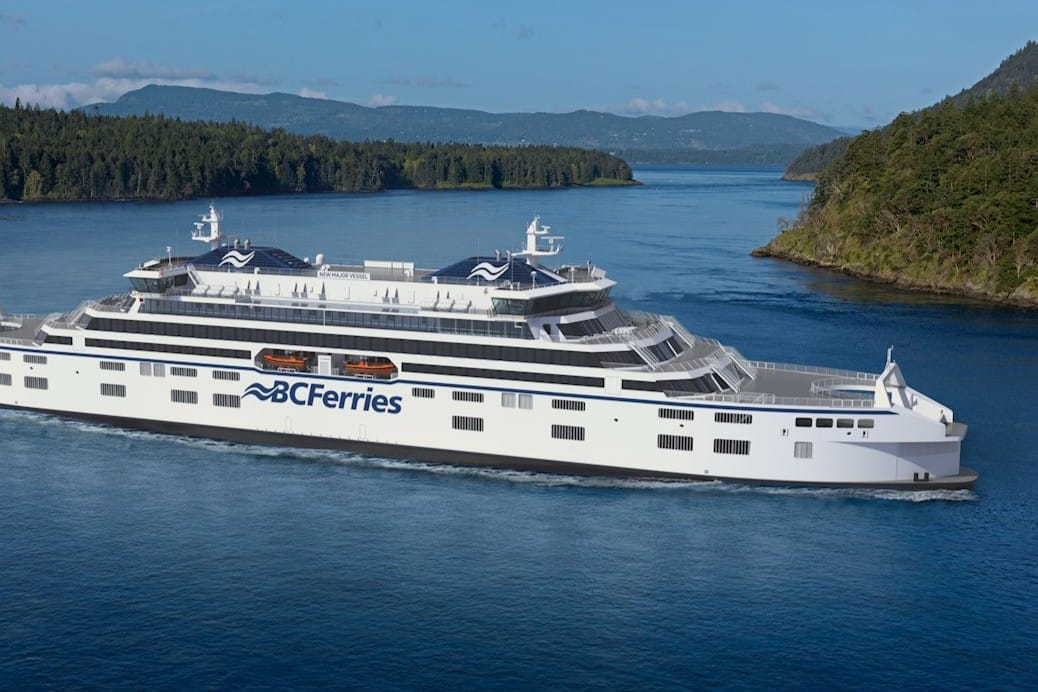
ABB has secured an order to provide energy, propulsion and control systems for four new hybrid ferries commissioned by BC Ferries, the companies said. The vessels will be built by CMI Weihai and are scheduled for delivery starting in 2029.
BC Ferries, one of the world’s largest ferry operators, runs 47 terminals across 25 routes in Canada’s British Columbia, carrying about 9.7 million vehicles and 22.7 million passengers annually. The four vessels form part of the operator’s New Major Vessels programme and will be double-ended ferries, allowing vehicles to load and unload from both ends.
See also: Incat Trials World’s Largest Battery-Electric Ferry Ahead of South America Deployment
While detailed specifications have not yet been finalised, tender documents indicate the ferries will be about 172 metres long, with capacity for roughly 360 cars and 2,100 passengers each. They are intended to operate in the Strait of Georgia between Vancouver Island and the Lower Mainland.
The ferries will be equipped with diesel-battery hybrid propulsion systems and designed for future conversion to fully electric operation. ABB said it will supply its gearless, steerable Azipod electric propulsion system, along with its Onboard DC Grid power distribution technology, which is designed to reduce conversion losses, improve efficiency and cut emissions compared with conventional systems.
See also: CATL Targets Open-Sea Electric Vessels Within Three Years
Each vessel can be fitted with battery storage of up to 70 megawatt-hours, enabling hybrid operation using biofuel or renewable diesel and facilitating a later transition to full electric propulsion. For all-electric operation, the ferries are designed to connect to shore-based charging systems with capacity exceeding 60 megawatts, ABB said.
In addition to propulsion and power systems, ABB will deliver digital solutions to provide crews with real-time operational insights, aimed at improving safety and efficiency. BC Ferries has said the hybrid vessels are expected to significantly reduce greenhouse gas emissions, improve fuel efficiency and lower underwater noise, helping to protect marine life such as the orca populations in the region.