
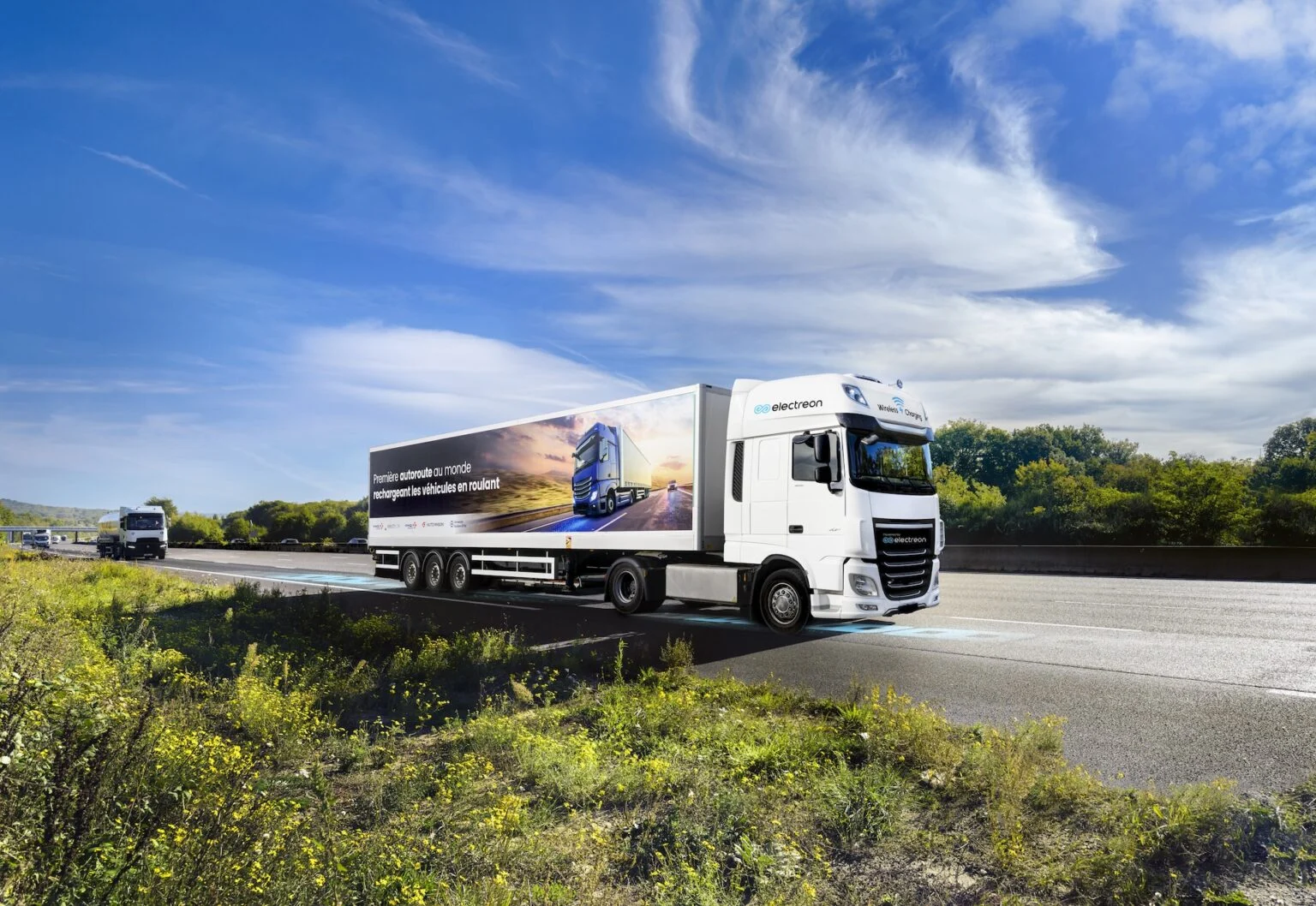
Israeli wireless charging company Electreon said its dynamic inductive charging systems are now operating with silicon carbide power modules supplied by German chipmaker Infineon Technologies, enabling high-power electricity transfer to vehicles while in motion.
The companies said Infineon’s custom-built 2000-volt silicon carbide EasyPACK power modules allow the system to deliver continuous charging power of around 200 kilowatts, with peak output surpassing 300 kilowatts. The performance was recently validated during live testing on France’s A10 motorway near Paris, where wireless charging coils have been installed beneath the road surface as part of a pilot led by motorway operator Vinci Autoroutes.
See also: Infineon to Supply Silicon Carbide Power Modules for Rivian’s Next-Gen R2 Electric Vehicle Platform
“Infineon’s customised SiC modules form the core of the application, efficiently converting energy from the grid to enable seamless battery charging,” the company said in a statement.
Electreon’s technology uses copper coils embedded under roadways to transmit electricity wirelessly to electric buses, trucks and passenger vehicles fitted with receiver units. Power is drawn from the roadside grid infrastructure and activated as vehicles pass over the coils, allowing charging without stopping. The system is being evaluated for potential use on motorways, toll roads, ports and airport access routes, where heavy traffic and continuous vehicle operation are common.
See also: Infineon, Visteon Partner to Advance EV Drivetrain Efficiency with GaN and SiC Semiconductors
Silicon carbide semiconductors are increasingly adopted in electric mobility due to their ability to switch at higher frequencies with lower energy losses than traditional silicon, as well as offering improved thermal performance and durability. However, industry analysts note that the technology remains significantly more costly than conventional power electronics.
“Electreon’s wireless charging system is a real game changer on the road to reducing carbon emissions in transportation,” said Dominik Bilo, Executive Vice President and Chief Sales Officer for Industrial & Infrastructure at Infineon. “By efficiently converting electrical energy, our modules enable charging while driving and are precisely tailored to Electreon’s requirements.”
See also: Infineon Launches Next-Gen Power Chips to Boost Efficiency and Performance in Electric Vehicles
Electreon and Infineon said the technology is already being deployed on test tracks in the United States, Germany, Norway, Portugal, Sweden, Italy, Israel and Japan, with further long-distance road projects under planning. In Germany, a nearly one-kilometre test section on the A6 motorway between Amberg-West and Sulzbach-Rosenberg began initial trials in October under the E|MPOWER research initiative.
“Wireless EV charging is already happening today, and Electreon is at the forefront of this transformation,” Electreon Chief Executive Oren Ezer said. “We’re using Infineon’s advanced silicon carbide technology to make in-road charging even more powerful and efficient, allowing electric buses and trucks to operate continuously without relying on traditional charging stations.”