
Tesla CEO Elon Musk said the company may need to construct its own large-scale semiconductor fabrication facility—dubbed a “Terafab”—to meet future demand for advanced chips powering its artificial intelligence and robotics ambitions.
Speaking at Tesla’s annual shareholder meeting on Thursday, Musk said that global chipmakers will not be able to meet Tesla’s long-term requirements. “One of the things I’m trying to figure out is — how do we make enough chips?” he told investors. “Even when we extrapolate the best-case scenario for chip production from our suppliers, it’s still not enough.”
See also: Tesla’s FSD Version 14 May Allow Texting While Driving, Says Musk
Tesla currently sources chips from Taiwan Semiconductor Manufacturing Co. (TSMC) and Samsung Electronics, but Musk said internal projections suggest that the company’s growing AI compute and vehicle autonomy programs could soon outpace available supply. He outlined a potential capacity goal starting at 100,000 wafer starts per month, scaling up to one million—a level comparable to leading global foundries.
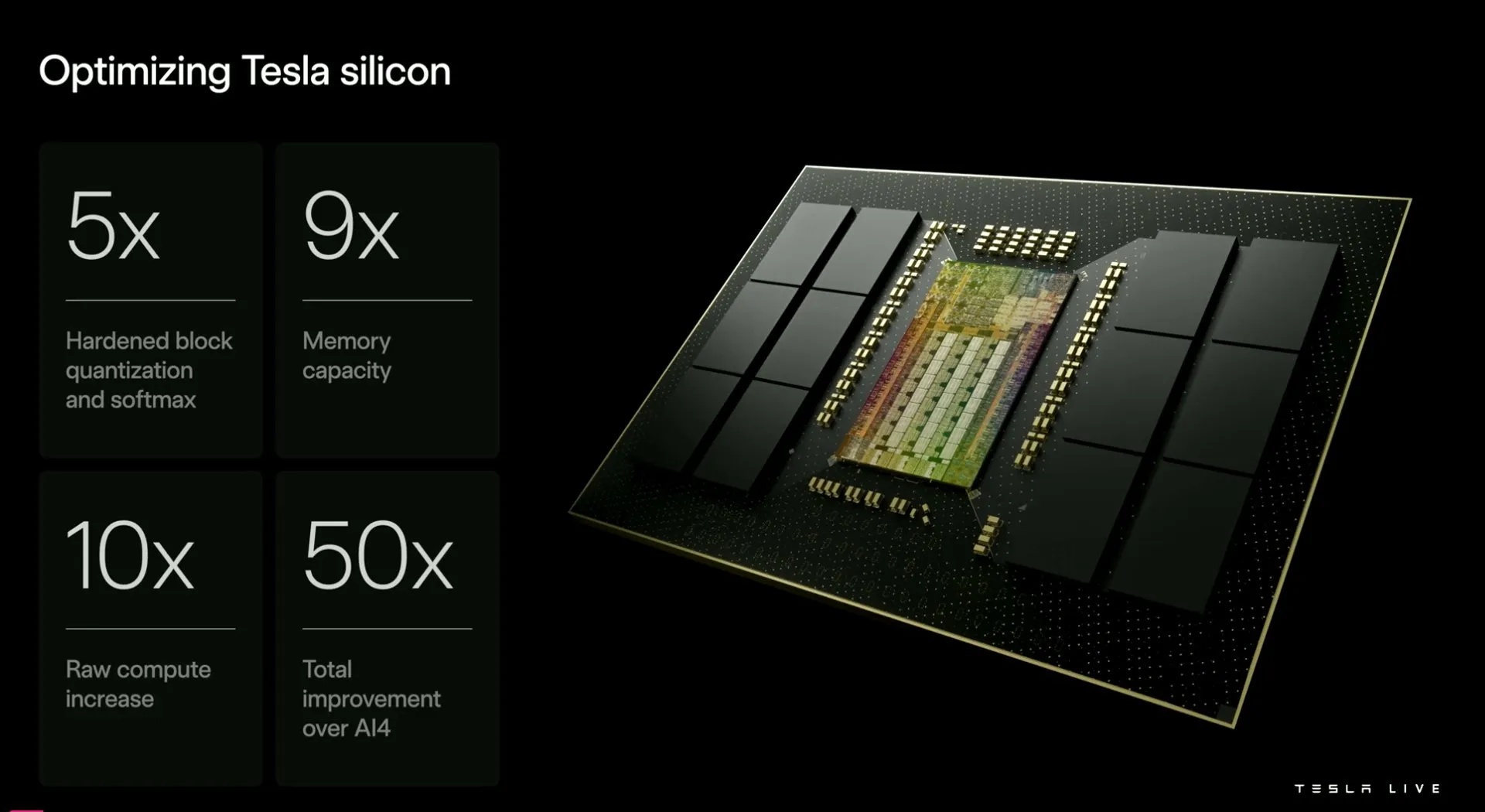
The initiative would mark a major strategic shift for Tesla, positioning it among the world’s semiconductor producers. Musk said Tesla’s next-generation AI5 chip, designed for autonomous driving and robotics applications, will begin low-volume production in 2026, with mass output in 2027. A sixth-generation AI6 chip is already in development, expected to double the performance of its predecessor when it launches around mid-2028.
See also: Tesla Unveils Updated Semi Truck Design Ahead of Full-Scale Production
Musk emphasized that the company’s custom silicon would deliver strong efficiency advantages. He said the chips would be “inexpensive, highly efficient,” costing about one-tenth of Nvidia’s Blackwell platform while using roughly one-third of its power.
In a notable development, Musk also revealed that Tesla is in early discussions with Intel about potential collaboration. “We might do something with Intel,” he said, describing the talks as “worth exploring.”
See also: Tesla Targets 50% Production Increase by 2026 as Musk Says Full Self-Driving Nears Readiness
The move comes as Tesla prepares to launch its fully autonomous Cybercab in April, which will rely on the company’s current AI4 hardware. The proposed Terafab, if realized, would underpin future vehicles and robotics systems as Tesla seeks greater control over its AI supply chain.