
The Government of Newfoundland and Labrador will provide CAD 3.8 million ($2.8 million) to expand the province’s electric vehicle (EV) charging network, with Newfoundland and Labrador Hydro (NL Hydro) adding a further CAD 463,000 in support.
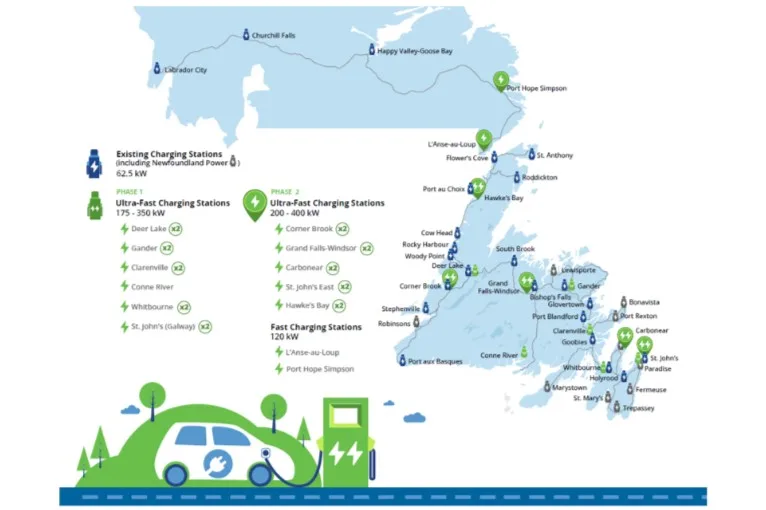
The funding, announced in Budget 2025, allocates CAD 1.9 million each for 2025-26 and 2026-27. The expansion will include four new fast chargers of up to 120 kW in L’Anse-au-Loup and Port Hope Simpson in 2026, the first of their kind in Southern Labrador. Ten additional ultra-fast chargers with up to 400 kW capacity will also be installed that year in St John’s East, Carbonear, Grand Falls-Windsor, Corner Brook and Hawke’s Bay.
“There are now 1,700 battery-electric vehicles in Newfoundland and Labrador – a 1,400 per cent increase over the past decade,” said Scott Reid, Minister of Environment and Climate Change. “Increasing access to ultra-fast chargers across the province ensures we have the necessary infrastructure to accommodate the growing EV community and goes hand-in-hand with our commitment to lower greenhouse gas emissions, reduce our carbon footprint and work collaboratively with our partners to create a greener transport sector.”
Jennifer Williams, President and CEO of NL Hydro, said growing demand underlined the importance of the investment. “With 21 electric vehicles in our fleet, Hydro is proud to support electric vehicle ownership in our province, and with more than 90 per cent renewable electricity generated in Newfoundland and Labrador, this is a great place to drive electric,” she said. “Last month, our charging network set a record for monthly usage, reaching more than 2,800 sessions. The addition of these ultra-fast chargers is the next frontier for EV travel in our province—cutting charging time in half, reducing wait times, and contributing to a more sustainable future for Newfoundland and Labrador.”
The project builds on 11 ultra-fast chargers funded through Natural Resources Canada’s Zero Emission Vehicle Infrastructure Program (ZEVIP), scheduled for completion by the end of 2025. When complete, the province will host 62 public fast chargers, including 21 ultra-fast units, alongside more than 220 Level 2 charging ports at government, commercial and private sites.