
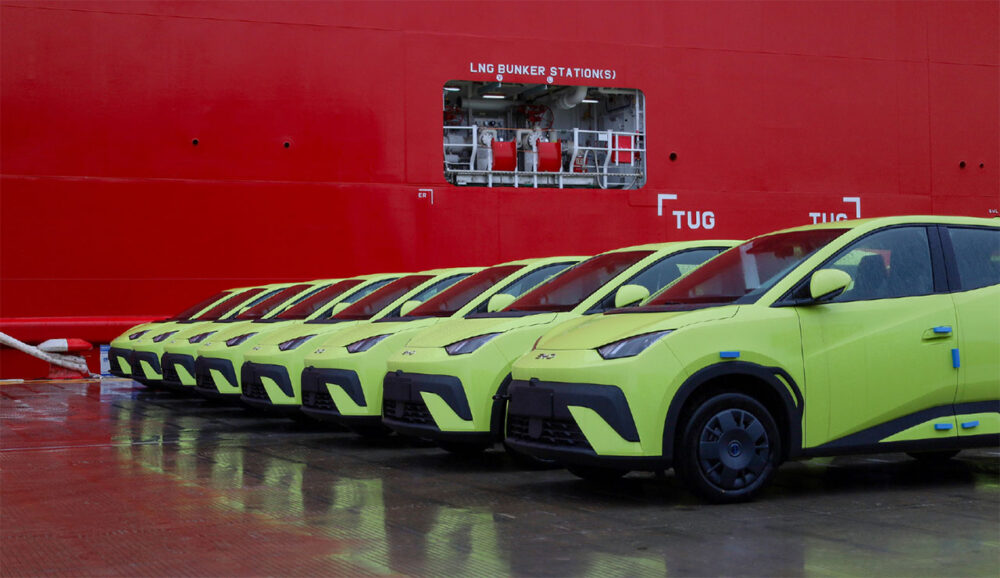
Chinese car makers are increasing their presence in Europe, with executives emphasizing long-term plans to establish local production and tailor vehicles to European customers, highlighting a shift from earlier struggles in the region.
At the IAA Mobility auto show in Munich this week, Chinese automakers, facing intense competition and margin pressure in their domestic market, showcased their latest electric vehicles (EVs) for Europe. GAC displayed its Aion V electric SUV, set to launch in Poland, Portugal, and Finland this month, and the Aion UT, which will go on sale in Europe next year.
“Everything we do starts with the needs of European users,” said GAC president of international operations Wei Haigang. “That means being in Europe, for Europe, accelerating steps towards localized production.”
Other Chinese brands including Hongqi, Chery, and Changan echoed a similar approach, emphasizing Europe-focused strategies. BYD’s executive Stella Li underscored the company’s commitment, stating, “We are in Europe to stay,” as the automaker prepares to launch production at its Hungary plant by year-end.
Chinese brands are gaining traction in Europe. Data from JATO Dynamics shows their market share nearly doubled year-on-year to 4.8% in January-July 2025. Analysts at McKinsey project Chinese automakers could capture a 14% share within a decade, approaching the level held by Japanese automakers and outpacing Korean competitors.
Xpeng vice chairman Brian Gu highlighted the company’s long-term plans, noting the opening of a research and development centre in Munich this week, aimed at “building for the long-term future with more local investments.” Similarly, Hongqi’s global design chief Giles Taylor said the brand’s European R&D centre, operational for seven years, is “focused on developing cars that will take on the European brief and reach out to European customers.”
Despite the expansion, industry analysts caution that most Chinese vehicles in Europe remain adaptations of domestic models rather than purpose-built European designs. Pedro Pacheco, vice president of research at Gartner, said, “Where is that differentiation to suit the taste of the European consumer? That’s what is missing.” He noted that major growth in Europe will require models designed specifically for local drivers, akin to Toyota’s approach with the Yaris in 1997.
The surge of Chinese EVs into Europe marks a significant shift in the global automotive landscape, as companies seek new markets amid domestic price wars and restricted access to the United States, the world’s third-largest car market.
Source: Reuters