
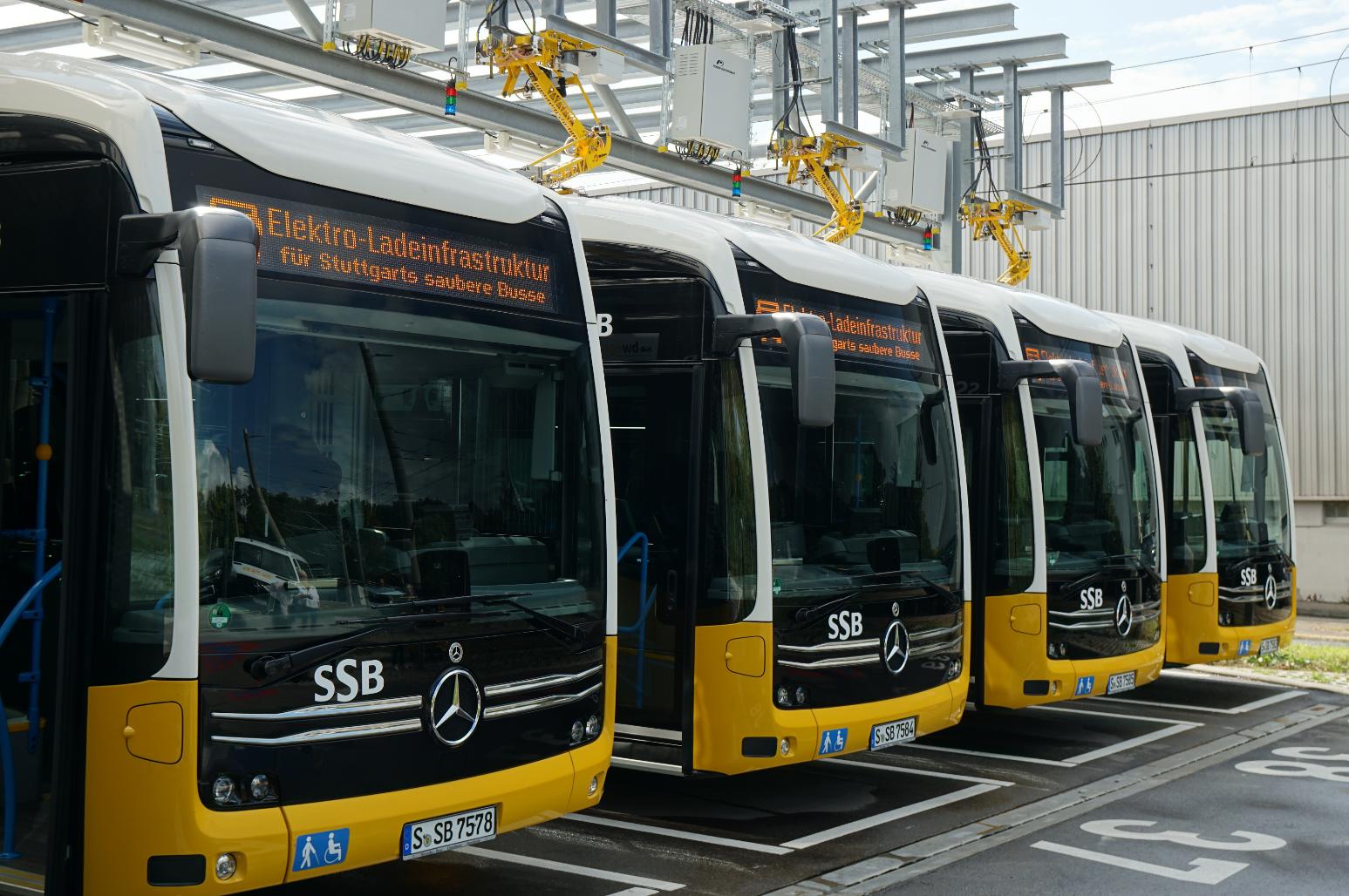
Stuttgart’s public transport operator SSB has opened a new charging hub for electric buses at its Möhringen depot, a step towards the city’s goal of electrifying all central bus routes by 2027.
The installation, put into service on September 4, includes 28 charging points with a capacity of up to 180 kW each. Daimler Buses acted as general contractor, working with Daimler Buses Solutions GmbH, Omexom and Power Electronics. The state of Baden-Württemberg supported the project with around €13 million under the German Municipal Transport Financing Act (LGVFG).
“The construction of the charging infrastructure for SSB in the immediate vicinity of our company headquarters here in Stuttgart-Möhringen is something special for us. With our complete package of charging points, electric buses and services, we are supporting SSB in advancing the electrification of local public transport in our metropolitan region, and thus becoming a role model for public transport operators in many other cities,” said Till Oberwörder, CEO of Daimler Buses.
“The state capital of Stuttgart has set itself the goal of using emission-reduced electric buses on all city centre scheduled service bus lines by 2027. For SSB, the switch to locally CO2-free buses is the biggest transformation in nearly a hundred years of scheduled bus services in Stuttgart,” said Thomas Moser, Chair of the Board and Technical Board of SSB. “What we can jointly achieve by replacing around 80 diesel buses through procurement of new electric buses, including charging infrastructure, in terms of advantages and the favourable image of future-oriented ‘green’ public transport sends out a clear signal.”
By April 2025, Daimler Buses had delivered 20 Mercedes-Benz eCitaro G articulated and fuel cell buses with NMC3 batteries to SSB. Another 43 buses, some with the newer NMC4 generation, will be delivered by October 2026. Fuel cell versions feature hydrogen tanks with a total capacity of 30 kilograms, enabling operation with hydrogen as a range extender.
The new system allows up to 28 buses to charge overnight at the depot using pantographs that lower onto charging rails mounted on bus roofs. Depending on the state of charge, power of up to 180 kW can be transmitted at 720 volts. Load management software is used to optimise charging across the fleet.
In addition to supplying charging equipment, Daimler Buses provided steelworks, electrical installation and the Sinos charging management system. A three-year service agreement includes spare parts, safety inspections and a 24/7 support hotline.
SSB is also working with Daimler Buses on a second charging hub in Stuttgart-Gaisburg with 37 charging points. Once both depots are complete, a total of 65 buses will be able to charge overnight. Intermediate charging points along city routes are also planned.
The state has allocated more than €24 million to support the two depot projects, along with about €3 million for new battery-electric buses in 2025.