
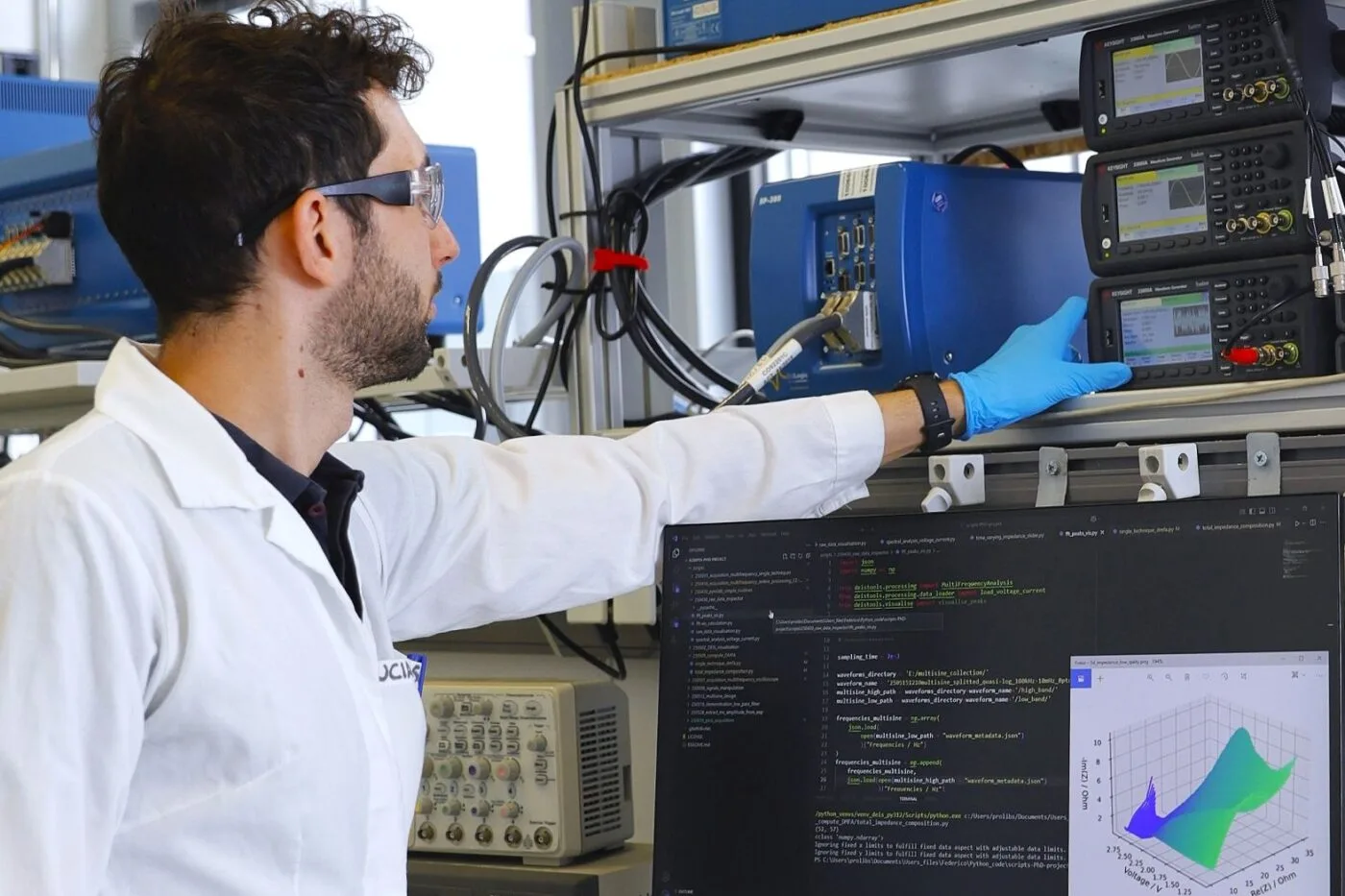
Germany’s Fraunhofer Institute for Manufacturing Technology and Advanced Materials (IFAM) has developed a real-time impedance spectroscopy method for lithium-ion batteries in electric vehicles, enabling dynamic monitoring of battery health during operation to improve safety and extend service life.
The new system, led by researcher Fabio La Mantia, measures a battery’s impedance — a key indicator of state of charge, state of health and internal safety — without the need for the vehicle to be at rest. Conventional impedance testing can take up to 20 minutes and requires the battery to be idle, but the Fraunhofer method allows instant readings while the battery is charging or discharging.
“This opens up new possibilities for optimising battery management, thereby extending the batteries’ lifespan,” said Hermann Pleteit, head of the project. “It also paves the way for these batteries to be used in safety-critical applications.”
The approach overlays normal battery currents with a multi-frequency test signal, sampling voltage and current up to one million times per second. High-resolution data is processed in real time, enabling battery management systems to detect localised overheating and shut down or limit affected cells before damage occurs, without relying on slower external temperature sensors.
Fraunhofer IFAM said the method could also allow EV chargers to adjust charging speed dynamically based on battery stress levels, supporting both ultra-fast charging and slower, wear-minimising charging cycles. Beyond EVs, the technology could be applied in aviation, maritime transport, and renewable energy storage systems, and is compatible with lithium-ion, solid-state, sodium-ion, lithium-sulphur and other emerging chemistries.