
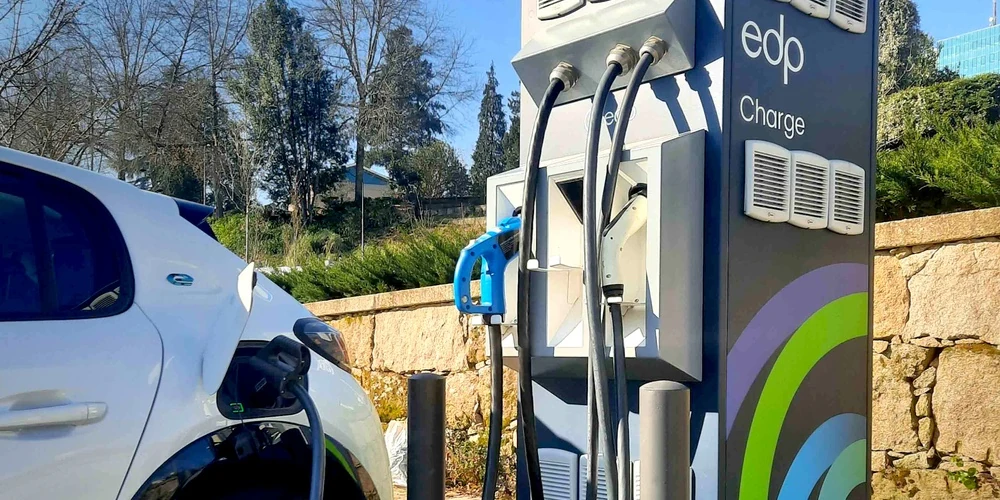
Portugal’s Council of Ministers has approved a new legal framework for electric mobility, removing the requirement for drivers to hold contracts with energy suppliers, in a move designed to simplify charging and promote market liberalisation.
The Regime Jurídico da Mobilidade Elétrica (RJME), part of the State Reform programme, will allow ad hoc charging sessions and direct payment using bank cards or QR codes. “Implementing a more efficient model, with fewer intermediaries and therefore fewer fees, is one of the key aspects of this regime. The government wants to bring more transparency to the sector, ensuring users have a clear and understandable invoice when charging their vehicles,” said Minister of Infrastructure and Housing Miguel Pinto Luz.
The updated law requires charging points rated at 50 kW or higher to offer bank card payments, while lower-powered chargers must provide alternative electronic methods, such as QR codes. Public charging locations will be required to display clear pricing information, similar to fuel prices at petrol stations. “The new electric mobility regime promotes the liberalisation of the sector, enabling an increase in the number of charging stations. With more competition, this is expected to lead to reduced costs and improved price transparency, particularly on motorways,” said Minister for Environment and Energy Maria da Graça Carvalho.
Charge point operators will no longer be obliged to connect to a centralised national platform such as Mobi.E and will have the freedom to adopt independent business models, including the use of renewable energy sources like solar power. Tesla, responding to the draft bill earlier this year, stated: “After 4.5 years, great progress in unblocking charging investment and driving EV adoption in Portugal.” The new rules include a transitional period until Dec. 31, 2026, and align with the EU’s Alternative Fuels Infrastructure Regulation (AFIR) requiring open access to charging without mandatory contracts.