
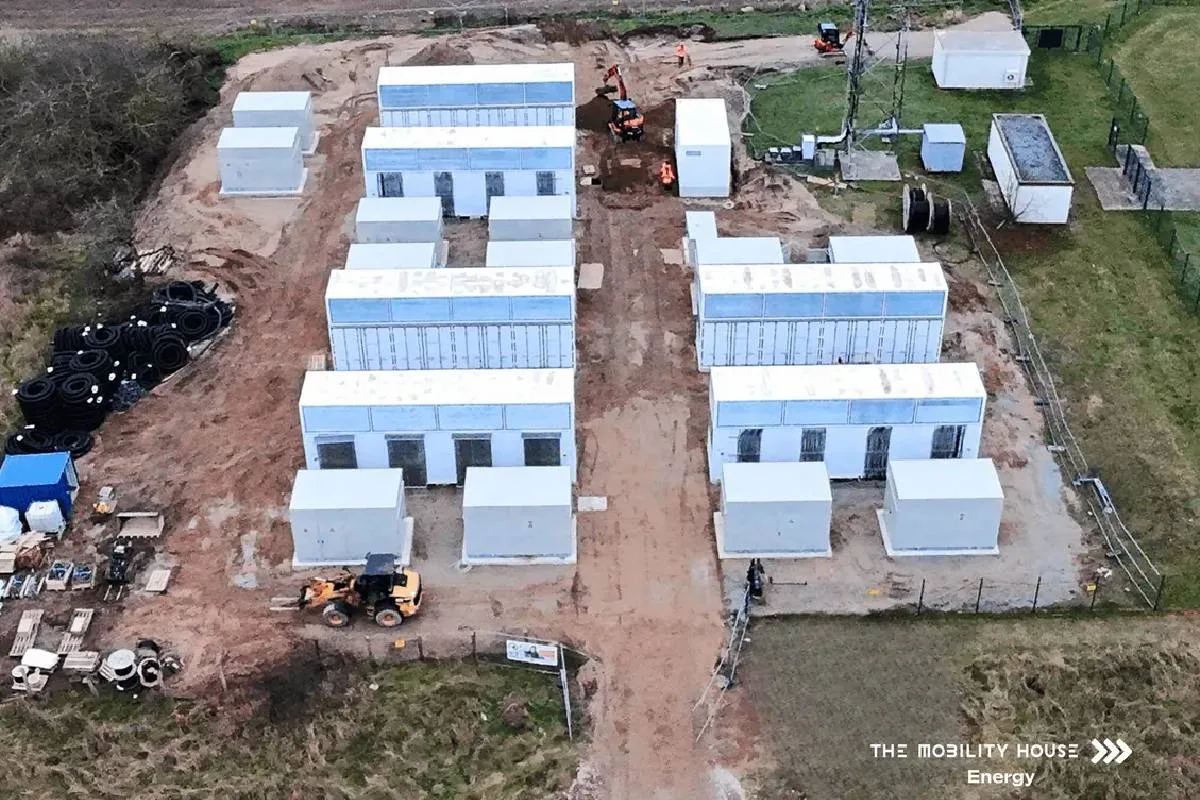
German energy technology firms Fenecon and The Mobility House are planning a large-scale battery storage facility in Grevesmühlen, northeastern Germany, with a capacity of 48 megawatt-hours (MWh). The installation, expected to go online in the second half of 2025, will use only new but unused electric vehicle (EV) traction batteries.
The batteries, described as high-quality but obsolete due to factors such as model changes or production surplus, will be sourced from various manufacturers. The facility will be connected to a local substation under construction by utility company E.DIS Netz GmbH in Mecklenburg-Western Pomerania.
See also: Schneider Electric and The Mobility House Collaborate on EV Charging Solutions for US Fleets
Preparations for the project are nearly complete, the companies said. The initiative follows a similar 8 MWh pilot storage system previously launched in North Rhine-Westphalia. Fenecon and The Mobility House also operate container-based storage systems in Iggensbach, Germany, and Greenville, United States.
“These very high-quality and long-lasting battery packs, which are not installed in the vehicle due to model changes, surplus production or missed car sales plans, are thus used sustainably in the sense of a circular economy,” the companies said in a joint statement.
The Mobility House plans to market the standardised battery systems using its internal software tools to optimise performance. “Based on its many years of expertise and intelligent marketing algorithms that minimise battery ageing and maximise economic efficiency,” the company said.
See also: The Mobility House Partners with Monta to Streamline EV Fleet Charging and Billing
Fenecon CEO Franz-Josef Feilmeier noted the potential of repurposed batteries to address inefficiencies in the market. “In Germany, more brand-new and high-quality electric vehicle batteries, which have unfortunately become obsolete, are currently thrown into the shredder every year than batteries are installed as part of large-scale storage systems,” Feilmeier said. “Our mission and that of our committed partners and customers is to utilise these high-quality batteries in the energy market as part of Made-in-Germany stationary storage systems.”
Separately, The Mobility House has also formed a joint venture with the Green Energy Storage Initiative to develop and operate storage systems with a planned capacity of 250 MW, expanding later to 500 MW.