

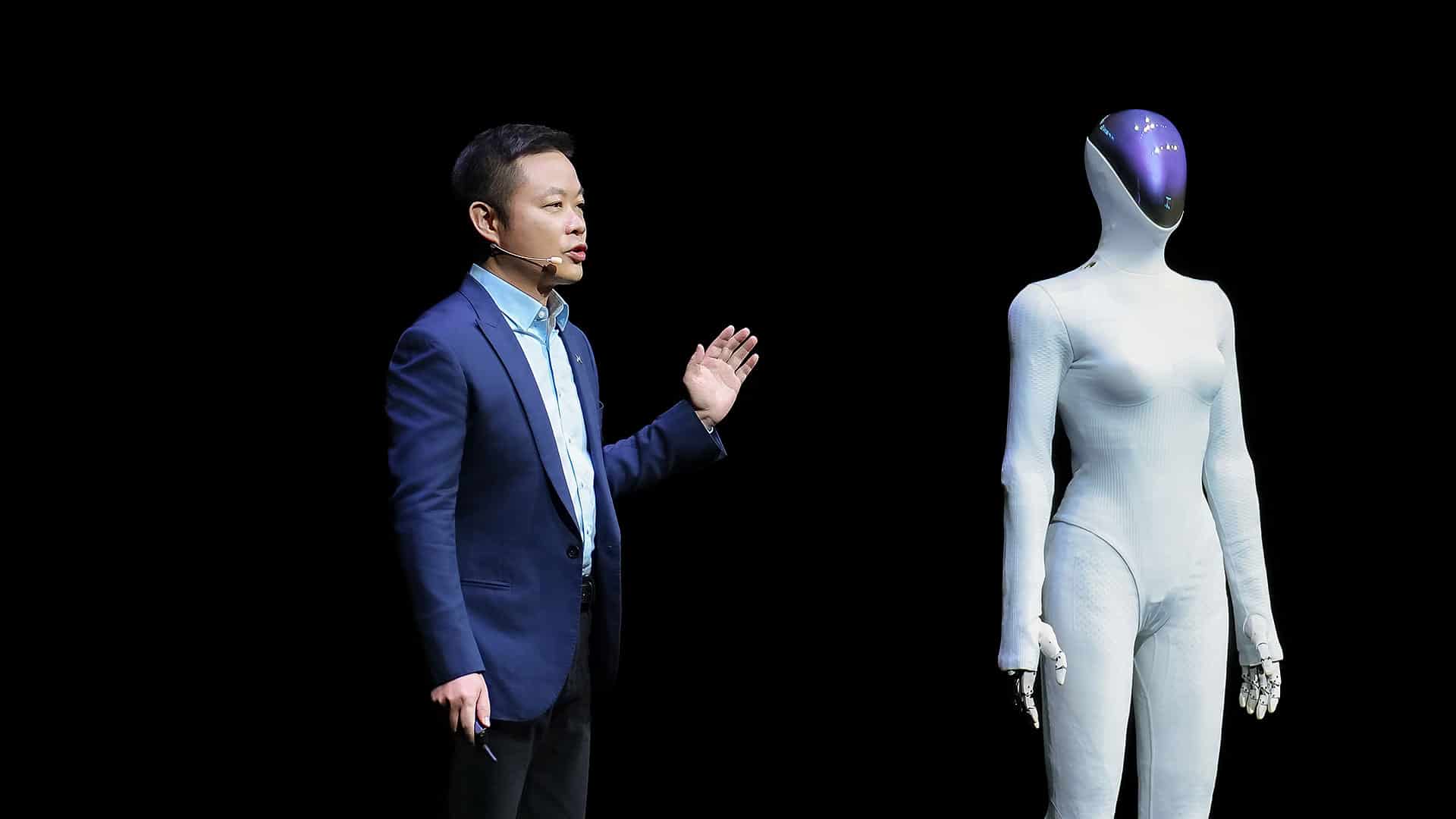
Xpeng introduced its next-generation Iron humanoid robot at the 2025 Xpeng AI Day in Guangzhou, underscoring the Chinese electric vehicle maker’s deepening investment in artificial intelligence and robotics. The upgraded Iron showcased fluid, human-like motion in a live catwalk demonstration, reflecting major advancements in balance, posture, and movement realism.
Xpeng Chairman and CEO He Xiaopeng said the company’s R&D team achieved Iron’s “light and gentle stride” by adding passive degrees of freedom at the toes, enhancing its natural walking dynamics. The company first unveiled the Iron robot in November 2024, standing 178 cm tall and weighing 70 kg, designed to closely resemble a human form.
See also: Xpeng to Launch Three Robotaxi Models in 2026, Featuring 3,000-TOPS In-House Chips
The new-generation Iron features a humanoid spine, bionic muscles, flexible skin, and a 3D curved display on its head, along with a hand offering 22 degrees of freedom. It is powered by three in-house developed Turing AI chips, delivering 2,250 TOPS of computing power, and integrates Xpeng’s second-generation VLA (Vision-Language-Action) model for adaptive, real-time learning.
The system enables Iron to handle complex tasks such as conversation, walking, and physical interaction. Its all-solid-state batteries provide a lightweight structure, higher energy density, and improved safety performance.
See also: Xpeng Expands Global Presence with Entry into Four New Markets
Mr. He said Iron will initially be deployed in commercial service environments, where its design allows rapid adaptation “like a human” across various industries. Xpeng also announced the launch of Iron’s Software Development Kit (SDK) to support collaboration with global developers in building an ecosystem for humanoid robot applications.
In a key partnership, Baoshan Iron & Steel (Baosteel) will integrate Iron into its industrial operations to explore applications in factory inspection and automation. Xpeng aims to begin mass production of advanced humanoid robots by the end of 2026, signaling its ambition to extend beyond electric mobility and into intelligent robotics at scale.