
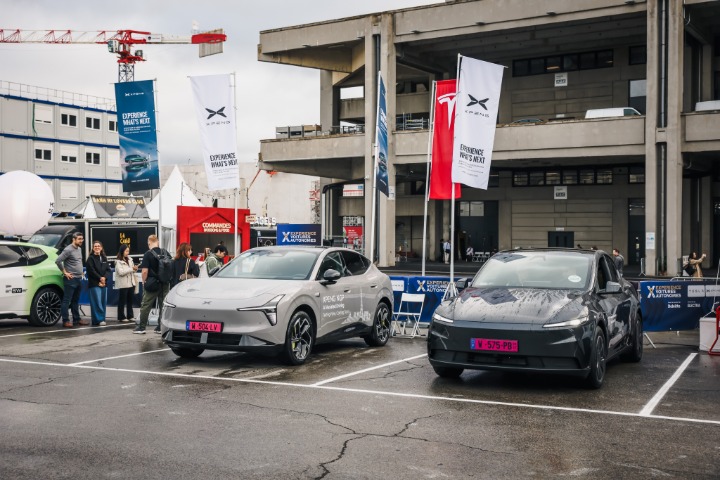
Xpeng demonstrated its NGP VLA 2.0 intelligent driving system on public roads in Paris during the Paris Motor Show 2026, offering supervised test drives to assess how the technology performs in European traffic conditions.
Tesla and Xpeng were the only two automakers among the 60 exhibitors to offer test drives on Paris streets, according to the account of the event. For Xpeng, the programme marked its first large-scale NGP test-drive event in Europe.
The drives took place as part of the motor show’s official Autonomous Lab venue. Each session lasted approximately 30 minutes and followed a pre-planned route, with a safety driver present to intervene when necessary.
How NGP VLA 2.0 Works
NGP stands for Navigation Guided Pilot, Xpeng’s intelligent driving system. VLA 2.0, short for Vision-Language-Action, is the artificial intelligence model that powers the latest version of the system.
The test vehicle was the Xpeng L03, known in China as the Xpeng Mona L03. Unlike a vision-only approach, NGP uses cameras alongside millimeter-wave radar and ultrasonic sensors to interpret its surroundings.
Xpeng had previously conducted smaller test-drive programmes in Amsterdam and Munich, including sessions in July 2026. The Paris programme provided a longer opportunity to evaluate the system in a different urban environment.
The company has also established a research and development centre in Munich, which opened in September 2025 and focuses on adapting its intelligent driving technology to European conditions.
Performance in European Urban Traffic
During the Paris test drive, NGP VLA 2.0 handled several common urban driving situations, including traffic signs, roundabouts, narrow streets, cyclists and pedestrians.
The system stopped at a zebra crossing for a family preparing to cross the road. It also navigated around a vehicle obstructing the lane and responded to cyclists sharing the urban road environment.
The test-drive account described the system’s performance around pedestrians and two-wheelers as particularly strong. It also reported that the vehicle handled nearby trucks confidently.
However, the drive did not establish that the system could operate independently in all conditions. A safety driver remained responsible for supervising the vehicle and intervened during parts of the route.
Lane Changes and Merging Remain Challenges
Lane-change decisions and merging into traffic were identified as areas for further improvement. These behaviours had also been noted during earlier testing in Beijing, where the system was described as sometimes hesitant to change lanes or take available opportunities to merge.
During the Paris session, the supervising driver made some interventions. According to the test-drive account, she considered some of these interventions precautionary rather than strictly necessary. She also took control when the vehicle returned to the exhibition venue for parking.
The observations suggest that the system’s performance in Paris was broadly consistent with its behaviour in China, although a single supervised drive is not sufficient to establish reliability across European road conditions.
The test also highlighted the importance of adapting automated driving systems to local road rules and driving practices. In particular, the vehicle’s response to pedestrians approaching crossings and its interaction with cyclists were key elements of the evaluation.
European Deployment Planned for 2027
Xpeng plans to introduce NGP to European customers in the first quarter of 2027. The initial rollout is expected to focus on models equipped with the company’s Turing chip.
These models are expected to include the P7+ sedan, X9 MPV, L03 Ultra coupe SUV and G9L seven-seat SUV. The rollout plan for vehicles equipped with Nvidia’s Orin chip has not been confirmed.
The planned launch will mark a further step in Xpeng’s effort to adapt its intelligent driving technology for markets outside China. Its performance in wider European use will depend on further localization, testing and deployment across different vehicles and driving environments.