
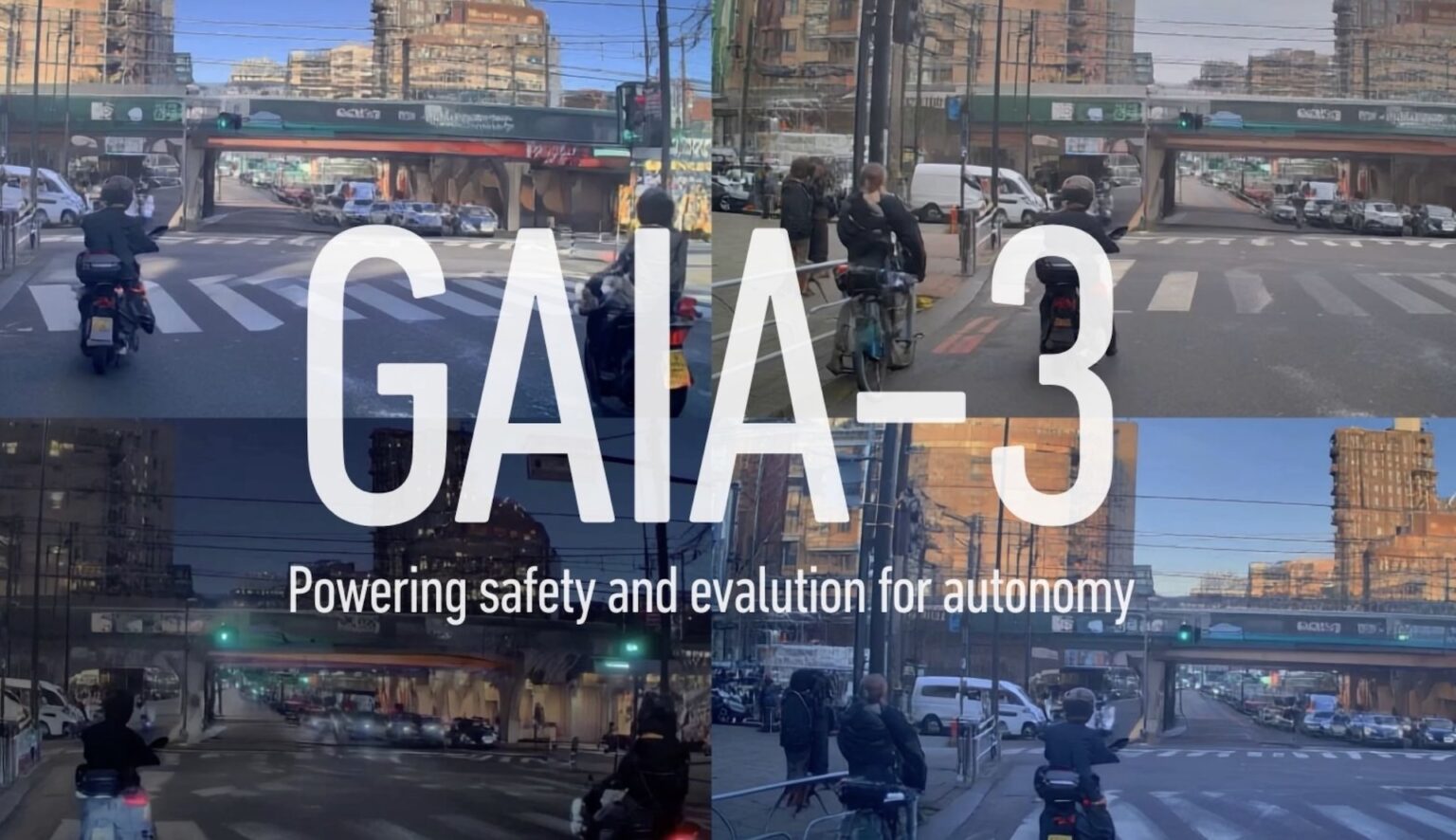
British autonomous driving startup Wayve has launched GAIA-3, a new large-scale generative world model aimed at improving how self-driving systems are evaluated through realistic simulation rather than relying solely on live road testing.
GAIA-3 features 15 billion parameters, roughly double the size of its predecessor, and has been trained on about 10 times more data spanning multiple continents, vehicle types and weather conditions. Wayve said the system is designed to generate safety-critical “what-if” scenarios, support evaluation across different vehicle platforms and test system robustness under changing visual conditions.
See also: Wayve Showcases Global Scalability of AV2.0 Embodied AI with Rapid Adaptation in Japan
The company said GAIA-3 also improves simulation efficiency by reducing synthetic test rejection rates by about fivefold and delivers more detailed visual rendering through an expanded video tokenizer that better captures physical interactions, lighting consistency and fine textures such as road signage. Early internal tests indicate that simulated performance under GAIA-3 aligns more closely with real-world driving results.
Jamie Shotton, Chief Scientist at Wayve, said the system is intended to replicate the full range of driving conditions. “The model learns to recreate the dynamics of real-world environments, from everyday traffic to rare events,” he said.
See also: UK’s Wayve Expands to Japan with New Centre to Accelerate Autonomous Driving Development
Wayve is also collaborating with the Warwick Manufacturing Group at the University of Warwick on the UK government-funded DriveSafeSim project, which aims to validate whether generative world models such as GAIA-3 can be used for formal safety evaluation of automated driving systems.
The launch follows a period of rapid expansion for the London-based company. Wayve previously acquired German data quality specialist Quality Match to improve the accuracy and safety of the datasets used to train its AI driving systems. The deal added around 20 employees to Wayve’s operations and expanded its engineering presence in Germany, where it recently opened a testing and development hub near Stuttgart. Quality Match founder Daniel Kondermann has joined Wayve as Director of Data.
See also: Nissan to Launch Next-Generation ProPILOT with Wayve AI and LiDAR in Japan by FY27
Investor interest in Wayve has also intensified. In September, Nvidia was reported to be considering a strategic investment of about $500 million in the company as part of its push to support British artificial intelligence startups, though no deal has been confirmed.
On the commercial front, Wayve and Uber said in June that they intend to launch a fully driverless robotaxi service in London under the UK government’s accelerated self-driving pilot programme. Separately, Nissan said in April it would begin adopting Wayve’s self-driving software in production vehicles from 2027 to enhance its ProPilot driver-assistance system.