



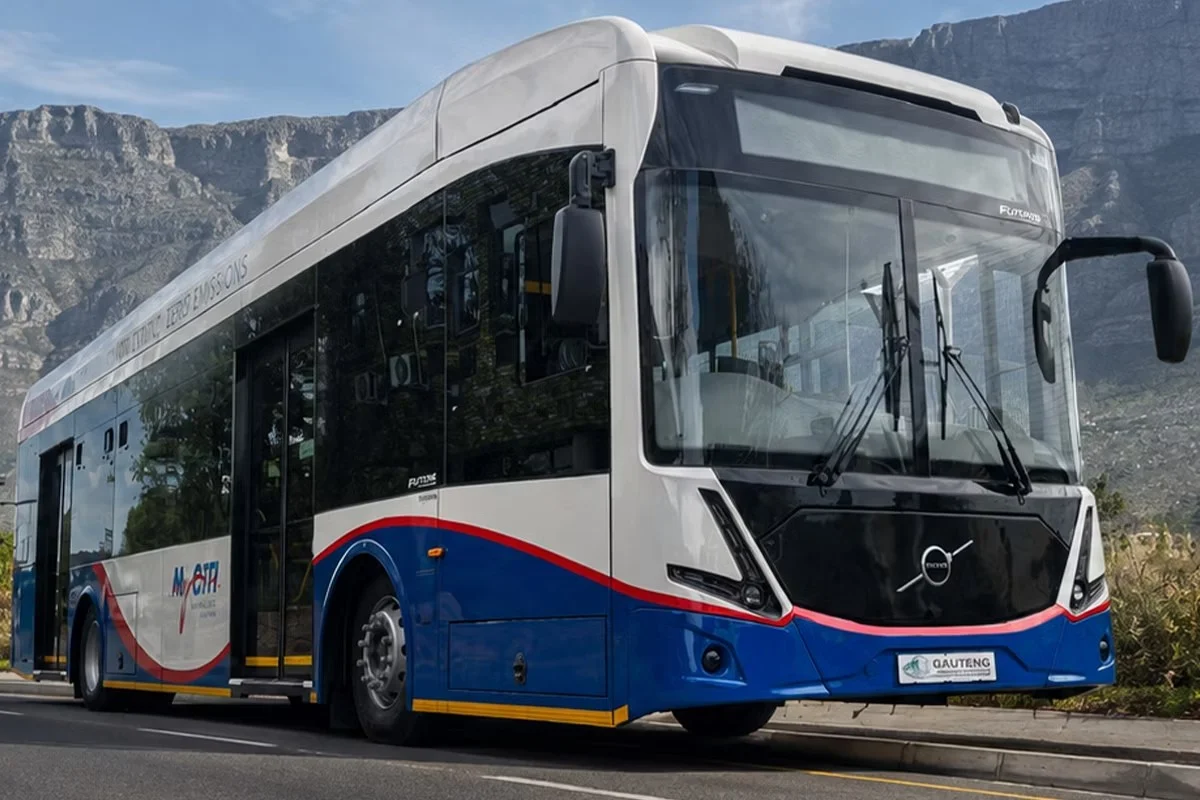
Volvo Buses will supply 38 BZR Low Entry Electric buses to Cape Town, introducing the first electric buses in the city with locally manufactured bodies. Deliveries are scheduled to begin in 2027, with the bodies being produced by South Africa’s Gauteng Bus and Coach Centre at its facility in Johannesburg.
The buses will be deployed as part of Cape Town’s transition toward electric public transport. The City of Cape Town will manage the charging infrastructure, while Volvo Buses will provide strategic support throughout the transition.
BZR Low Entry Electric Selected for Cape Town
The Cape Town order covers the Volvo BZR LE Electric, a low-entry battery-electric bus based on Volvo Buses’ BZR Electric platform.
Autel Energy Powers Cape Town EV Bus Hub With MaxiCharger Technology
Volvo has not disclosed the specific battery capacity or performance configuration selected for the 38 vehicles, saying that the installed energy capacity will be tailored to the city’s operational requirements.
According to Volvo’s published specifications, the BZR Low Entry Electric can be configured as a two- or three-axle bus measuring between 9.8 and 14.8 metres in length. Available powertrain configurations deliver either 200 kW or 400 kW, while nominal battery capacity can reach up to 630 kWh.
The low-entry design is intended to provide easier passenger access and improved accessibility.
Local Manufacturing Supports Electrification
The bus bodies for the Cape Town vehicles will be developed and manufactured by Gauteng Bus and Coach Centre in Johannesburg.
The project therefore combines Volvo’s electric bus chassis technology with local body manufacturing.
Cape Town Selects Volvo to Supply 30 Electric Buses for MyCiTi Service
Volvo Buses said the transition from diesel to electric public transport requires planning and coordination among multiple stakeholders. The company is acting as a strategic adviser as Cape Town prepares for the deployment.
Rob Quintas, City Councillor responsible for urban mobility in Cape Town, said the city has ordered a minimum of 38 buses, with the possibility of increasing the number depending on funding availability.
“We have ordered a minimum of 38 buses, but this number may increase with funding availability. The new buses will be paid for by means of Public Transport National Grant funding,” said Rob Quintas, City Councillor responsible for urban mobility in Cape Town.
Leon Nelson, Director of Volvo Buses in South Africa, described the project as an important step for the city and the company.
“This is a landmark project for both Cape Town and for us. We can be very proud to introduce electric buses to the city, and in doing so, prove that we acknowledge and support a sustainable future,” said Leon Nelson, Director of Volvo Buses in South Africa.
BZR Platform Supports Multiple Applications
Volvo Buses introduced the BZR Electric platform in March 2024 as part of the Volvo Group’s shared electric mobility architecture.
The 600-volt platform supports vehicles ranging from approximately 9.5 to 14.9 metres in its base configuration. Its powertrain combines an electric motor with a two-stage automated transmission, with either 200 kW from a single motor or 400 kW from a dual-motor configuration.
The architecture was designed to support different applications, including Bus Rapid Transit and coach configurations.
Electric Platform Extends to Coaches
The BZR platform also underpins Volvo’s 8900 Electric intercity bus and is being adapted for longer-range coach applications.
A coach version under development can accommodate up to eight battery packs with a combined energy capacity of 720 kWh, compared with up to seven packs and 630 kWh for the BZR Low Entry Electric.
Cape Town Plans to Electrify Public Transport and Municipal Fleet
Volvo Buses also produces the BZRT electric chassis for extra-long city buses, including articulated and double-articulated configurations of up to 28 metres.
The BZRT can likewise accommodate up to eight battery packs totaling 720 kWh and offers 200 kW or 400 kW powertrain configurations.
The Cape Town project marks the BZR platform’s expansion into South African public transport, while the locally manufactured bodies add a further element of manufacturing localization to the city’s electrification program.


