
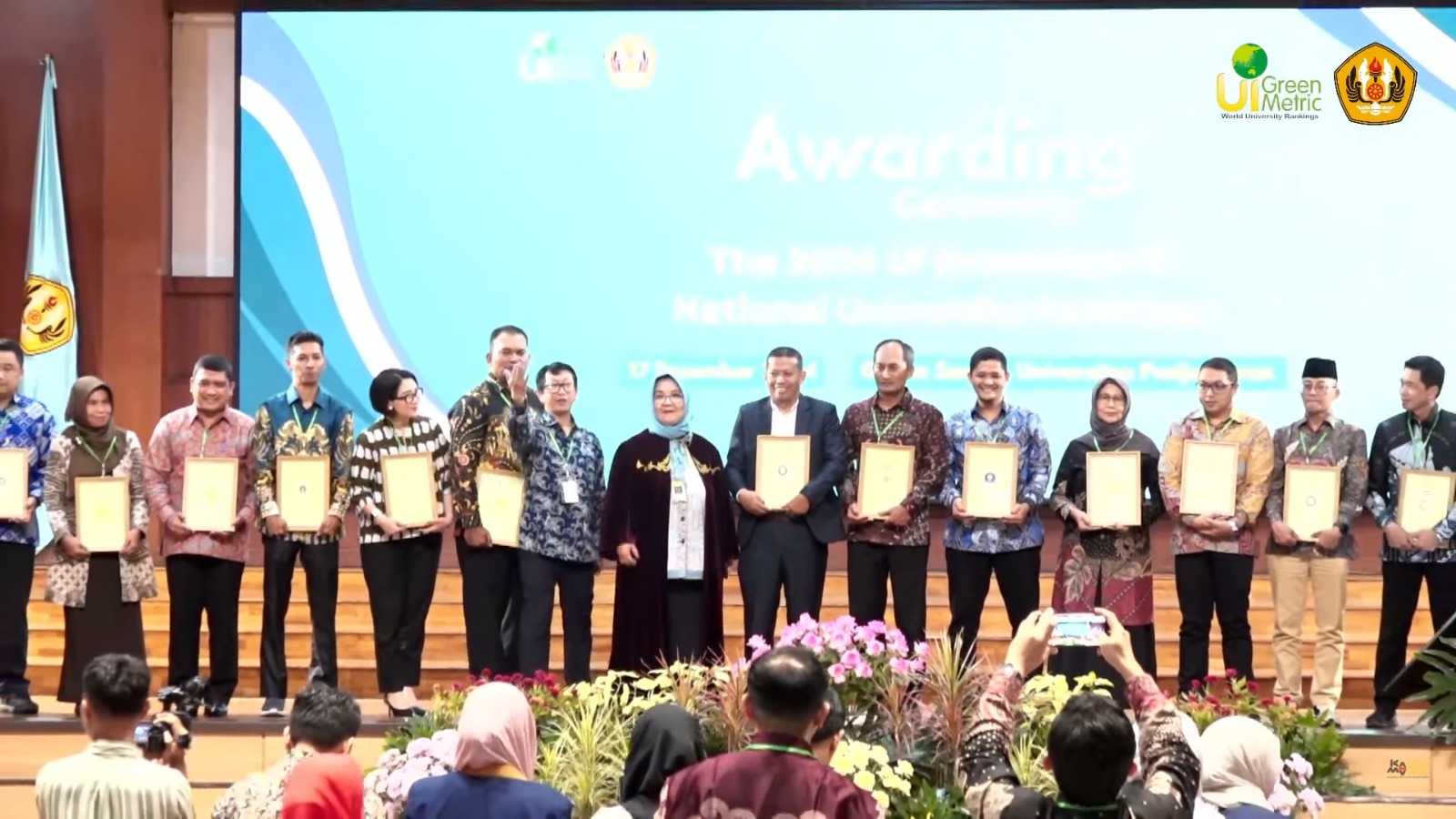
Universitas Negeri Semarang (UNNES) has advanced its sustainability leadership, moving up to 32nd place globally in the 2024 UI GreenMetric World University Rankings while retaining its fifth-place position in Indonesia. The latest results highlight the university’s progress in promoting sustainability across education, infrastructure, and research.
The recognition was presented to Prof. Dr. Amin Retnoningsih, M.Si., Head of the UNNES Conservation Subdirectorate, during the UI GreenMetric National Ranking Award Ceremony on December 17, 2024, in Bandung. She said the achievement reflects the joint effort of the entire UNNES academic community.
“This achievement is not the result of one individual’s effort, but a reflection of the collective hard work of the entire UNNES academic community,” Prof. Amin said. “We truly appreciate the dedication and commitment from all parties that enabled UNNES to remain in the national Top 5 and move up to 32nd globally. This embodies the spirit of our conservation campus.”
Rector Prof. Dr. S. Martono, M.Si., said the improvement represents growing international acknowledgment of UNNES’s sustainability work. “Our rise in the global ranking shows that UNNES’s sustainability initiatives are gaining international recognition. We will continue to drive forward green innovations to build a more sustainable future,” he said.
The UI GreenMetric assessment evaluates universities based on environmental, economic, and socio-cultural criteria, using six key indicators: setting and infrastructure (15%), energy and climate change (21%), waste (18%), water (10%), transportation (18%), and education and research (18%). The 2024 ranking period ran from May to October 31, 2024.
UNNES, recognized as a conservation-based university, continues to align its academic mission with the Sustainable Development Goals (SDGs), particularly SDG 4 (Quality Education), SDG 11 (Sustainable Cities and Communities), and SDG 13 (Climate Action). The university said the ranking reinforces its vision of becoming a world-class institution that integrates environmental responsibility into education, research, and community engagement.