




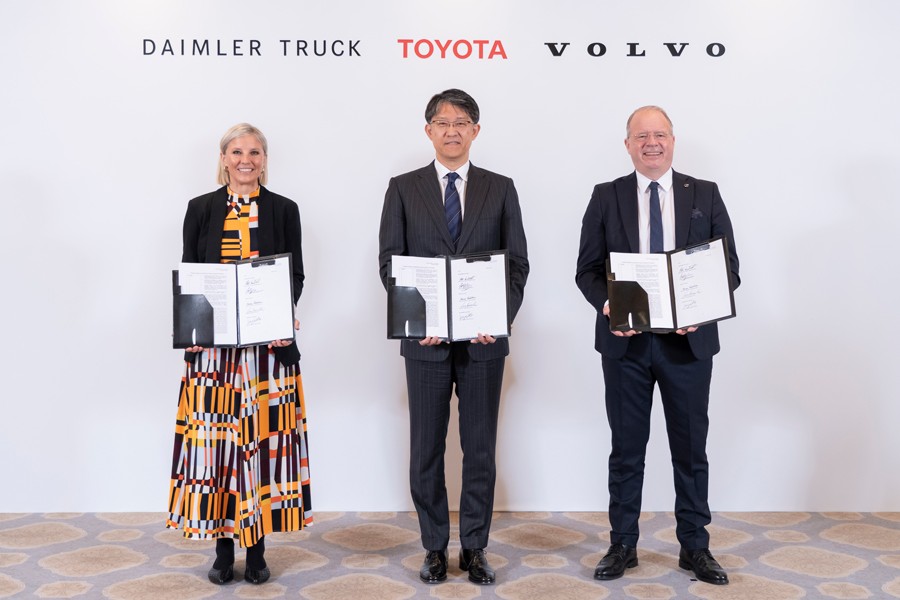
Japan’s Toyota plans to join fuel cell joint venture Cellcentric as an equal partner alongside Daimler Truck and Volvo Group, in a move aimed at accelerating hydrogen technology for heavy-duty transport.
The three companies have signed a letter of intent, with a binding agreement yet to be finalized. The partners said they intend to strengthen Cellcentric’s position as a leading supplier of fuel cell systems for heavy commercial vehicles, while continuing to operate independently in other business areas.
Cellcentric was established in 2021 by Daimler Truck and Volvo Group to develop fuel cell systems for trucks and other heavy-duty applications. The venture is building a production facility in Weilheim an der Teck, Germany, although timelines have been adjusted as commercialization of hydrogen-powered trucks has been pushed into the 2030s.
Toyota’s planned entry reflects its broader shift toward commercial vehicle applications for hydrogen technology. The company, which has more than three decades of fuel cell development experience, has expanded beyond passenger cars into buses, trucks and other heavy-duty uses.
Karin Rådström, CEO of Daimler Truck, said: “We are proud that Toyota plans to join cellcentric as a shareholder. This will enable us to strengthen development and further scale hydrogen technology, which we believe complements battery-electric drives in decarbonising transport.”
Andreas Gorbach, a board member at Daimler Truck, added: “Joining forces with the world’s largest automotive manufacturer and fuel cell pioneer is a privilege for us – and a game changer in making hydrogen in transportation a reality and cellcentric the go-to place for fuel-cell technology in commercial vehicles worldwide.”
Martin Lundstedt, CEO of Volvo Group, said the collaboration would help accelerate adoption of hydrogen solutions. “We are thrilled to explore this collaboration with Toyota, so that we through cellcentric can accelerate and create critical mass for hydrogen applications,” he said, adding that cooperation is essential to achieving net-zero transport goals.
Toyota’s chief executive also highlighted the strategic importance of the partnership: “We are deeply grateful for the opportunity to soon be joining Daimler Truck and Volvo Group as partners in building a hydrogen society… [We] can combine their strengths to deliver one of the world-leading fuel cell systems for heavy commercial vehicles.”
The companies said Toyota plans to participate through a capital increase, enabling equal ownership alongside the founding partners. Cellcentric will remain an independent entity, supplying fuel cell systems to a broad customer base.
Nicholas Loughlan, CEO and CTO of Cellcentric, welcomed the development. “We are extremely proud that Toyota intends to join as a shareholder of cellcentric – a great sign of trust in our company from one of the world‘s leading automotive companies,” he said.
Cellcentric currently employs around 560 people across sites in Germany and Canada and holds approximately 700 patents related to fuel cell technology. The partners said further discussions will now focus on finalizing a binding agreement.


