


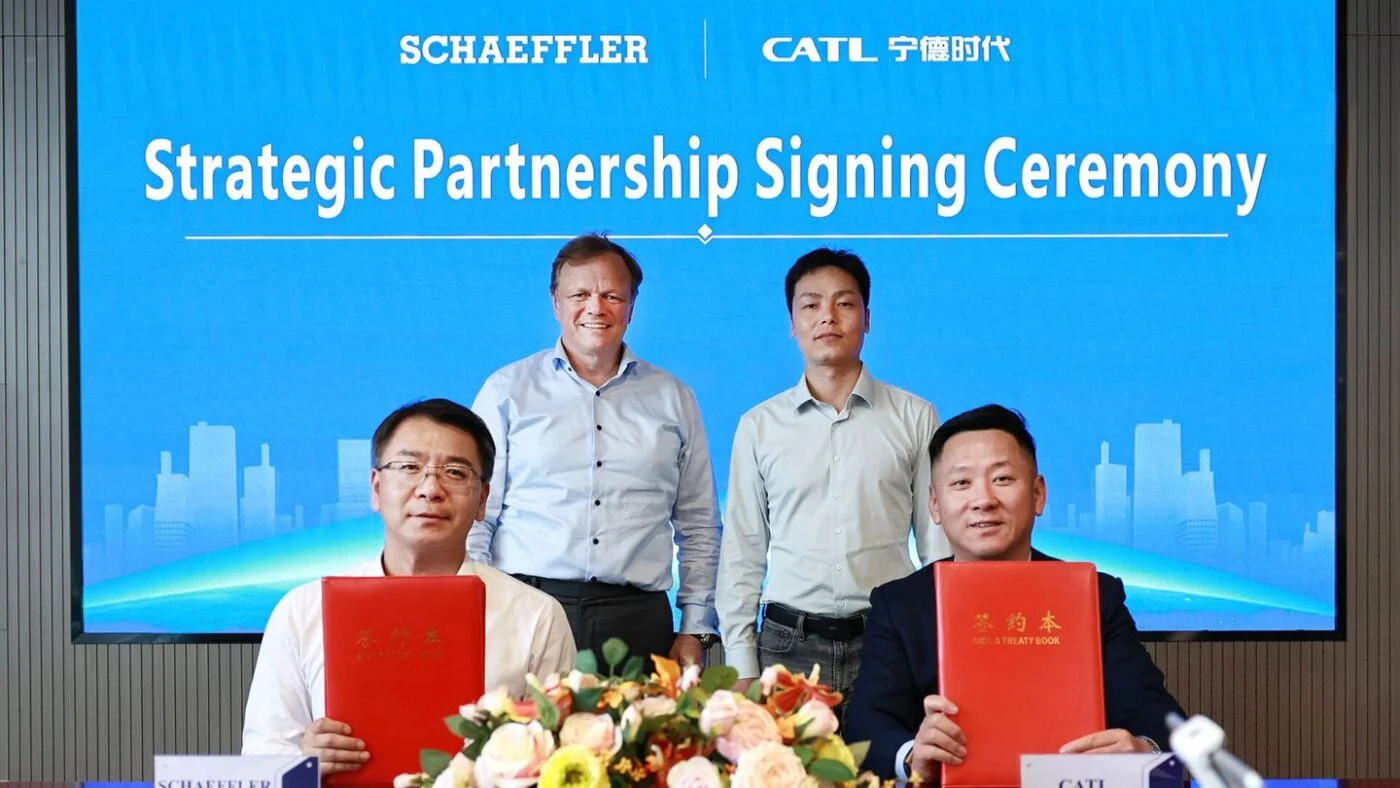
Schaeffler and CATL have agreed to jointly develop battery management systems and integrated power electronics for electric vehicles, with the initial focus on the European automotive market. The collaboration builds on an existing customer project already secured by the two companies, although they have not disclosed the customer or planned series-production timeline.
Joint Development Covers BMS and Integrated Electronics
The German automotive supplier and Chinese battery manufacturer have signed a letter of intent covering two main areas: battery management systems (BMS) and X-in-1 Integrated PowerBox (IPB) solutions.
Schaeffler Showcases Integrated Energy Management Technologies for Next-Generation EVs
The Integrated PowerBox concept is designed to combine multiple high-voltage electronic and electromechanical functions into a single system. Integrating these components can reduce space requirements, cabling and the number of interfaces within an electric powertrain.
The companies have not specified which components will be incorporated into the X-in-1 system or how many functions the final product will combine.
Schaeffler and CATL Combine Battery Expertise
The BMS programme will combine capabilities from both companies across different parts of the battery value chain.
Schaeffler will contribute hardware and software development, system integration, functional safety, testing and validation. The company also has development and manufacturing infrastructure in Europe that can support local production.
Schaeffler Appoints Jochen Schröder As COO Amid Planned Board Restructuring
CATL will contribute its expertise in battery cells and systems, battery algorithms and high-volume industrialisation.
The companies intend to develop BMS solutions tailored to the requirements of European vehicle manufacturers. The partnership could later expand beyond Europe into additional international markets.
“Thanks to our established footprint in Europe, Schaeffler offers extensive expertise in local R&D, manufacturing, market entry and regulatory compliance, enabling us to deliver end-to-end support for project rollouts.”
— Thomas Stierle, Member of the Board for E-Mobility, Schaeffler AG
Stierle said the companies aim to establish a competitive product portfolio for Europe and other markets.
AI and Cloud Technologies Under Consideration
The cooperation could eventually extend into software and digital battery management.
CATL said the companies will explore the use of cloud computing and artificial intelligence in battery management systems. No specific AI functions or commercial applications have yet been disclosed.
Schaeffler Expands EV Drivetrain Repair Kits for BMW, Hyundai, Nissan and Volkswagen
The development reflects the increasing role of software in managing battery performance and electric vehicle powertrain systems.
Partnership Supports European Supply Chain Localization
The agreement comes as automakers and suppliers continue to develop more localized EV technology and manufacturing capabilities in Europe.
Schaeffler can contribute established European research, development and production operations, while CATL has expanded its presence in the European market and is seeking to adapt its battery technologies to local automotive requirements.
The companies intend to address European vehicle manufacturers as well as Chinese automakers expanding internationally.
CATL Continues Next-Generation Battery Development
The collaboration also comes as CATL works on future battery technologies. The company has announced plans to begin pilot production of solid-state battery cells in 2027.
Schaeffler Begins Mass Production of High-Voltage Inverter Brick in China
CATL CEO Robin Zeng has said volume production of solid-state batteries is not expected before 2030, indicating that the technology remains in development even as the company expands its current battery and power electronics activities.
The Schaeffler partnership is focused initially on battery management and integrated power electronics rather than solid-state batteries, with the first commercial programme already linked to an undisclosed customer project.


