




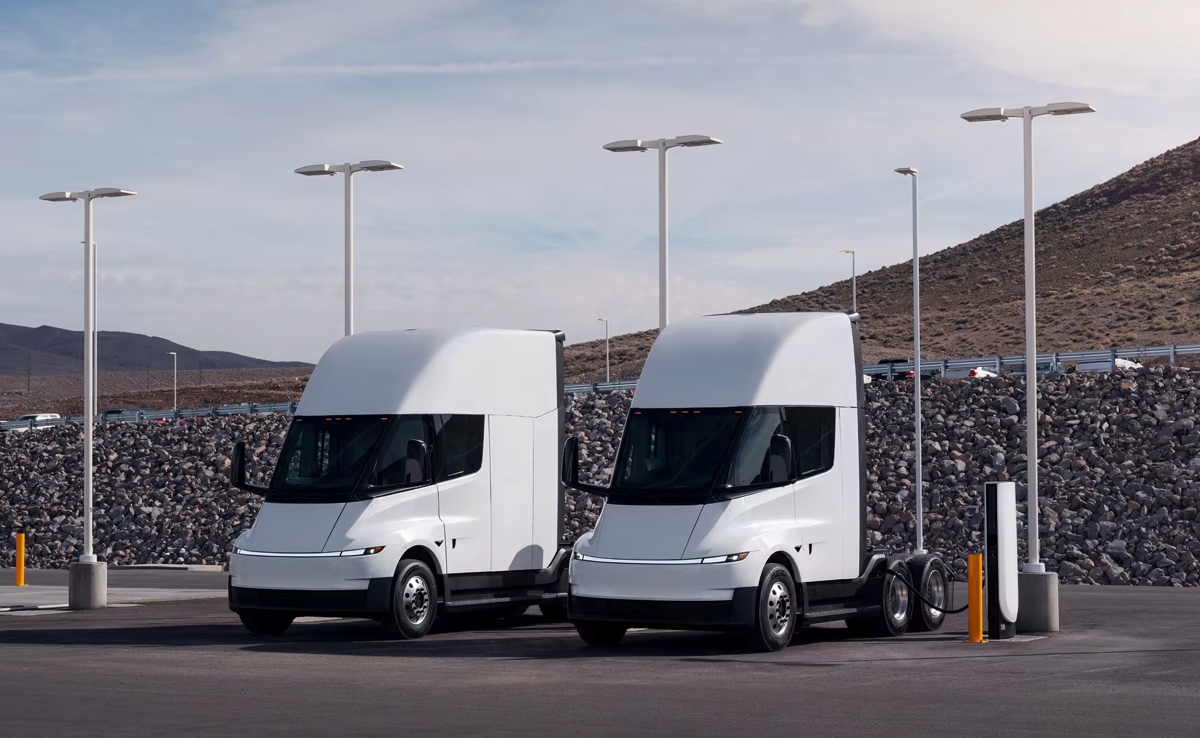
Tesla plans to reveal specifications and launch details for the Semi in Europe at IAA Transportation 2026 in Hanover, Germany, marking the company’s most detailed presentation yet of its battery-electric heavy truck for the European market. Tesla has confirmed that a Semi will be displayed at the exhibition and that additional information about the European model and market introduction will be provided at the event.
Tesla Prepares European Semi Launch
Tesla previously displayed a Semi at IAA Transportation in Hanover, but the company did not disclose details about when the electric truck would enter the European market.
This year’s exhibition is expected to provide more information, with Tesla confirming that it will present the European model variant and its market launch plans.
The announcement comes as Tesla moves the Semi from limited pre-production toward series manufacturing in the United States.
Semi Production Ramps Up in Nevada
Tesla is manufacturing the Semi at a dedicated facility located next to Gigafactory Nevada. The plant has been designed for an annual production capacity of 50,000 trucks, although output is expected to increase gradually rather than immediately reach that level.
The start of series production is intended to bring economies of scale to Tesla’s heavy-duty electric truck programme. In the United States, Tesla has indicated prices of $290,000 for the Long Range version and $260,000 for the Standard version.
Tesla Semi Offers Up to 800 km of Range
Tesla’s U.S. production model is offered in Standard Range and Long Range versions.
The Standard Range model has a claimed range of 325 miles, or approximately 523 km, and a gross vehicle weight of 82,000 pounds, equivalent to around 37.2 tonnes. The Long Range version has a claimed range of 500 miles, or approximately 800 km.
Both versions use three integrated electric motors capable of producing up to 800 kW. Battery capacities are 548 kWh for the Standard Range version and 822 kWh for the Long Range model.
Tesla has not yet disclosed whether the European Semi will use the same specifications as the U.S. version. Further details are expected at IAA Transportation.
1.2 MW Charging Supports Heavy-Duty Operations
The Semi is designed to support charging at up to 1.2 MW. Tesla is developing corresponding charging infrastructure in parts of the United States using a V4-based charging system.
The system uses separate satellite chargers and a technical unit known as the Powerunit. Tesla expects the 1.2 MW configuration to restore the majority of the Semi’s approximately 800-km range in around 30 minutes.
The charging requirements of heavy electric trucks will be an important consideration as Tesla prepares the Semi for European commercial operations.
Einride Orders 500 Tesla Semis for U.S. Fleet
Tesla’s European expansion comes alongside a major U.S. deployment agreement with Swedish electric freight company Einride.
Einride plans to add 500 Tesla Semi trucks to its U.S. fleet under its collaboration with Tesla, taking its planned battery-electric truck fleet in the country to 750 vehicles.
The trucks are expected to operate through Einride’s Saga AI platform for customers including Amazon, with deployments planned across freight corridors in California, Texas, New Jersey, Illinois and Georgia.
The planned procurement is scheduled to begin in September 2026 and be completed within two years.
Electric Truck Market Continues to Expand
The Tesla Semi’s planned European launch comes as global sales of electric trucks and buses continue to grow. Global electric truck and bus sales surpassed 500,000 units in 2025, rising 86% for the second consecutive year, according to the International Council on Clean Transportation.
China accounted for nearly 90% of global sales, while electric truck and bus adoption also increased across Europe and other major markets.


