
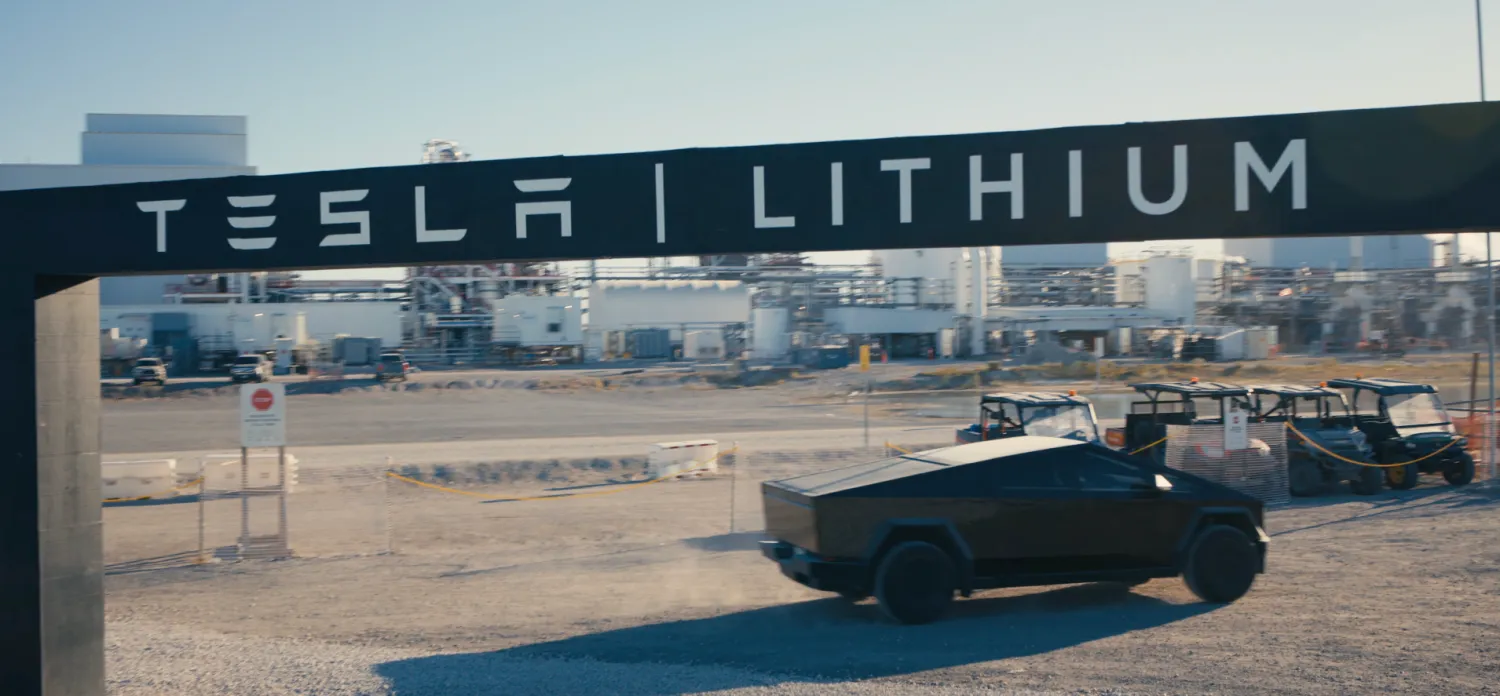
Tesla has begun production at its lithium refinery near Corpus Christi, Texas, the company said, offering a closer look at a project it hopes will ease a key bottleneck in the electric vehicle supply chain.
Tesla confirmed the start of operations in a newly released video highlighting the refinery in Robstown, near the coastal city of Corpus Christi. The facility, construction of which began in 2023, is designed to convert spodumene ore into battery-grade lithium hydroxide using a proprietary process developed by the automaker.
See also: Tesla Marks 5 Million Electric Drive Systems Produced at Shanghai Factory
“For years, lithium refining has been the choke point,” Tesla Chief Executive Elon Musk has previously said, arguing that while lithium resources are plentiful, refining capacity remains constrained. Tesla opted to build its own plant after repeated calls for entrepreneurs to invest in the sector failed to close the gap.
In the video, refinery site manager Jason Bevan outlined the project’s accelerated timeline. “From breaking ground in 2023 to running rock through the kiln in 2024 to start a full integrated plant startup now in 2025,” Bevan said, suggesting the facility reached full integrated operations late last year.
See also: Tesla Q4 Deliveries Fall 15% to 418,227, Marking Second Straight Annual Decline
Bevan said the site is the first refinery in North America to directly process spodumene, a hard-rock lithium ore, into lithium hydroxide, a key material used in electric vehicle batteries. Unlike traditional refining methods that rely on acid roasting, Tesla’s process is acid-free, the company said.
“Our process is more sustainable than traditional methods and eliminates hazardous byproducts,” Bevan said. Instead of producing waste materials such as sodium sulfate, Tesla said its refinery generates a benign co-product made up of sand- and limestone-like material that can be reused in concrete production.
See also: Tesla Reports Record Expansion of Global Supercharger Network in 2025
Tesla said the project moved quickly by running feasibility studies, design and construction in parallel, avoiding the staged development approach commonly used in large industrial projects. The company described the refinery as a cornerstone of its efforts to localise battery materials supply in the United States and reduce exposure to global processing constraints.
The start-up comes as automakers race to secure critical minerals and refining capacity amid rising EV demand and tighter supply chains, with lithium hydroxide seen as essential for next-generation, high-energy-density batteries.