

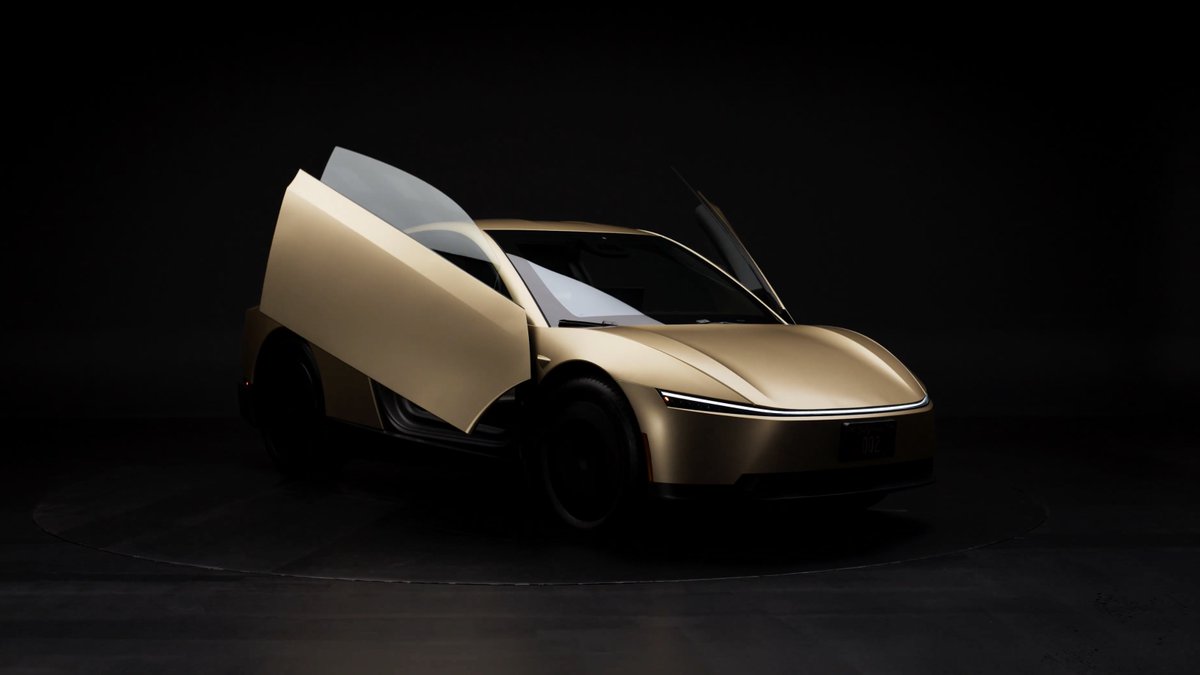
Tesla will begin production of its long-awaited Cybercab, a fully autonomous electric vehicle without pedals or a steering wheel, in April 2026 at its factory in Austin, Chief Executive Elon Musk said during the company’s annual shareholder meeting on Thursday.
The announcement came shortly after shareholders approved a compensation package for Musk that could be worth up to $1 trillion in company shares, the largest in corporate history. “We’ve got the first car that is specifically built for unsupervised, full self-driving to be a robotaxi called a Cybercab — it doesn’t even have pedals or steering wheel,” Musk said. “It’s very much optimized for the lowest cost-per-mile in an autonomous mode and production is happening right here in this factory, and we’ll be starting production in April next year.”
See also: Tesla Plans Cybercab Production in Q2 2026 with Full Autonomy
Tesla first revealed the Cybercab in October 2024 during its “We, Robot” event in California, presenting it as a purpose-built vehicle for future robotaxi operations. Musk said the company’s new manufacturing line could achieve a 10-second cycle time, a significant acceleration from the one-minute cycle time for the Model Y, potentially enabling production of 2 million to 3 million Cybercabs annually. “So these will be everywhere in the future,” he added.
The company, however, has yet to demonstrate that its vehicles can drive autonomously at scale without human supervision. Tesla’s chairwoman Robyn Denholm previously told Bloomberg that the Cybercab would feature a steering wheel and pedals as a backup, appearing to contradict Musk’s statement.
See also: Tesla Secures U.S. Patent for Advanced Manufacturing System to Streamline Cybercab Production
Musk acknowledged that the Cybercab would need approval from U.S. regulators before operating without standard driving controls. He pointed to Amazon-backed Zoox, which received a limited exemption to test its custom-built robotaxis on public roads, and to General Motors’ failed bid for approval for its Cruise Origin vehicle. “I think we’ll be able to deploy all the Cybercabs that we produce,” Musk said. “Once it becomes like, extremely normal in cities, it’s just going to become like … the regulators will have just fewer and fewer reasons to say no.”