
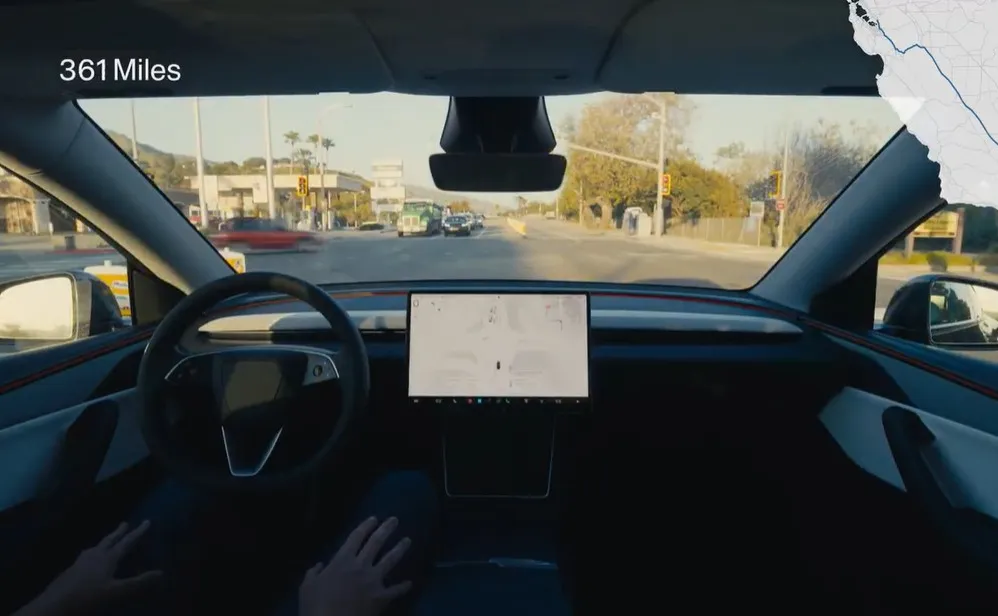
Tesla has discontinued Autopilot, its entry-level driver-assistance system, as the company seeks to steer customers toward its more advanced software, Full Self-Driving (Supervised), amid regulatory and legal pressure in California.
Tesla’s online vehicle configurator now shows that new cars come standard only with Traffic-Aware Cruise Control, removing Autopilot branding entirely. The change follows a December ruling by a California judge that found Tesla had engaged in deceptive marketing by overstating the capabilities of both Autopilot and Full Self-Driving over several years. The California Department of Motor Vehicles, which brought the case, temporarily stayed the ruling to give Tesla time to comply, including by dropping the Autopilot name.
See also: Lemonade Launches Insurance Tied to Tesla’s FSD, Promising Lower Per-Mile Rates
Autopilot previously bundled Traffic-Aware Cruise Control with Autosteer, a lane-centering feature capable of steering through curves. It was unclear whether the change affects existing Tesla owners, the company said.
See also: Tesla Patent Points to Software Path for Extending Life of Older FSD Hardware
The move also comes shortly after Tesla announced it would stop offering Full Self-Driving as a one-time $8,000 purchase from Feb. 14, shifting instead to a monthly subscription priced at $99. Chief Executive Elon Musk said on Thursday that the subscription price would rise as the software improves.
Musk has repeatedly said he expects Tesla vehicles to eventually support “unsupervised” driving. In December, he said a new version of Full Self-Driving would allow drivers to use their phones during trips, though such behaviour remains illegal in most U.S. states.
On Thursday, Tesla also rolled out its first robotaxi versions of the Model Y in Austin, Texas, operating without human safety drivers onboard. The vehicles use a more advanced iteration of Tesla’s driving software and are monitored by company vehicles following behind.
See also: Tesla Rolls Out FSD v14.2.2 With Incremental Improvements to Driving Behavior
Despite years of development, adoption of Full Self-Driving has lagged Tesla’s ambitions. In October 2025, Tesla Chief Financial Officer Vaibhav Taneja said only about 12% of customers had paid for the software. Achieving 10 million active FSD subscriptions by 2035 is among the performance targets tied to Musk’s recently approved compensation package.
Tesla first introduced Autopilot in the early 2010s and made it standard across its lineup in 2019. Over time, regulators have scrutinised how the company described the system’s capabilities. The National Highway Traffic Safety Administration has linked misuse of Autopilot to hundreds of crashes and at least 13 fatalities, citing concerns that drivers may have placed too much trust in the technology.