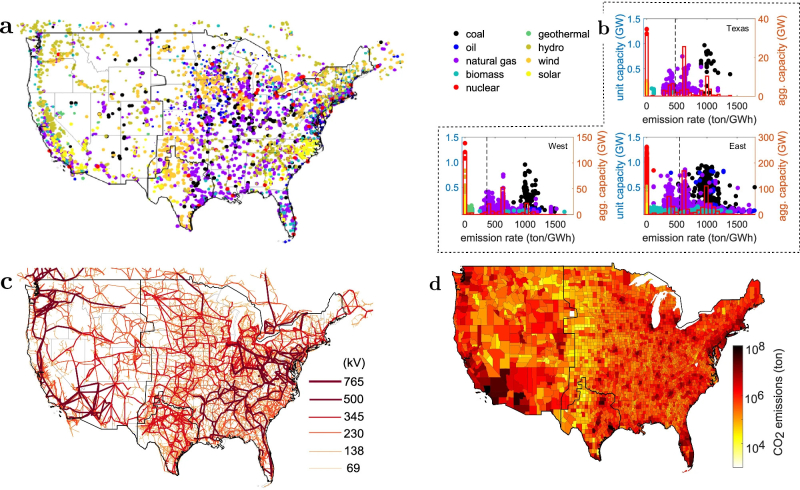



Switching all U.S. gasoline-powered vehicles to electric models would not be enough to tackle climate change unless the nation also upgrades its transmission grid, according to a Northwestern University study published in Nature Communications.
Researchers found that “grid congestion” would prevent clean electricity from reaching many charging locations, forcing reliance on nearby fossil fuel plants and wiping out a third of potential emissions cuts.
“The charging schedule of EVs can be optimized to align with intermittent renewable generation,” said Adilson Motter, a Northwestern physics professor and director of the Center for Network Dynamics. “But even with smart charging, efficient use of clean energy still depends on having enough transmission capacity to deliver it where it’s needed.”
The team’s modeling showed that modest upgrades—boosting transmission capacity by 3–13%—could alleviate bottlenecks and unlock most of the emissions benefits from full EV adoption. Solutions include adding high-voltage lines and strengthening links between the Eastern, Western and Texas grids.
“Power grids began as local networks, where consumption was close to generation,” Motter said. “No one wants to redesign it from scratch, but we do need targeted upgrades that reflect the large-scale reach of today’s grid.”
The study was supported by the Center for Engineering Sustainability and Resilience, the Paula M. Trienens Institute for Sustainability and Energy, and the National Natural Science Foundation of China.